How to Organize a Tiny Shower Without Built-In Shelves
A tiny shower can feel cluttered surprisingly fast when there is nowhere built in to put anything.
Three shampoo bottles on the floor, a razor balanced against the wall, a washcloth hanging from the faucet—and suddenly a shower that was already small feels even smaller.
The good news is that small shower organization does not require adding lots of storage. In fact, squeezing several organizers into a tiny stall can make the problem worse.
A better approach is to keep fewer things inside the wet zone, choose one primary storage location, and use vertical or corner space without taking away the room you need to shower comfortably.
Here is how to build a simple system when your shower has no niche, shelf, or useful ledge at all.
Why Small Shower Organization Gets Tricky So Quickly
In a larger shower, scattered bottles may simply look untidy. In a tiny shower, they interfere with how you actually use the space.
Anything stored on the shower floor reduces standing room. Bulky organizers can intrude into shoulder and elbow space. Bottles lined around a narrow edge are easy to knock over.
That means the goal isn’t to find a place for every bathroom product inside the shower.
It’s to decide which products deserve space there in the first place.
If your entire bathroom lacks useful storage—not just the shower—start with a broader system for organizing a small bathroom with no storage. Inside the shower, though, keep the strategy much narrower.
1. Take Everything Out Before Adding Storage
Before shopping for a shower caddy, remove everything from the shower.
Then divide the products into three simple groups.
Daily or Frequent Shower Products
These might include shampoo, conditioner, body wash, facial cleanser, and a razor.
Occasional Products
Think clarifying shampoo, hair masks, scrubs, specialty treatments, or products you use once a week.
Backups
Extra shampoo, unopened soap, refill bottles, and duplicates do not need to live inside a tiny shower.
Only the first group automatically earns permanent shower space.
Occasional products can stay elsewhere and come into the shower when needed. Backups should almost always live outside the wet zone.
This one step may reduce the amount of shower storage you need more effectively than adding another shelf.
2. Choose One Primary Storage Zone
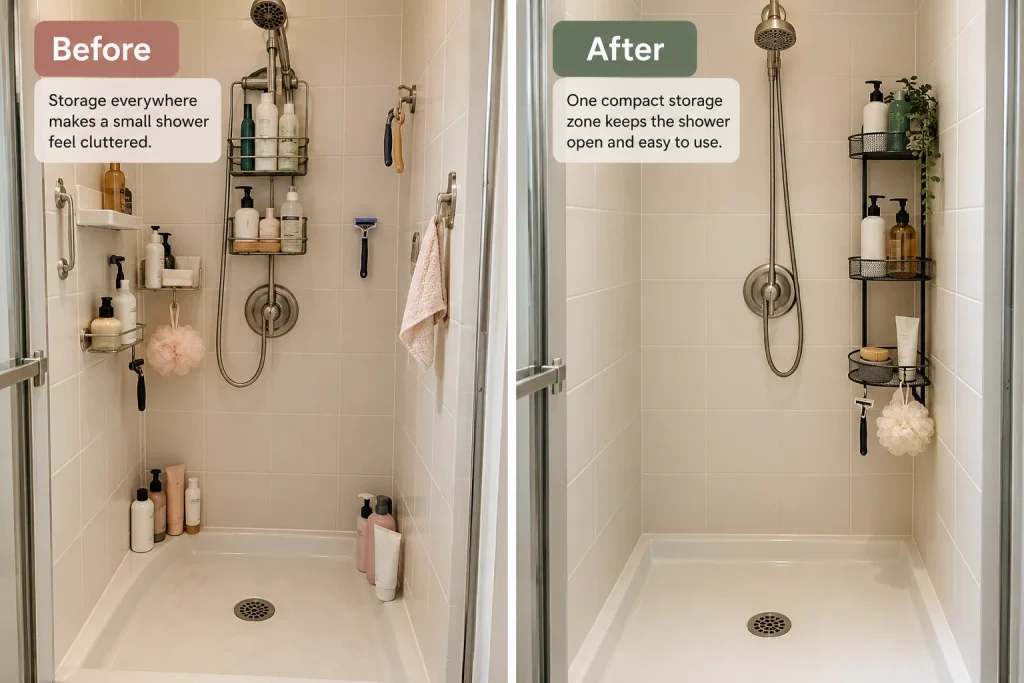
Keeping shower storage in one compact zone helps preserve more usable spaceOne of the easiest ways to make a tiny shower feel even more crowded is to scatter storage everywhere.
A shelf on one wall, a suction basket on another, bottles around the faucet, hooks on the door, plus something sitting on the floor creates visual and physical clutter.
Instead, choose one primary storage zone.
Usually, that will be:
- one corner,
- the wall around the showerhead,
- one section of smooth tile,
- or the shower door.
Try to fit your everyday bottles into that zone before adding anything elsewhere.
The result feels much closer to having a built-in niche because your supplies read as one organized group rather than objects floating around the shower.
3. Choose an Organizer That Fits the Shower—Not Your Entire Product Collection
Choose your organizer based on what your shower gives you, not on how much storage the organizer can hold.
If one slim caddy can hold your daily products, stop there. Move to a larger or secondary storage solution only when one zone genuinely isn’t enough.
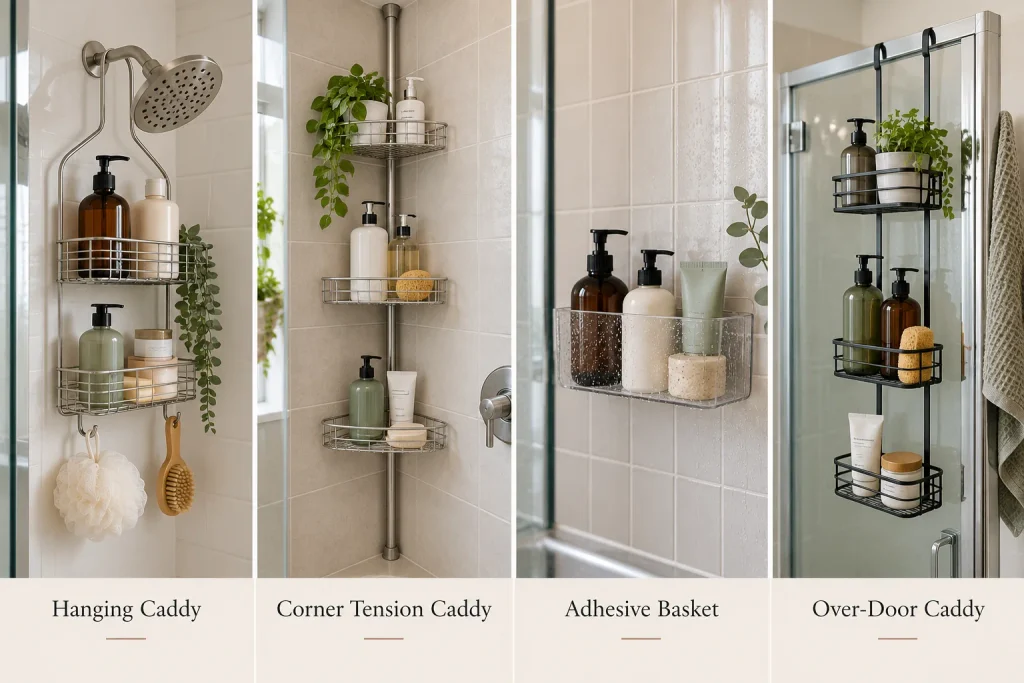
Choose the organizer that fits your shower layout and daily routine—not simply the one with the most storageHanging Shower Caddy
A caddy hanging from the showerhead is one of the simplest options because it uses space that is already occupied by plumbing.
It works particularly well when you:
- have relatively few products,
- don’t want to attach anything to tile,
- have enough clearance below the showerhead,
- and can keep the caddy stable.
Look for a slim model rather than automatically choosing the largest one available.
In a tiny shower, capacity isn’t useful if the organizer itself becomes an obstacle.
Tension-Pole Caddy
If you have a free corner and need more vertical storage, a floor-to-ceiling tension caddy can create several levels without built-in shelving.
This can work especially well in a shared shower because shelves can be divided by person or product category.
But measure first.
A pole organizer with deep baskets can take up more usable shower space than expected. Position it in the corner least likely to interfere with entering, turning, or reaching the controls.
Adhesive Shower Shelves
Adhesive baskets can create a clean, shelf-like setup without constructing a niche.
They’re particularly useful when the area around your showerhead is already crowded.
Before installing one, check:
- whether the mounting system is intended for wet or humid areas,
- which wall surfaces the manufacturer approves,
- its stated weight capacity,
- and its installation and curing instructions.
Surface compatibility varies between products, so follow the instructions for the specific mounting system rather than assuming every adhesive shelf will work on every tile, stone, grout, or textured surface.
If you’re renting, you can also use no-drill storage ideas throughout the rest of the bathroom rather than limiting that approach to the shower.
Suction Storage
Suction baskets and hooks can work well for lightweight items and can often be repositioned.
They generally perform best on compatible smooth, nonporous surfaces.
If a suction accessory repeatedly slips or loses its seal, don’t keep relying on it simply because it is convenient.
Use suction storage selectively rather than covering several shower walls with separate accessories.
Over-the-Door Storage
If your shower enclosure has a suitable door, an over-door caddy can shift storage away from the walls.
Check both sides before buying one.
Make sure it doesn’t interfere with the door closing, create an awkward projection into a narrow stall, or place frequently used products somewhere difficult to reach.
4. Use the Corner—But Protect Your Standing Space
Corners are valuable in a tiny shower because your body usually uses the center of the stall more than the extreme edges.
That makes a corner a logical place for vertical storage.
The key is to keep it shallow.
Before installing anything, stand in the shower and mimic your normal routine.
Turn around. Reach toward the showerhead. Bend slightly. Reach for the controls.
Notice which corner your shoulders and elbows naturally avoid.
That is usually a better storage location than simply choosing the corner that looks emptiest when the shower is unoccupied.
A tiny shower needs to work around a moving person, not just look organized when nobody is inside it.
5. Use Small Hooks for Awkward Items
Not every shower item belongs on a shelf.
Razors, shower brushes, washcloths, and similar items may be easier to manage on hooks.
This lets you reserve shelf space for bottles while using small vertical areas for lightweight accessories.
But don’t cover every available surface with hooks.
One or two strategically placed hooks can solve awkward storage problems. Eight hooks filled with dangling items simply create another kind of clutter.
Whenever possible, hang wet items where they can drain and dry instead of bunching several damp items together.
6. Organize Products in the Order You Use Them
Once you’ve chosen the organizer, resist the temptation to arrange everything primarily by appearance.
Instead, organize according to your shower routine.
💡 For example:
- Most accessible shelf: shampoo, conditioner, body wash
- Secondary position: face wash or another regularly used product
- Hook or small holder: razor or shower tool
- Outside the shower: treatments, backups, duplicates, and rarely used products
In a shared shower, another option is to assign one shelf or basket to each person.
The best system is the one that reduces searching, reaching, moving bottles, and putting products back in the wrong place.
7. Don’t Automatically Decant Everything
Matching bottles can make a shower look visually calmer, but decanting isn’t required for good organization.
Adding dispensers without solving the underlying product overload simply creates prettier clutter.
If original packaging fits comfortably into your storage system, there is nothing wrong with keeping it.
Consider dispensers when they solve a specific problem—such as several awkwardly shaped bottles taking up too much shelf space—not simply because every organized shower seems to have them.
8. Make Drainage Part of the Storage System
Shower organization has one constraint that closet or pantry organization doesn’t: everything regularly gets wet.
That should affect what you choose.
Prefer shelves, baskets, and soap holders that allow water to escape instead of creating flat areas where water collects.
Also leave enough space around products to remove them and clean the organizer.
A shelf that technically holds nine bottles but requires removing all nine every time you clean it isn’t necessarily better than a shelf comfortably holding five.
Good shower storage should make cleaning easier, not create another complicated surface to maintain.
9. Keep the Shower Floor Clear When Possible
The shower floor is tempting because it requires no installation.
But in a tiny stall, it is also your most valuable usable space.
Avoid turning the perimeter into a lineup of shampoo bottles.
Likewise, a freestanding shower rack may technically provide plenty of storage but still be the wrong solution if you have to step around it.
Wall, hanging, and corner storage usually make more sense when floor space is extremely limited.
There is one important exception: don’t remove or obstruct anything intended for safety or accessibility just to create a cleaner-looking storage layout.
Storage should adapt to the shower—not compromise safe use of it.
10. Keep Electrical Items Out of the Shower Zone
Shower storage should be limited to shower-safe toiletries and accessories.
Hair dryers, curling irons, chargers, and other electrical grooming tools belong in an appropriate dry storage area outside the shower.
The U.S. Consumer Product Safety Commission recommends unplugging small bathroom appliances when they’re not in use because plugged-in appliances can create a shock hazard if they fall into water.
If hair tools are competing with toiletries elsewhere in the bathroom, treat them as their own storage category rather than trying to incorporate them into the shower setup.
11. Give Occasional Products a “Bring-In” Home
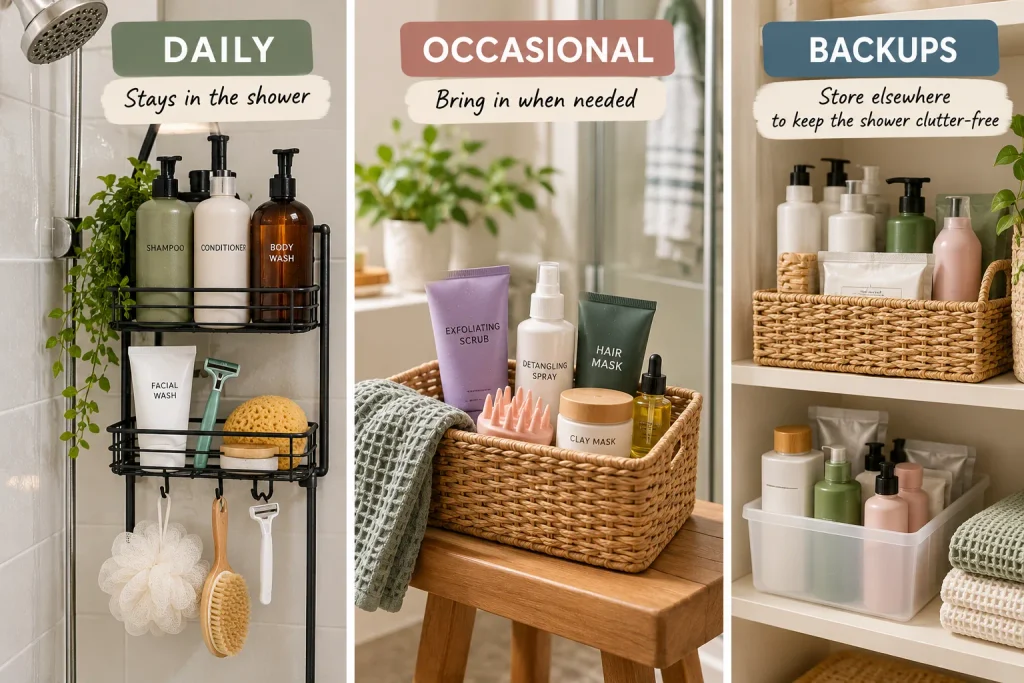
Keep daily products in the shower, bring occasional items in only when needed, and store backups elsewhereYou don’t have to permanently store something in the shower simply because you use it there.
This distinction is particularly useful in very small homes.
A weekly hair treatment, specialty scrub, or occasional grooming product can live in a nearby cabinet or basket and come into the shower only when needed.
Think of your shower storage as active storage, not inventory storage.
Daily products stay.
Occasional products visit.
Backups live somewhere else.
That rule alone can prevent a tiny shower from slowly filling up again.
12. Try One of These Simple Tiny-Shower Setups
You don’t need to combine every storage idea in this guide.
Most small showers work better with one primary organizer plus, at most, one small secondary accessory.
If You Have Smooth Tile
Try:
1–2 compatible wall baskets + 1 small hook
Keep everyday bottles grouped vertically and use the hook for one lightweight shower tool.
If You Don’t Want Anything Attached to the Wall
Try:
1 slim hanging shower caddy
Choose one sized for the products you actually use rather than the largest model that fits.
If Several People Share the Shower
Try:
1 tension-pole corner caddy
Assign shelves by person rather than mixing everyone’s products together.
If the entire bathroom is shared, dividing a small bathroom into clear storage zones can carry the same logic beyond the shower.
If Your Shower Is Extremely Narrow
Go even simpler:
1 compact caddy + fewer products
Don’t solve a six-bottle problem with a giant four-tier organizer if reducing the shower to three everyday products would work better.
The Five-Minute Shower Reset
Even a good storage system eventually accumulates clutter.
Every week or two, take a few minutes to:
- Remove empty bottles.
- Return occasional products to their outside storage.
- Move backups out of the shower.
- Wipe or rinse the organizer as appropriate.
- Check that hooks, suction cups, adhesive mounts, or tension components remain secure according to their manufacturer’s instructions.
- Put daily products back in their assigned places.
If the entire bathroom needs attention, use a 20-minute bathroom declutter checklist rather than turning this small shower reset into a whole-room project.
A Small Shower Doesn’t Need Much Storage
A tiny shower usually works best with less, not more.
Keep only the products you use regularly, group them into one primary storage zone, and choose an organizer that preserves your standing space instead of filling every available surface.
When everything inside the shower has a clear purpose and an easy place to return to, even a very small shower can feel calmer, easier to clean, and much less crowded.