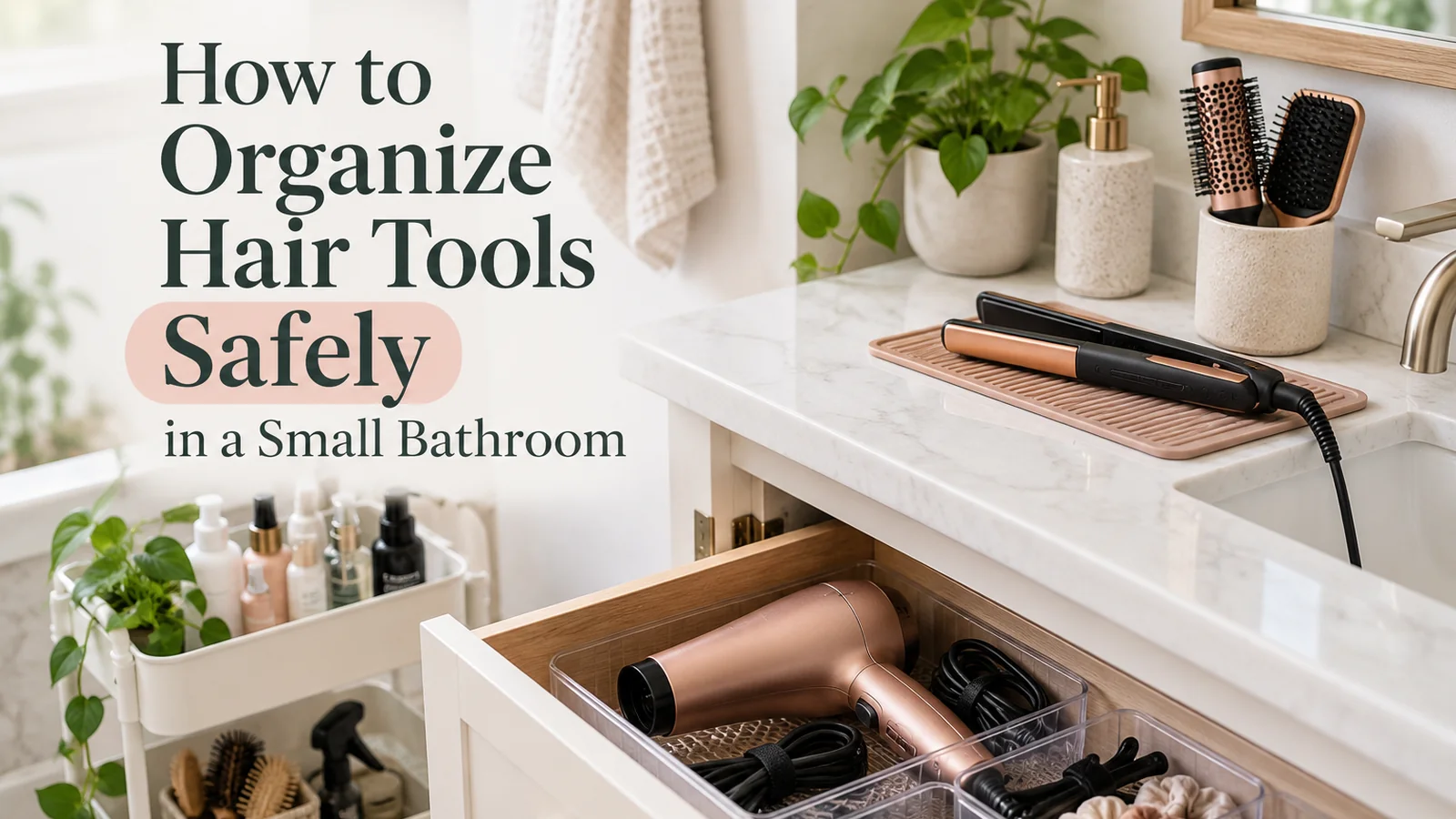
How to Organize Hair Tools Safely in a Small Bathroom
Hair dryers, flat irons, curling wands, and their tangled cords can take over a small bathroom counter surprisingly fast. Put everything away, though, and getting ready can turn into a search through crowded drawers.
The trick is finding storage that works for your routine without putting hot or electrical appliances in the wrong place.
Good hair tool storage in a bathroom doesn’t require a large vanity or a collection of expensive organizers. It starts with choosing the right spot for each tool, keeping everyday essentials accessible, and knowing where hot tools can safely cool before being put away.
| Storage Spot | Best For | What to Consider |
|---|---|---|
| Inside a vanity door | Hair dryer, brushes | Cabinet clearance and cord placement |
| Vanity drawer | Flat iron, curling wand, attachments | Store heated tools only after cooling |
| Heat-safe landing spot | Recently used hot tools | Follow manufacturer cooling instructions |
| Side of the vanity | Hair dryer, lightweight accessories | Distance from water and secure mounting |
| Slim rolling cart | Multiple tools and hair products | Floor space, stability, and moisture |
| Outside the bathroom | Occasional styling tools | Convenient access without bathroom clutter |
Start With the Hair Tools You Actually Use
Before buying another organizer, gather your hair tools in one place.
You may discover that the hair dryer you use every morning is sharing space with two curling wands, an old straightener, several attachments, and brushes you rarely touch.
Separate everything into three groups:
- Daily essentials: Tools you reach for most mornings.
- Occasional tools: Items used once a week or less.
- Accessories: Brushes, clips, diffuser attachments, combs, and hair ties.
Keep the first group closest to where you get ready. The others can go in a less accessible drawer, cabinet, or even another room.
For example, someone who blow-dries their hair daily but curls it only on weekends doesn’t need both appliances beside the sink.
This small decision can free up more useful space than adding another shelf.
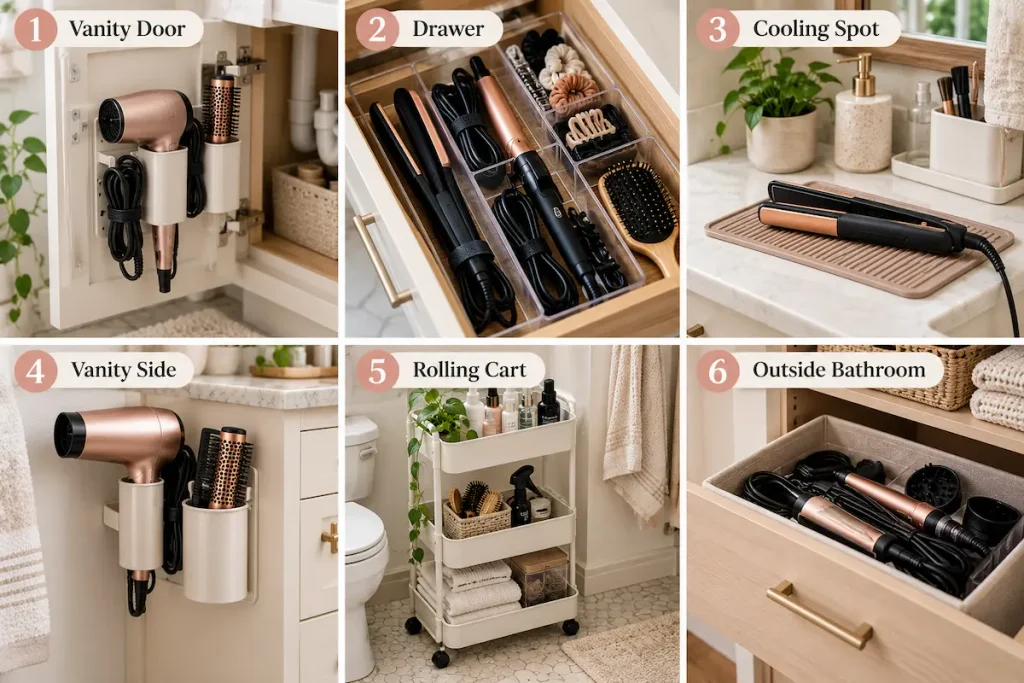
6 Practical Hair Tool Storage Ideas for Small Bathrooms
The best storage spot depends on your bathroom layout, not just the organizer’s appearance.
Look for unused space around the vanity first. Then consider whether each location is dry, accessible, and suitable for the tools you want to keep there.
1. Use the Inside of a Vanity Door
The inside of a vanity cabinet door can be surprisingly useful for storing a hair dryer or brushes.
A shallow mounted holder keeps the dryer off the counter without taking up an entire drawer. It’s particularly helpful when the cabinet has one large compartment around the plumbing.
But measure before installing anything.
A bulky dryer handle or nozzle might prevent the door from closing. Plumbing, cleaning bottles, and internal shelves can also reduce the available clearance.
Hold the organizer and dryer against the door, then check how everything fits when the door closes.
For renters, a removable mounting option may work, provided it’s compatible with the cabinet finish and rated to support the weight.
Keep electrical appliances away from leaks, damp supplies, and areas where cords could become trapped.
2. Organize a Vanity Drawer
A drawer is often the neatest place to store flat irons, curling wands, and smaller accessories.
You don’t necessarily need a specialized hair tool organizer.
A couple of narrow dividers can separate styling tools from brushes and attachments. Longer tools can lie along the drawer’s length, while smaller accessories occupy a divided section at one end.
Before choosing containers, measure the drawer’s usable depth and width.
If the drawer is shallow, avoid stacking tools. You’ll end up moving several items every time you need the one underneath.
Most importantly, don’t put a hot styling tool into an ordinary drawer immediately after use. Allow it to cool according to its manufacturer’s instructions before returning it to enclosed storage.
If your vanity has limited storage overall, our guide to [organizing a small bathroom with no storage] offers a broader approach to deciding what deserves cabinet and drawer space.
3. Create a Heat-Safe Landing Spot
A curling iron or flat iron needs somewhere to go between being switched off and being fully cool.
That temporary location is different from its permanent storage spot.
A heat-resistant mat or a holder specifically designed for hot styling tools may provide a practical landing area, as long as it’s compatible with the appliance and used according to the manufacturer’s instructions.
Choose a stable, dry surface away from towels, toiletries, and anything that could be damaged by heat.
In a small bathroom, this might be a narrow section of the vanity that stays clear during your morning routine.
Avoid assuming that any silicone pouch, plastic organizer, or wall-mounted holder is suitable for a hot appliance. Check the product’s stated heat limitations.
Once the tool has cooled, return it to its drawer or cabinet.
You don’t need a permanent display of styling tools on the counter—just a safe, predictable place for them during cooling.
4. Use the Side of the Vanity
If the inside of your vanity is crowded, look at its exterior side panel.
This overlooked surface may accommodate a compact dryer holder or a small organizer for brushes and accessories.
It’s a useful option when you have a little space beside the vanity but no room for additional furniture.
Placement matters, however.
A holder near the bathtub or directly beside a sink may save space while introducing an unnecessary electrical hazard.
Choose a location where the dryer and its cord cannot easily fall or be pulled into water.
Also check that the organizer won’t interfere with opening drawers, cabinet doors, or walking through the bathroom.
5. Consider a Slim Rolling Cart
A narrow rolling cart can help when your bathroom has little built-in storage.
One level might hold brushes and hair products, while another holds fully cooled styling tools and their accessories.
However, a cart isn’t automatically a space-saving solution.
In a very narrow bathroom, even a small cart can block a drawer, interfere with the door, or make cleaning more difficult.
Measure the floor space before buying one, including the room needed to move around it.
Look for a stable cart with appropriate moisture-resistant materials, and keep electrical appliances away from splashes.
If the cart must be moved every time someone uses the bathroom, it’s probably not the right solution.
6. Store Occasional Tools Outside the Bathroom
Not every hair tool needs to live in the bathroom.
If you use hot rollers once a month or keep several specialty curling wands for occasional styling, consider storing them in a bedroom drawer or closet.
A small labeled container can keep the tools and their attachments together.
This is especially useful in bathrooms shared by several people, where every drawer already has competing demands.
The goal isn’t to create a perfect bathroom-only storage system. It’s to make the bathroom easier to use.
Sometimes that means giving a rarely used item a home somewhere else.
How to Store Hot Hair Tools Safely
Hair tool organization involves more than controlling clutter. Heat, electricity, and water all affect where appliances should be used and stored.
Keep Electrical Tools Away From Water
The U.S. Consumer Product Safety Commission (CPSC) advises consumers to unplug hair dryers when they aren’t being used and avoid placing or storing them where they could fall or be pulled into a sink or bathtub.
That guidance has a practical implication for small-bathroom organization: a convenient holder isn’t necessarily a suitable storage location.
For example, a hair dryer holder mounted directly beside a sink may keep the counter clear, but it is a poor choice if the appliance or its cord could easily reach water.
The CPSC also identifies integral immersion protection as an important safety feature for hand-supported hair dryers. This protection is designed to reduce electrical-shock risk if a dryer contacts water, but it does not make using or storing electrical appliances near water safe.
See the CPSC’s hand-supported hair dryer safety guidance.
For everyday storage, keep one principle in mind: unplug electrical styling tools after use and choose locations where neither the appliance nor its cord can easily end up in water.
Let Hot Tools Cool Before Putting Them Away
A flat iron may look ready to store as soon as it’s switched off, but its heated plates can remain hot afterward.
Curling irons and wands present the same problem.
Follow the manufacturer’s cooling instructions and keep hot surfaces away from towels, paper products, plastic containers, and other materials that could be damaged by heat.
Don’t place a recently used tool inside a closed drawer or cabinet unless the manufacturer specifically permits that storage method.
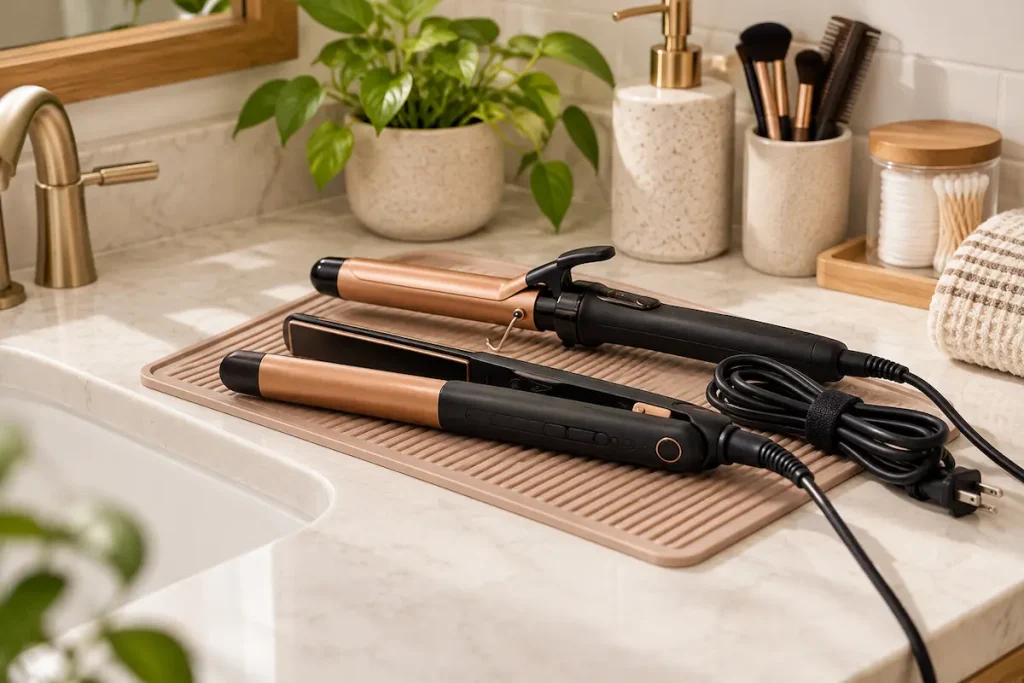
A simple two-stage system works well:
Cooling spot: A suitable heat-safe surface or compatible holder.
Permanent storage: A drawer, cabinet, or organizer used once the appliance has cooled.
This approach keeps hot tools from becoming permanent countertop clutter without rushing them into unsuitable storage.
Keep Cords Organized Without Damaging Them
Even a neatly stored hair dryer can make a drawer messy if its cord spreads across everything else.
Reusable cord ties can help contain loose cables after the appliance is unplugged and cooled.
Avoid pulling cords into tight loops or winding them tightly around a tool when the manufacturer advises against it.
Store each cord with its appliance rather than letting cables collect separately.
If a cord is damaged, frayed, or has exposed wiring, stop using the appliance rather than trying to hide the damage with an organizer.
Good cord organization should make tools easier to handle and inspect—not simply make the mess invisible.
A Simple Hair Tool Setup for a Very Small Bathroom
You don’t need six organizers to put these ideas into practice.
Imagine a bathroom with one small vanity cabinet, a shallow drawer, and barely enough counter space for everyday toiletries.
A workable setup might look like this:
| Item | Storage Location |
|---|---|
| Daily hair dryer | Holder inside the dry vanity cabinet |
| Flat iron | Drawer after cooling completely |
| Brushes and attachments | Small divided container |
| Curling wand used occasionally | Bedroom dresser or closet |
| Recently used hot tool | Designated heat-safe cooling spot |
This arrangement gives everyday items priority without forcing everything into the bathroom.
If several people share the space, assigning separate storage areas can help. Our guide to [creating bathroom zones in a shared small space] explains how to divide personal and shared items without overcrowding the vanity.
Before purchasing anything, try the arrangement using storage you already own.
Check whether drawers close easily, cords stay contained, and frequently used tools can be retrieved without moving several other items.
If the system works for a week, you’ll have a much better idea of whether an additional organizer is actually necessary.
Final Thoughts
The best hair tool storage for a small bathroom isn’t the setup that hides the most items. It’s one that makes your routine easier while respecting the limits of the space.
Keep everyday tools accessible, move occasional items out of prime storage, and give heated appliances a suitable place to cool before putting them away.
A few carefully chosen storage spots can make even a tiny bathroom feel more manageable—without filling it with more organizers.