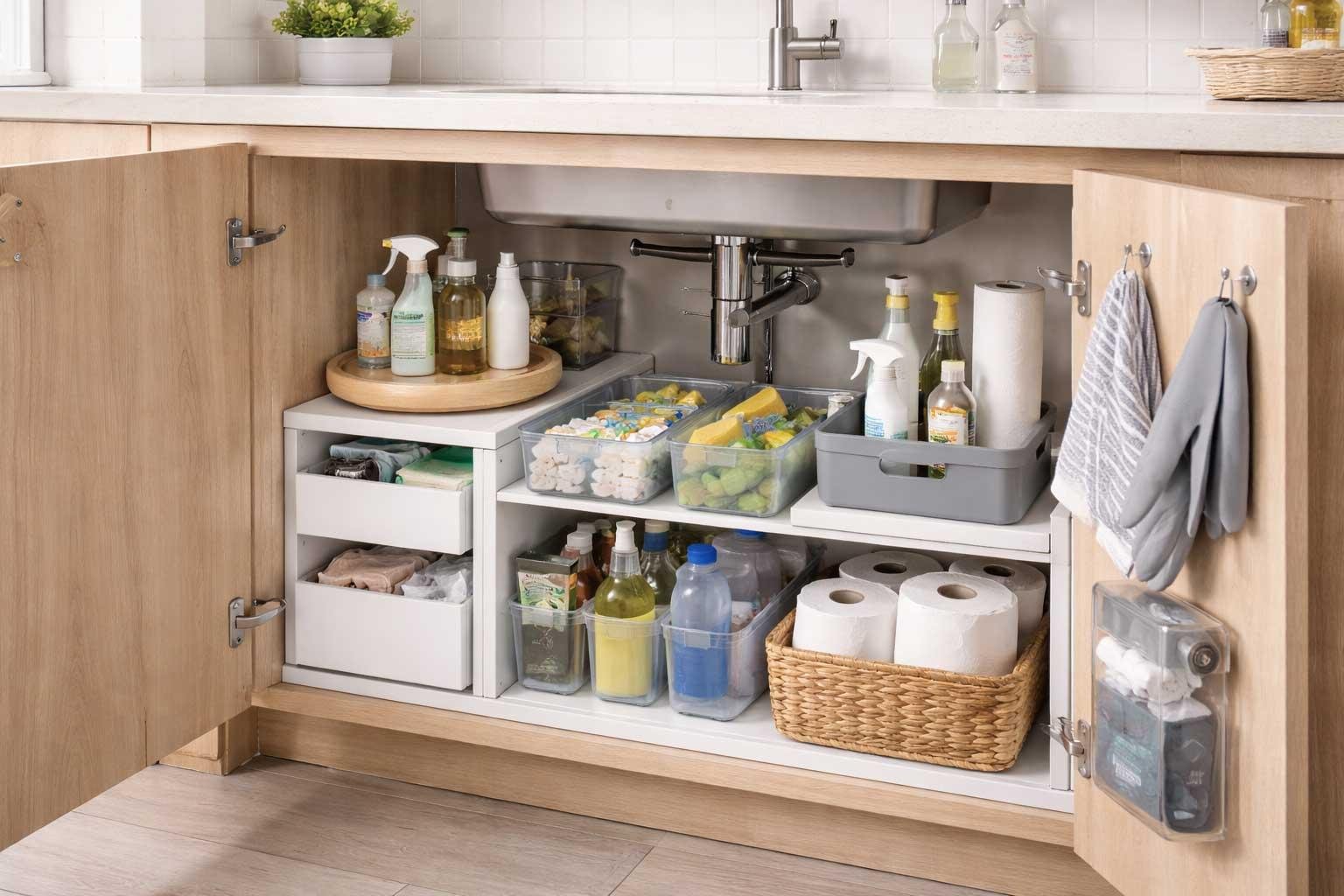
13 Under-Sink Storage Ideas for a Small Kitchen
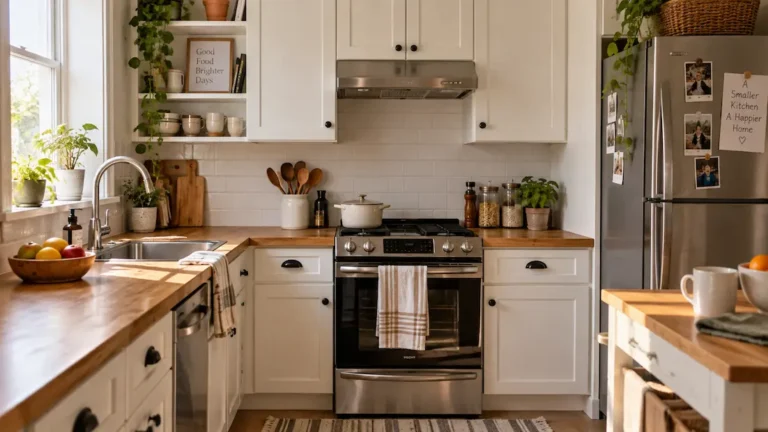
The cabinet under your kitchen sink can be one of the most frustrating places to organize. There are pipes in the middle, cleaning bottles falling over, and a dark corner where things seem to disappear.
And when you have a small kitchen, leaving that space unused isn’t much of an option.
The good news? Under kitchen sink organization doesn’t require an expensive cabinet makeover. A few carefully chosen organizers can make awkward spaces useful while keeping plumbing accessible.
These 13 under-sink storage ideas will help you find the right solution for your cabinet, whether you’re working around a garbage disposal, dealing with deep shelves, or trying to fit everyday cleaning supplies into a narrow space.
13 Under-Sink Storage Ideas at a Glance
Not every organizer works in every cabinet. Start with the problem you’re trying to solve, then choose a storage idea that fits your available space.
| Storage Idea | Best For |
|---|---|
| Adjustable under-sink shelf | Working around pipes |
| Narrow pull-out drawers | Reaching items in deep cabinets |
| Clear handled bins | Grouping cleaning supplies |
| Door-mounted organizer | Cabinets with limited floor space |
| Tension rod | Hanging lightweight spray bottles |
| Small Lazy Susan | Accessing bottles in deep corners |
| Stackable drawers | Organizing smaller supplies vertically |
| Narrow side storage | Using gaps beside plumbing |
| Portable cleaning caddy | Everyday cleaning essentials |
| Trash-bag dispenser | Containing loose rolls and boxes |
| Adhesive hooks | Hanging gloves and brushes |
| Waterproof cabinet mat | Managing minor drips and spills |
| Daily-use and backup zones | Preventing overcrowding |
Small-space tip: You don’t need all 13 ideas. Combining a narrow pull-out, one handled bin, and a few door-mounted hooks may be enough to organize the entire cabinet.
Before You Start: Measure Around the Plumbing
Before buying any under-sink organizers, empty the cabinet and take a closer look at its layout.
Unlike a regular kitchen cabinet, the space under your sink isn’t an empty rectangle. Drain pipes, water supply lines, shutoff valves, garbage disposals, and cabinet hinges can all interfere with storage.
Measure these four areas:
- Usable width: The open space on either side of the plumbing.
- Usable depth: The distance from the cabinet opening to the back wall, accounting for pipes and fittings.
- Vertical clearance: The available height beneath and beside the plumbing.
- Door clearance: The space organizers can occupy without hitting hinges or preventing the doors from closing.
If you’re considering a pull-out organizer, measure the actual door opening, not just the interior cabinet width.
Leave enough room to inspect plumbing connections and reach shutoff valves. Any organizer placed near these areas should be easy to remove.
Once you know which spaces are genuinely usable, choosing the right storage solutions becomes much easier.
13 Under-Sink Storage Ideas for a Small Kitchen
1. Add an Adjustable Shelf Around the Pipes
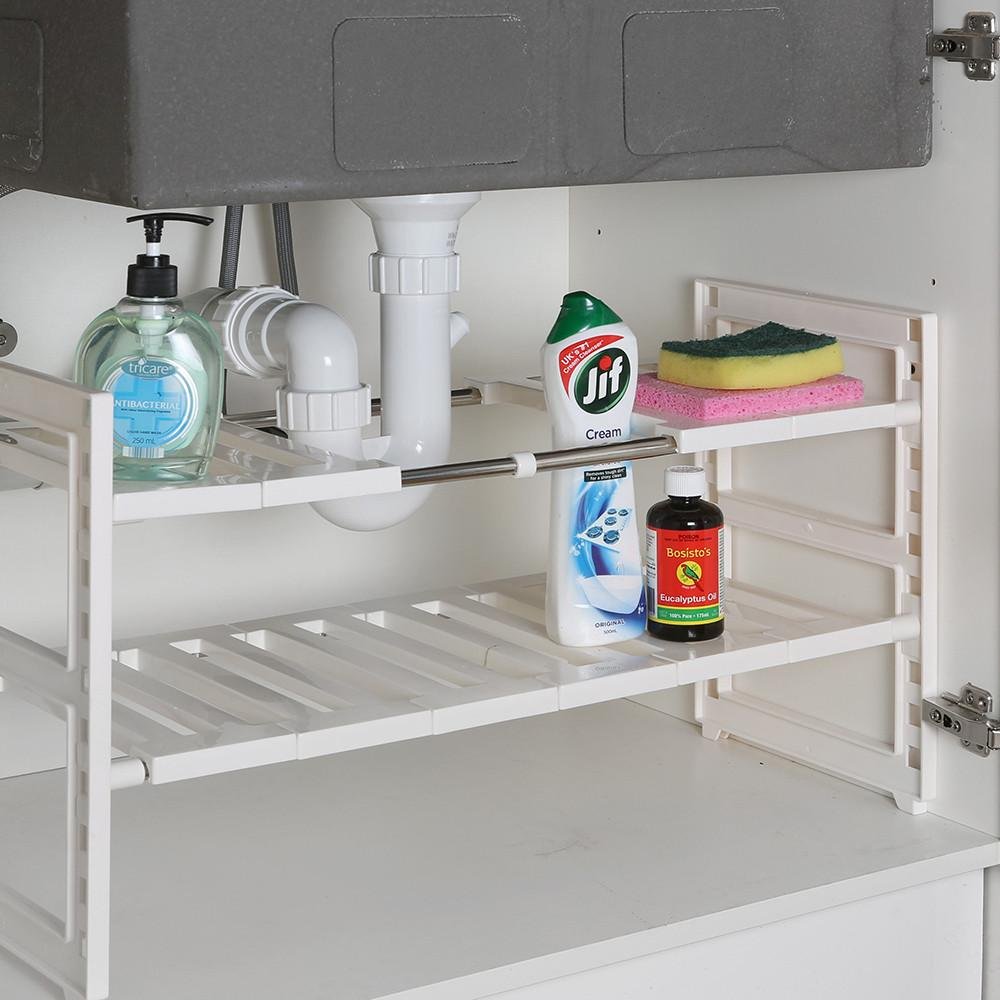
A standard shelf can be difficult to install under a kitchen sink because the drain pipe often runs through the middle of the cabinet.
An adjustable under-sink shelf solves this problem by using movable panels or separate shelf sections that fit around the plumbing.
Instead of losing the entire upper half of the cabinet, you can create a second storage level for sponges, dishwashing supplies, and smaller cleaning products.
Place taller bottles underneath and lighter supplies on the upper shelf.
✅ Best for: Cabinets with enough width on both sides of the pipes but limited usable floor space.
Before purchasing, check whether the shelf panels can be adjusted independently. Fixed shelves with a small cutout may not fit unusual plumbing layouts.
Avoid placing shelves where they obstruct valves or make leaks difficult to spot.
2. Use Narrow Pull-Out Drawers
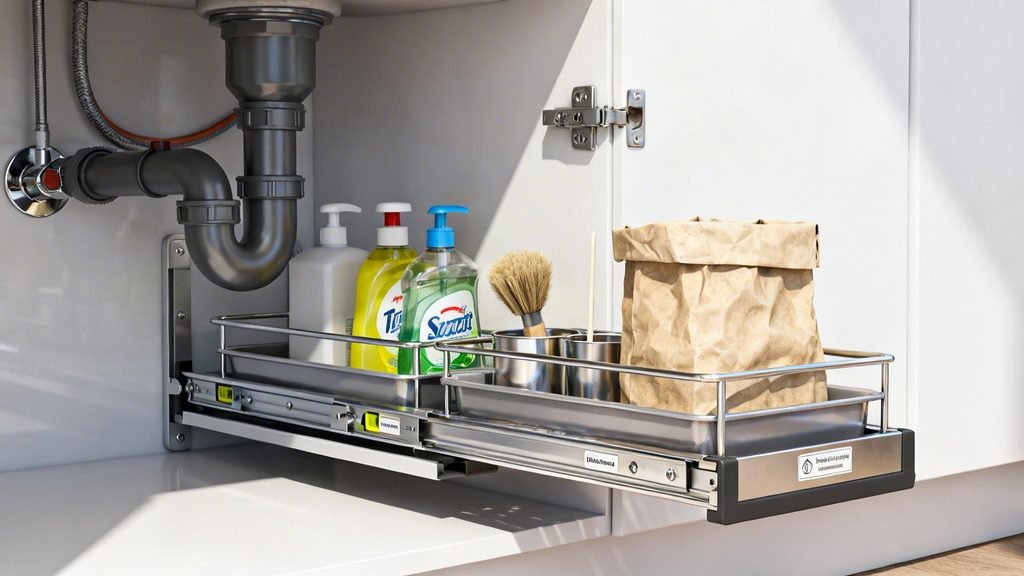
Deep under-sink cabinets can hold plenty of supplies, but reaching anything at the back often means moving everything in front.
A narrow pull-out drawer brings those hidden items forward.
For cabinets with central plumbing, two slim pull-outs—one on each side—may work better than a single wide organizer.
Use them for dish soap, dishwasher detergent, cleaning bottles, or small refill containers.
✅ Best for: Deep cabinets with clear vertical spaces beside the pipes.
Choose a pull-out with raised sides to prevent bottles from tipping when you slide it forward.
Also consider the installation method. Some pull-outs are freestanding, while others require screws or mounting hardware.
If your cabinet is unusually narrow or has a large garbage disposal, removable handled bins may be a better choice.
3. Group Cleaning Supplies in Clear Handled Bins
One of the simplest under sink storage ideas is to divide supplies into a few removable containers.
Instead of arranging bottles individually, group them by purpose.
For example, you might have one bin for dishwashing supplies, another for everyday surface cleaners, and a third for sponges and cleaning cloths.
When you need something, pull out the entire bin rather than reaching around the pipes.
Clear containers make it easier to see what’s inside, while handles are especially useful in deep cabinets.
✅ Best for: Renters, irregular cabinet layouts, and anyone who wants flexible storage without installation.
Choose washable plastic bins rather than fabric baskets. The area beneath a sink is more vulnerable to moisture and spills than an ordinary pantry shelf.
Keep the bins small enough to remove without bumping the plumbing.
4. Turn the Cabinet Doors Into Storage
The inside of a cabinet door is often overlooked, even when the cabinet itself is packed.
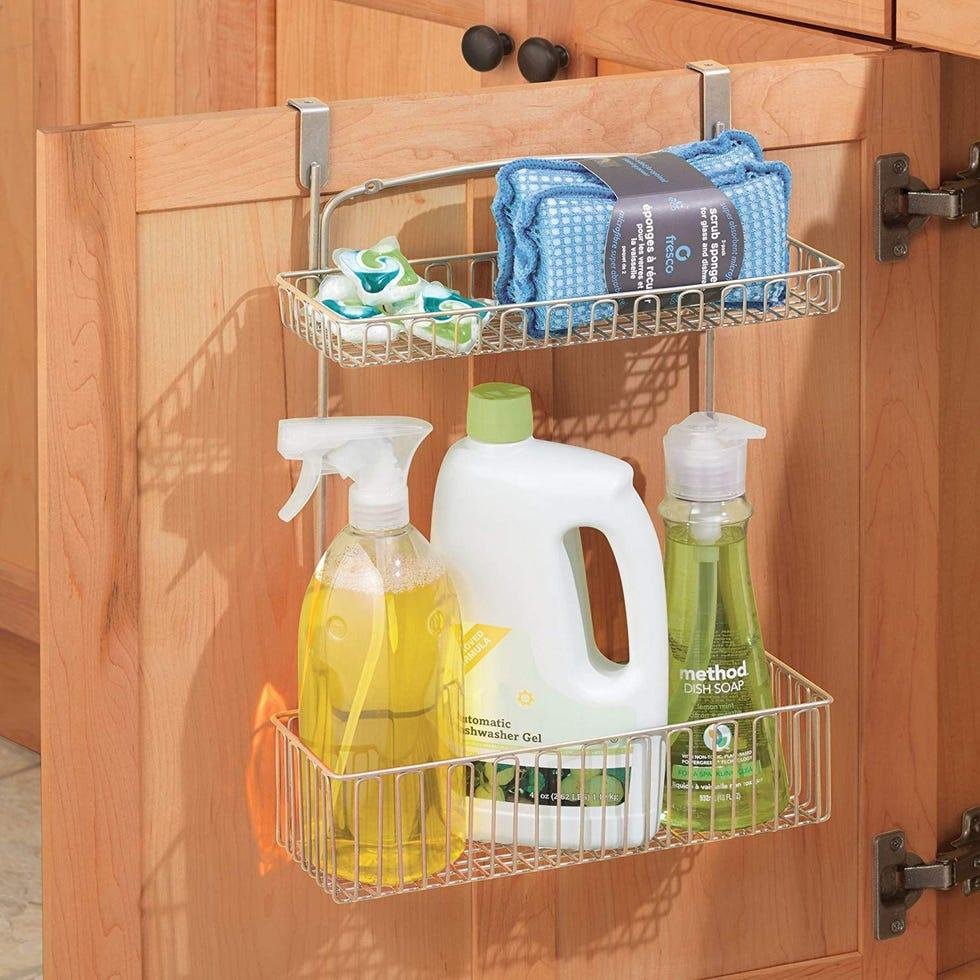
A slim door-mounted organizer can create extra storage without taking up valuable floor space.
Use it for lightweight items such as sponges, cleaning cloths, gloves, and small brushes.
You can also choose a rack with narrow compartments for dishwasher supplies or other compact items.
✅ Best for: Very small cabinets where plumbing occupies most of the interior.
Before installing a rack, check how the cabinet closes. The organizer must clear the sink basin, plumbing, hinges, and anything stored inside.
For rental kitchens, removable adhesive or over-the-door organizers may be practical alternatives, provided they are compatible with the cabinet and can support the intended weight.
Avoid loading the door with heavy cleaning bottles.
5. Hang Spray Bottles From a Tension Rod
If spray bottles are taking up too much room, a tension rod can help you use the space above the cabinet floor.
Install a short rod across a clear section of the cabinet and hang compatible spray bottles by their trigger handles.
This leaves space underneath for shallow bins or smaller supplies.
The bottles also stay visible, making it easier to find the cleaner you need.
✅ Best for: Cabinets with a clear horizontal opening and several lightweight spray bottles.
Make sure the rod is securely positioned between suitable surfaces and doesn’t press against plumbing.
Keep the load light. A tension rod can slip, especially if it’s holding heavy, full bottles.
If your cabinet has very little horizontal clearance, door-mounted hooks or a portable caddy may be more reliable.
6. Add a Small Lazy Susan for Bottles
A deep cabinet corner can become a collection of half-used cleaning products that are difficult to reach.
A small Lazy Susan makes that space more accessible.
Place frequently used bottles on the turntable and rotate it when you need something from the back.
This works particularly well for groups of shorter bottles that would otherwise hide behind one another.
✅ Best for: Cabinets with one open corner or a clear area beside the plumbing.
Choose a turntable with a raised edge to help keep bottles contained.
Measure its diameter carefully. It needs enough room to rotate without hitting the pipes, cabinet walls, or nearby organizers.
If the available space is long and narrow rather than roughly square, a pull-out bin will probably make better use of it.
7. Stack Small Drawers Vertically
The cabinet floor may be crowded even when there’s unused space above it.
Small stackable drawers can help you use that height.
They work especially well for compact supplies such as spare sponges, scrubbers, microfiber cloths, and cleaning accessories.
Unlike stacked open bins, drawers let you reach the lower level without lifting off everything above it.
✅ Best for: Tall, narrow openings beside the plumbing.
Choose low-profile drawers that fit comfortably beneath pipes or other obstructions.
Avoid building a tall, unstable stack. Two secure drawers are often more useful than four that wobble or make it difficult to inspect the cabinet.
For items that are frequently wet, use ventilated storage or allow them to dry before putting them away.
8. Use the Narrow Spaces Beside the Pipes
A cabinet with complicated plumbing may not have enough room for a large organizer.
But it can still have several useful pockets of space.
Look for narrow gaps between the plumbing and cabinet walls.
A slim bin might fit beside a drain pipe. A short container could sit beneath the P-trap. A taller corner might accommodate an upright cleaning caddy.
Rather than forcing one organizer into the entire cabinet, treat each open area as a separate storage zone.
✅ Best for: Cabinets with central drain pipes, bulky garbage disposals, or irregular layouts.
Keep the storage proportional to the available space. A six-inch gap doesn’t need an oversized organizer.
This same approach can help throughout your kitchen. Our guide to 17 Small Kitchen Storage Ideas That Use Every Inch explores more ways to make use of narrow gaps, overlooked corners, and awkward cabinet spaces.
9. Create a Grab-and-Go Cleaning Caddy
If you regularly carry cleaning supplies from the kitchen to other rooms, a portable caddy can be more useful than fixed storage.
Keep your most frequently used cleaners together in one handled container.
When it’s time to clean, lift out the caddy and take everything you need with you.
Once you’re finished, the entire group returns to its designated spot.
✅ Best for: Small households with a limited collection of everyday cleaning products.
Choose a caddy with a stable base and compartments that keep bottles upright.
Don’t fill it with every cleaner you own. Reserve it for essentials and store infrequently used products separately.
If children or pets can access the cabinet, move hazardous cleaning products to appropriately secured storage instead.
10. Give Trash Bags Their Own Dispenser
Trash bags are easy to overlook when organizing under the kitchen sink.
Loose rolls unravel, cardboard boxes get crushed, and half-empty packages take up more space than necessary.
A compact dispenser can keep trash bags contained in one location.
Depending on your cabinet, you might use a slim upright holder, a small bin, or a suitable door-mounted dispenser.
✅ Best for: Cabinets where trash-bag boxes are taking up valuable shelf space.
Place the dispenser close to the cabinet opening if you change trash bags frequently.
Avoid mounting it where it interferes with hinges, plumbing access, or the movement of other organizers.
If you use several bag sizes, keep only the most frequently needed roll under the sink.
11. Add Hooks for Gloves and Small Cleaning Tools
Not every cleaning supply needs a shelf or drawer.
Rubber gloves, small brushes, and lightweight cleaning accessories can be stored on hooks.
Install a few hooks inside a cabinet door or along an unused side wall.
This keeps small items from collecting at the bottom of the cabinet and makes them easier to find.
✅ Best for: Narrow surfaces that cannot accommodate bins or shelves.
Use hooks rated for the surface and weight of the items you plan to hang.
For reusable gloves, allow them to dry before storing them in an enclosed cabinet.
A couple of well-placed hooks are usually enough. Too many can make the cabinet feel cluttered and interfere with other storage.
12. Protect the Cabinet Base With a Waterproof Mat or Tray
Even a well-organized under-sink cabinet can experience occasional drips from wet bottles, cleaning supplies, or minor spills.
A waterproof cabinet mat or shallow tray creates a removable protective layer.
It also makes cleaning easier because you can lift the mat out, wipe it down, and inspect the cabinet underneath.
✅ Best for: Cabinets with a wood-based floor or a history of minor spills.
Choose a liner that fits the cabinet without curling up around pipes or obstructing access.
A raised-edge tray can help contain small amounts of liquid, but it should not be treated as a solution for leaking plumbing.
Check beneath the mat periodically. Trapped moisture can damage cabinet materials even when the visible surface looks dry.
If you notice an active leak, persistent dampness, or water damage, address the plumbing problem before reorganizing the cabinet.
13. Separate Daily Supplies From Backups
Sometimes the biggest under-sink storage problem isn’t the cabinet layout.
It’s simply that too many things are competing for the same space.
Instead of keeping every bottle and refill under the sink, divide your supplies into daily-use items and backups.
Store frequently used products near the front of the cabinet.
Move bulky refills and rarely used supplies to another suitable storage area, keeping hazardous products secure.
✅ Best for: Cabinets that feel overcrowded even after adding organizers.
Try keeping one everyday cleaning caddy and one small container for occasional supplies.
This prevents the under-sink cabinet from becoming general overflow storage.
If your kitchen also lacks a pantry, it helps to assign clear purposes to every storage area. Our guide to How to Organize a Small Kitchen With No Pantry explains how to create practical storage zones without overcrowding your cabinets.
How to Organize Under the Sink Around Pipes
The easiest way to organize under sink around pipes is to divide the cabinet according to its actual usable space.
Think of it as three zones rather than one large storage area.
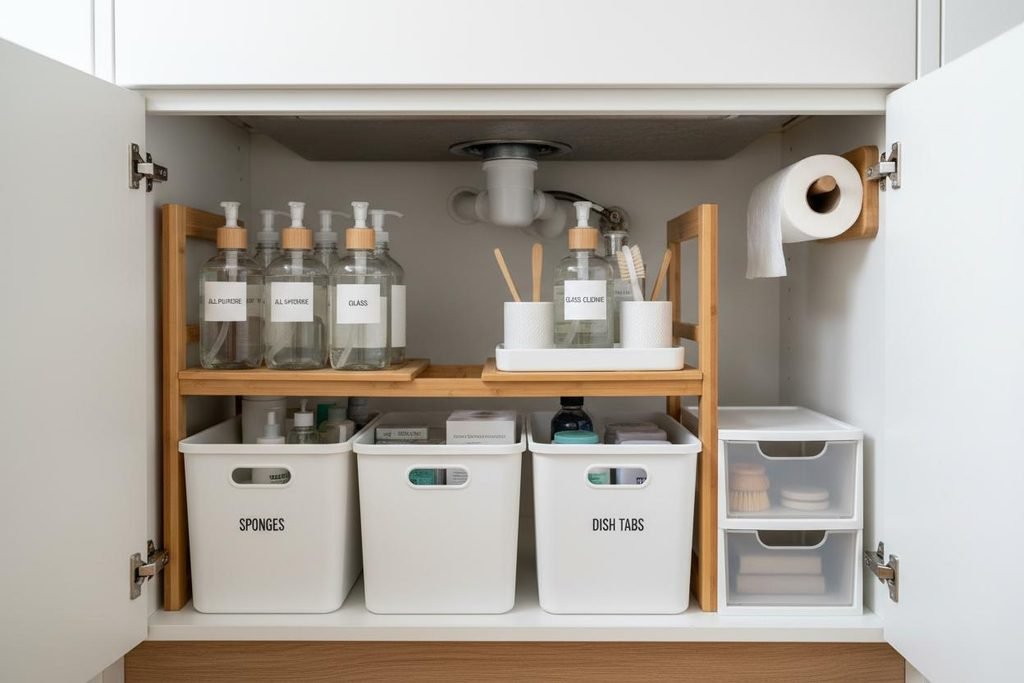
The Plumbing Zone: Keep It Accessible
The central area around the drain, water supply lines, and shutoff valves should remain easy to inspect.
Avoid placing permanent shelves or tightly packed containers directly in front of plumbing connections.
If you need to store something nearby, choose a lightweight organizer that can be removed quickly.
The Side Zones: Store Everyday Supplies
The spaces beside the plumbing are usually the most useful areas for bins, narrow pull-outs, and stackable drawers.
Place frequently used products toward the front and less-used supplies behind them.
If one side is narrower, reserve it for smaller containers instead of trying to make both sides symmetrical.
The Door Zone: Store Lightweight Accessories
Use the inside of the cabinet doors for compact items that would otherwise clutter the floor.
Hooks, slim racks, and small holders work well here.
Check that everything clears the cabinet contents when the doors close.
This three-zone approach makes it easier to organize an awkward cabinet without blocking the plumbing or purchasing more organizers than you need.
What Should You Store Under the Kitchen Sink?
The cabinet under your kitchen sink is generally most useful for supplies related to dishwashing, cleaning, and waste disposal.
Good candidates include dish soap, dishwasher supplies, cleaning brushes, sponges, trash bags, and a small collection of frequently used cleaners.
However, not everything belongs in this space.
Food and pantry staples should be stored in a clean, dry area away from potential plumbing leaks and household chemicals.
Paper towels and other moisture-sensitive supplies may also be better stored elsewhere, particularly if your under-sink cabinet tends to become damp.
Hazardous cleaning products require extra care. The U.S. Consumer Product Safety Commission recommends keeping household chemicals in their original containers and storing them securely away from children. An accessible under-sink cabinet may not be an appropriate location unless it can be properly secured.
Also avoid storing bulky items that block shutoff valves or make it difficult to inspect plumbing connections.
The goal is to keep useful everyday supplies close to the sink without turning the cabinet into a crowded catch-all.
Keep Your Under-Sink System Simple
A small kitchen doesn’t need an elaborate organizing system to make the space beneath the sink work better.
Start by removing what doesn’t belong, measuring around the plumbing, and identifying the areas that are easiest to reach.
Then choose two or three under-sink storage ideas that solve your biggest problems.
A narrow pull-out, a removable cleaning caddy, and a few door hooks may be all you need to turn an awkward cabinet into practical, easy-to-maintain storage.