
How to Use Wall Space Without Making a Small Room Feel Busy
When floor space is limited, looking up makes sense.
Walls can hold shelves, cabinets, books, media equipment, and many of the things currently competing for space on your coffee table or floor. That is why vertical storage in a living room can be so useful in a small home.
But there is a catch.
Cover every available wall with storage and the room may technically hold more while feeling smaller, busier, and harder to relax in. Instead of clutter on the floor, you end up with clutter at eye level.
The goal is not to use every empty inch of wall. It is to make a few areas work harder while leaving enough visual breathing room around them.
Here is how to do that.
Why Vertical Storage Can Make a Small Living Room Feel Bigger—or Busier
Vertical storage works because it shifts some of the storage load away from your limited floor area.
A tall bookcase may hold considerably more than a low cabinet with a similar footprint. Floating shelves can add useful storage without using floor space at all. Wall-mounted cabinets can replace furniture that would otherwise project farther into the room.
But physical space and visual space are not the same thing.
A wall covered with small shelves, baskets, framed art, books, plants, and miscellaneous objects may occupy almost no floor area while creating a great deal of visual activity.
That is why effective living room vertical storage needs to balance two goals:
- increase usable storage
- reduce visual competition
Before adding anything to a wall, ask what problem you are actually trying to solve.
Do you need somewhere for books? Media equipment? Work supplies? Toys? Blankets? Objects that keep collecting on the coffee table?
Start with the storage problem, not the empty wall.
An unused wall does not automatically need to become storage.
Start With the Wall That Can Do the Most Work
Instead of adding one shelf here, another basket there, and a narrow cabinet somewhere else, look first for one wall that could become your primary vertical storage zone.
This could be:
- the wall around the TV
- an empty wall beside the sofa
- a narrow wall that cannot accommodate deep furniture
- the wall above an existing console
- an awkward corner where a tall unit fits better than a wide one
Concentrating storage can make a small living room feel calmer because your eye reads one intentional storage area rather than multiple unrelated storage moments scattered around the room.
Think of it as giving storage an address.
If part of the room also functions as a workspace, the best wall may be the one that can support living room office organizing without forcing another desk cabinet or supply cart onto the floor. A few shelves or a shallow wall cabinet above the work zone can keep office supplies contained while preserving more open walking space.

Concentrating storage on one wall can make a small living room feel calmer than spreading shelves across the room8 Ways to Use Vertical Storage Without Overwhelming the Room
1. Choose One Tall Storage Piece Instead of Several Short Ones
When a small living room needs substantial storage, going taller can make more sense than spreading furniture across the entire perimeter.
For example, one tall bookcase may create less visual disruption than a console, two small shelving units, and several floor baskets occupying three different walls.
The advantage is not simply capacity.
A tall unit creates one clear vertical shape. Several short pieces create repeated visual stops around the room while also using more floor space.
Look for proportions that fit the wall rather than automatically buying the largest unit possible.
A narrow bookcase can be especially useful beside a doorway, next to a sofa, or in a corner that is too tight for conventional furniture.
If the contents are likely to look messy, consider a unit with doors on at least part of it. Closed sections let you gain height and capacity without putting every household item on display.
2. Take Storage Higher, but Keep the Upper Zone Quiet
Using the height of a wall is one of the biggest advantages of vertical storage, but the highest shelves should not become an overflow zone.
Items above comfortable reach are best reserved for belongings you do not need every day.
That might include:
- seasonal decor
- extra books
- rarely used board games
- archival photo boxes
- spare linens
- lightweight display objects
Visually, the top of a tall storage arrangement usually works best when it is calmer than the middle.
Instead of filling every upper shelf edge to edge, leave some space around objects. If several small items need to live there, a few similar boxes can create less visual noise than a row of unrelated containers.
The idea is to use the room’s height without making the ceiling area feel crowded.
3. Use Floating Shelves Where Floor Space Matters Most
Floating shelves are particularly useful when the real problem is a lack of floor space.
A shelf above a desk, console, or narrow stretch of wall can add storage without introducing another piece of furniture.
But floating shelves are also one of the easiest vertical storage ideas for a living room to overuse.
Three shelves with a clear purpose may solve a problem. Twelve little shelves scattered around the room can create a dozen new surfaces that all need to be filled, cleaned, and visually managed.
Before installing one, decide what will actually live there.
If the answer is simply “I’ll find something,” you probably do not need the shelf yet.
Use floating shelves where they perform a specific job: holding a small book collection, keeping a few everyday items within reach, or creating a compact display that replaces clutter elsewhere.
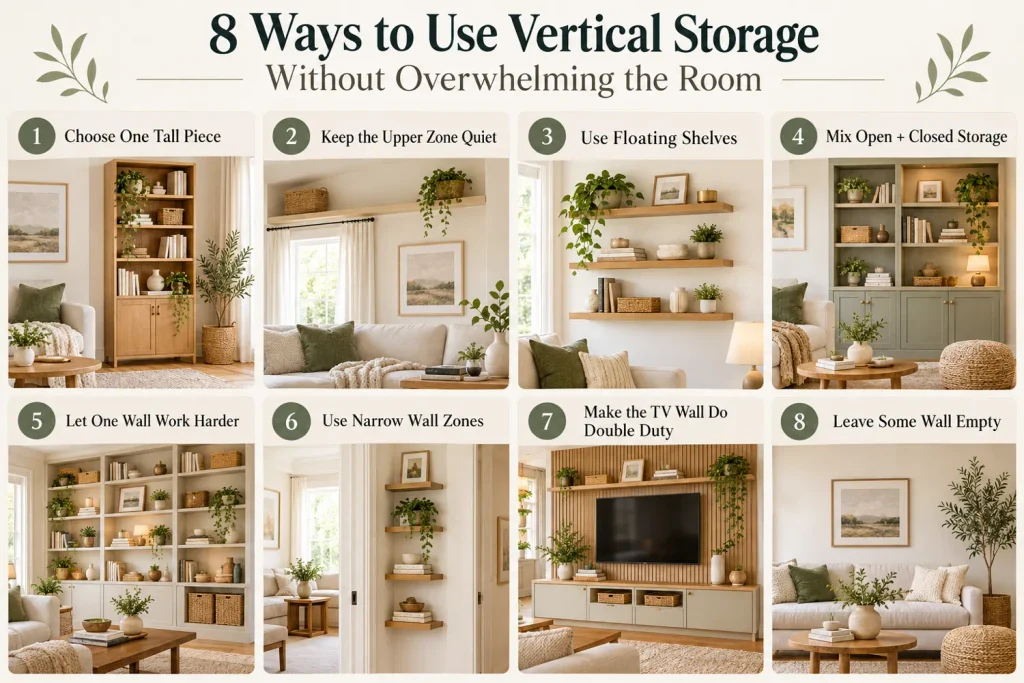
Eight ways to add vertical storage while keeping a small living room visually calm4. Combine Open and Closed Storage
Not everything benefits from being visible.
Books, a few ceramics, plants, or attractive baskets may work beautifully on open shelving. Charging cables, paperwork, game controllers, children’s supplies, and miscellaneous household items usually create much more visual noise.
A practical wall-storage setup often uses both.
For example, closed cabinets might occupy the lower part of the wall while a smaller amount of open shelving sits above them.
The cabinets handle useful things you do not particularly want to see. The shelves hold the smaller number of objects that can stay visible without making the room feel crowded.
The point is not to make every storage category disappear. It is to keep the visually complicated ones from dominating the wall.
5. Let One Wall Work From Floor to Ceiling
Sometimes the most effective wall storage for a small living room is one hardworking storage wall rather than bits of storage around the entire room.
A floor-to-ceiling arrangement might combine:
- closed lower cabinets
- a TV or artwork in the middle
- shelving above
- narrow book storage along one side
Because the storage reads as one composition, the rest of the room can remain comparatively simple.
This is especially useful when you already have a natural focal wall.
The key is restraint within the storage itself.
Floor-to-ceiling storage does not mean every compartment needs a different basket, color, accessory, and decorative object. Repeating materials and leaving selected areas lightly filled can help a large storage wall feel more architectural and less like a collection of containers.
6. Use Narrow Wall Zones That Regular Furniture Cannot Fill
Some of the most useful wall-storage opportunities are not large walls at all.
Look at the narrow spaces beside doors, between windows, next to a fireplace, beside a media unit, or at the end of a sofa.
These areas may be too small for conventional furniture but large enough for:
- a slim bookcase
- a vertical magazine rack
- shallow shelving
- a wall-mounted basket
- a narrow cabinet
- a small set of hooks for appropriate everyday items
The word shallow matters.
Storage that projects too far into a walkway can make a small room feel physically tighter even when it fits on paper.
Protect circulation first. A few extra inches of storage are rarely worth forcing people to navigate around a cabinet every time they cross the room.
7. Make the TV Wall Do Double Duty
The TV wall is already visually active, which can make it a logical place to consolidate additional storage.
Instead of putting the television on one piece of furniture, books on another, and media accessories somewhere else, consider whether they can share the same zone.
A low closed cabinet can hide electronics and cables. Narrow shelves can hold books or a controlled amount of decor. Wall-mounted elements can use some of the space above or beside the screen.
If toys also live in the living room, this same wall can sometimes absorb a small amount of toy storage in a small living room through closed lower cabinets or baskets placed within easy reach.
That is usually calmer than adding a separate toy organizer on another wall.
Just avoid framing the television with dozens of tiny objects.
The screen already creates a strong visual rectangle. Some negative space around it usually looks calmer than packing every surrounding inch.
8. Leave Some Wall Space Completely Empty
This may be the most important rule when planning vertical storage in a small room.
You do not have to use every wall.
Empty space separates storage zones, gives the eye somewhere to rest, and helps the useful features in the room stand out.
If one wall has floor-to-ceiling shelving, perhaps the wall opposite it only needs one piece of art.
If the TV wall handles most of the storage, the wall behind the sofa may not need picture ledges, baskets, hooks, and another shelf system.
A room can be small without every surface having a job.
Sometimes the job of a wall is simply to stay quiet.
What Should Go High—and What Should Stay Low?
Once you have chosen where your living room wall storage will go, it helps to divide it into three rough zones.
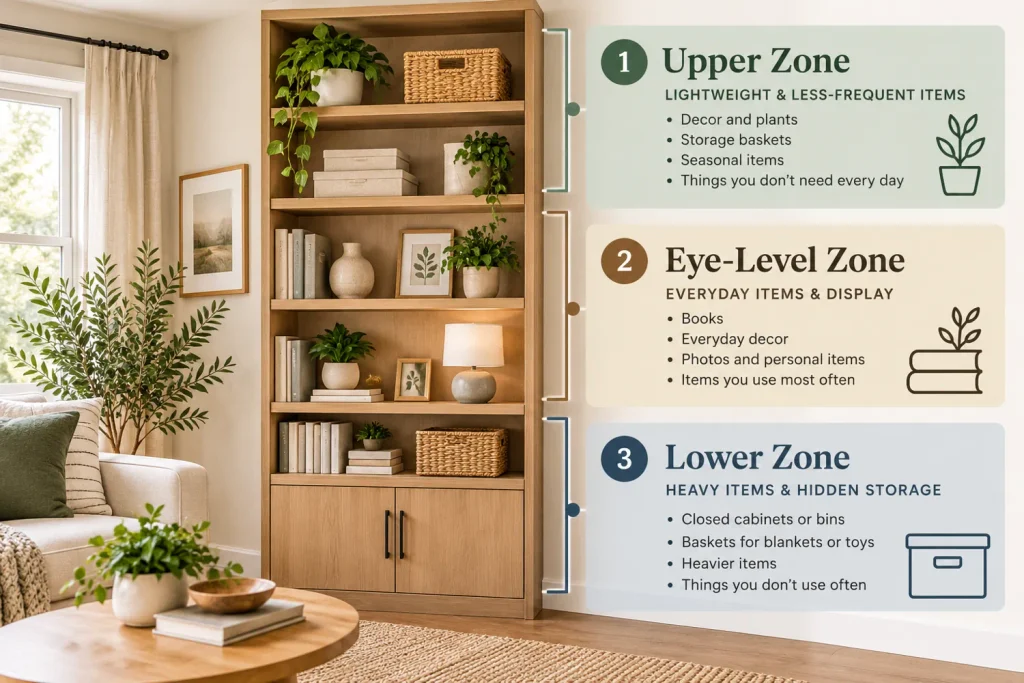
A simple vertical storage plan: keep lightweight, occasional items high, everyday items at eye level, and heavier or visually messy items lowerUpper Zone: Light and Infrequently Used
Use the highest storage for things you do not need often and can retrieve safely when necessary.
Seasonal decor, lightweight boxes, and occasional-use belongings make more sense here than something you reach for every evening.
Avoid designing a daily routine that requires a stool simply because an upper shelf was available.
Eye-Level Zone: Useful or Worth Seeing
Eye-level shelves attract attention first.
Use that valuable space for frequently used objects, books, or a limited amount of display rather than miscellaneous overflow.
This is also where visual clutter becomes most noticeable.
If an object is neither useful nor something you enjoy seeing, it probably does not deserve prime wall space.
Lower Zone: Heavy and Visually Messy
Lower cabinets are useful for heavier items and belongings that would make open shelving look busy.
They are easier to reach and give visual weight to the bottom of a tall storage arrangement.
This is also where soft household items often make the most sense. If throws tend to pile up on the sofa, a lower cabinet, deep basket, or bench compartment can provide blanket storage for a small living room without adding another visual layer higher on the wall.
There is also a safety reason to be thoughtful about tall furniture. The U.S. Consumer Product Safety Commission recommends securing bookcases and other furniture to the wall and placing heavier items on lower shelves to reduce tip-over hazards, especially in homes where children live or visit.
Always follow the furniture manufacturer’s installation and anchoring instructions.
How to Keep Open Shelving From Looking Cluttered
Open shelves become visually busy when every surface turns into a collection of unrelated small things.
You do not need perfectly styled shelves. You simply need enough structure that your eye can quickly understand what it is looking at.
Start by grouping similar objects instead of distributing them individually.
Five books together read as one group. The same five books separated among candles, figurines, photographs, and containers create many more visual points.
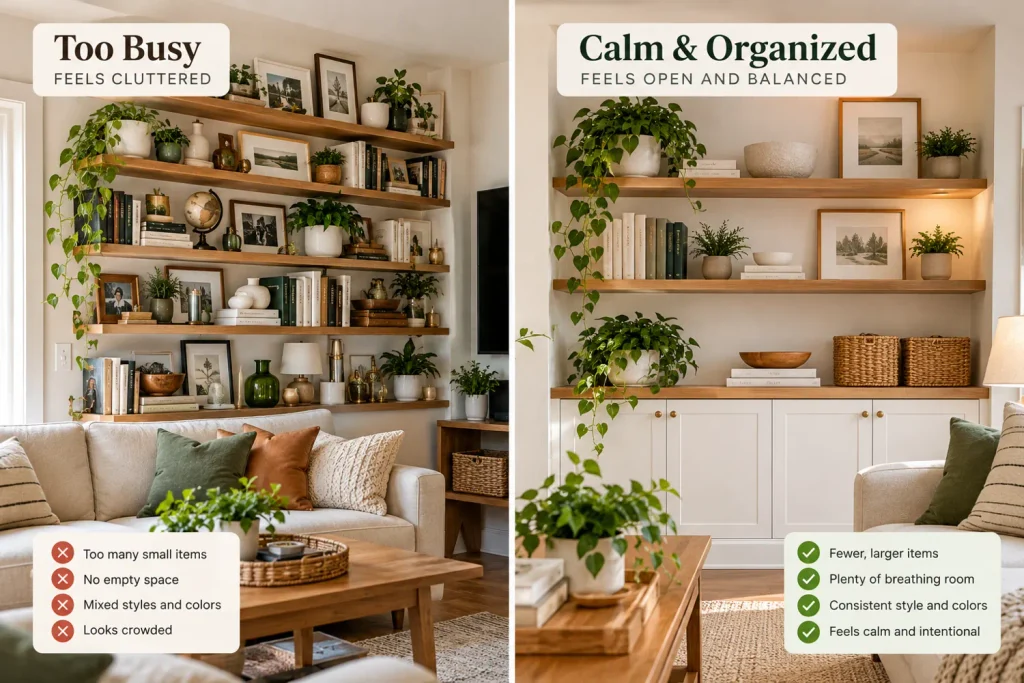
Open shelving feels calmer when you use fewer, larger groupings and leave visible breathing room between itemsA few simple habits help:
Leave gaps. A shelf does not need to be full to be useful.
Use fewer, larger groups. Three meaningful arrangements generally look calmer than fifteen small objects.
Repeat materials. A few similar boxes or baskets create less visual variation than a different container for every category.
Limit display storage. When everything you own is visible, the wall has too much information to communicate.
Give everyday objects boundaries. A tray, basket, or pair of bookends can make a functional collection feel intentional without hiding it completely.
If a shelf still looks cluttered no matter how carefully you arrange it, the problem may not be styling.
It may simply be holding too much.
Use Closed Storage for the Visually Messy Categories
Some belongings create visual activity even when they are perfectly organized.
Think about cables, paperwork, children’s toys, gaming accessories, craft supplies, spare electronics, or miscellaneous household tools.
These are good candidates for a cabinet, drawer, or opaque basket.
You do not need to hide everything. The point is simply to let visually complicated categories disappear while keeping a smaller number of books, plants, and useful objects visible.
This balance matters especially when using vertical storage in a living room, because anything placed higher on the wall naturally enters your line of sight.
Vertical Storage Mistakes That Make a Small Room Feel Smaller
Wall storage can solve a lot of small-space problems, but more is not automatically better.
Adding Storage to Every Empty Wall
Once you start thinking vertically, every blank section can look like an opportunity.
Resist that instinct.
Storage spread around the entire perimeter can make the room feel enclosed even when each individual piece is relatively shallow.
Using Too Many Tiny Shelves
Many small shelves create repeated horizontal lines and often encourage equally small decor.
One longer shelf or one contained shelving unit may look calmer while holding the same amount.
Filling Shelves Just Because Space Exists
Unused capacity is not failure.
A little spare room makes storage easier to maintain and gives future belongings somewhere to go.
Making Everything Open
Open storage is convenient until every household category becomes part of your visual field.
Use it selectively.
Choosing Storage That Is Too Deep
A wall-mounted cabinet may save floor space technically, but if it projects deeply into a narrow circulation path, the room can become harder to use.
Measure the walking space, not just the available wall.
Ignoring Installation and Anchoring
Tall bookcases, wall-mounted cabinets, and shelves need to be installed appropriately for the wall type, product, and expected load.
Do not assume that hardware suitable for one wall construction will work for another.
A Simple Wall-Space Test Before You Add Anything
Before buying another bookcase or installing another shelf, run through this quick test.
1. Name the problem.
What objects currently do not have a good home?
2. Choose the best wall.
Could one existing storage zone absorb them instead of creating another storage area?
3. Decide whether the contents should be visible.
Books may suit an open shelf. Tangled chargers probably do not.
4. Check the depth.
Will the new storage interfere with walking paths, doors, curtains, windows, or seating?
5. Mock up the size.
Painter’s tape can help you visualize the outline of a tall cabinet or shelving arrangement before committing to it.
6. Look at the whole room.
If this wall becomes busier, could another wall become quieter?
That final question matters.
Good small-room organization is not only about what you add. It is also about where you decide to stop.
Make the Right Inches Work Harder
The best vertical storage in a living room does not make the space hold as much as physically possible. It makes the room easier to use without making it harder to look at.
Concentrate wall storage where it solves a real problem. Keep visually messy categories lower or behind doors when possible. Use the upper part of the room selectively, and leave enough empty wall around the storage for the room to breathe.
In a small living room, the goal is not to use every inch.
It is to make the right inches work harder.