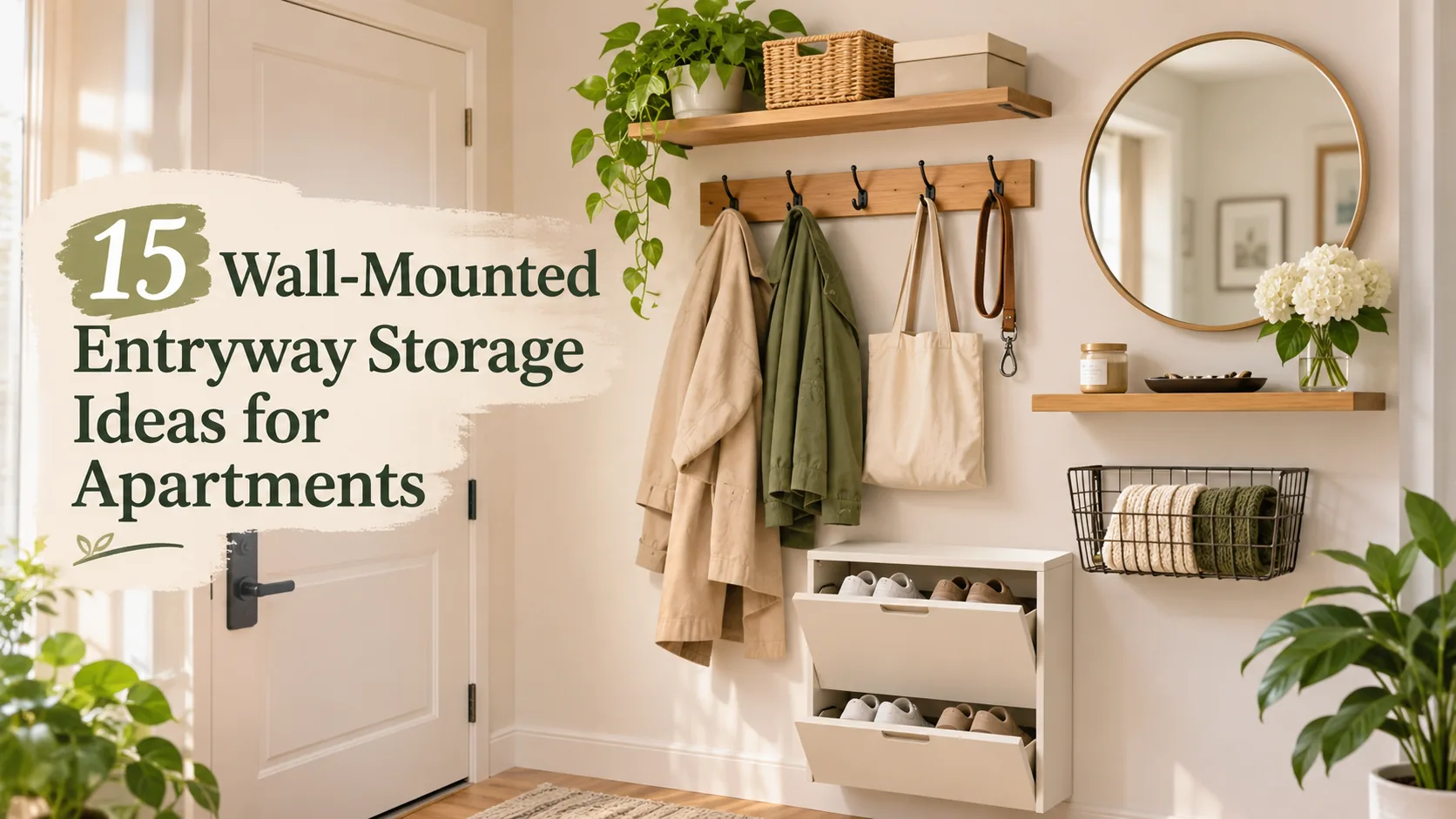
15 Wall-Mounted Entryway Storage Ideas for Apartments
A small apartment entryway can get crowded fast. Two jackets, a work bag, a few pairs of shoes, and yesterday’s mail may be enough to make the front door feel cramped.
Adding furniture isn’t always an option, especially when the door opens into a narrow hallway or directly into the living room.
That’s where wall-mounted entryway storage comes in. A few well-chosen hooks, shelves, or shallow cabinets can give everyday belongings a place to go without taking up valuable floor space.
These 15 ideas focus on practical solutions for small apartments, including options for renters who can’t make permanent changes.
Before You Mount Anything, Check These 4 Things
Before buying wall storage, take a few minutes to see how your entryway actually works.
- Door clearance: Open the door fully and check where the handle and door edge travel. Remember that hanging bags and coats take up more room than empty hooks.
- Available depth: A shallow shelf may work in a narrow hallway, while a deeper organizer could make walking through uncomfortable.
- Wall construction: Drywall, plaster, brick, and masonry require different mounting methods. Check the manufacturer’s instructions, especially for shelves and heavy items.
- Rental restrictions: Review your lease before drilling. Removable adhesive hooks may work for lightweight belongings, but they’re not substitutes for securely mounted cabinets.
One useful trick is to hold your largest everyday bag against the wall where you plan to hang it. You’ll quickly see whether it blocks the doorway or makes the walkway feel too narrow.
15 Wall-Mounted Entryway Storage Ideas for Apartments
1. Install a Simple Peg Rail for Everyday Coats
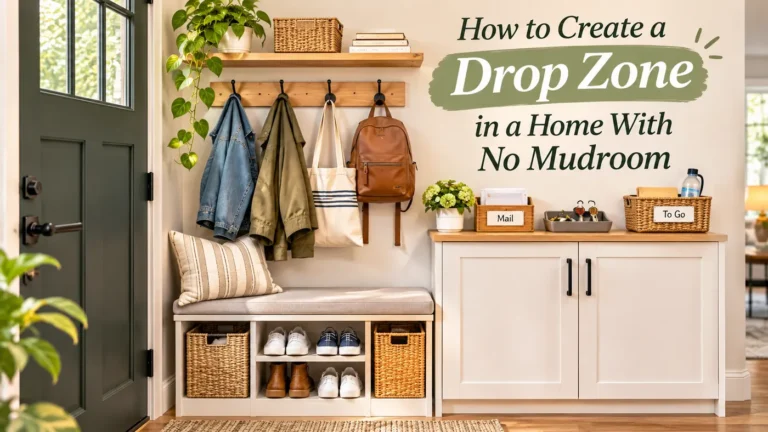
A wooden peg rail is one of the easiest ways to organize a small apartment entryway without adding a freestanding coat rack.
Mount a short rail near the door for the jackets, hats, and bags you use most often. Four or five pegs may be enough for a couple, particularly if off-season coats are stored elsewhere.
Look for pegs with enough space between them so bulky jackets don’t overlap excessively. The rail should be mounted securely enough for the expected load.
Resist the temptation to choose the longest rail that fits. Extra hooks often become extra places to leave things.
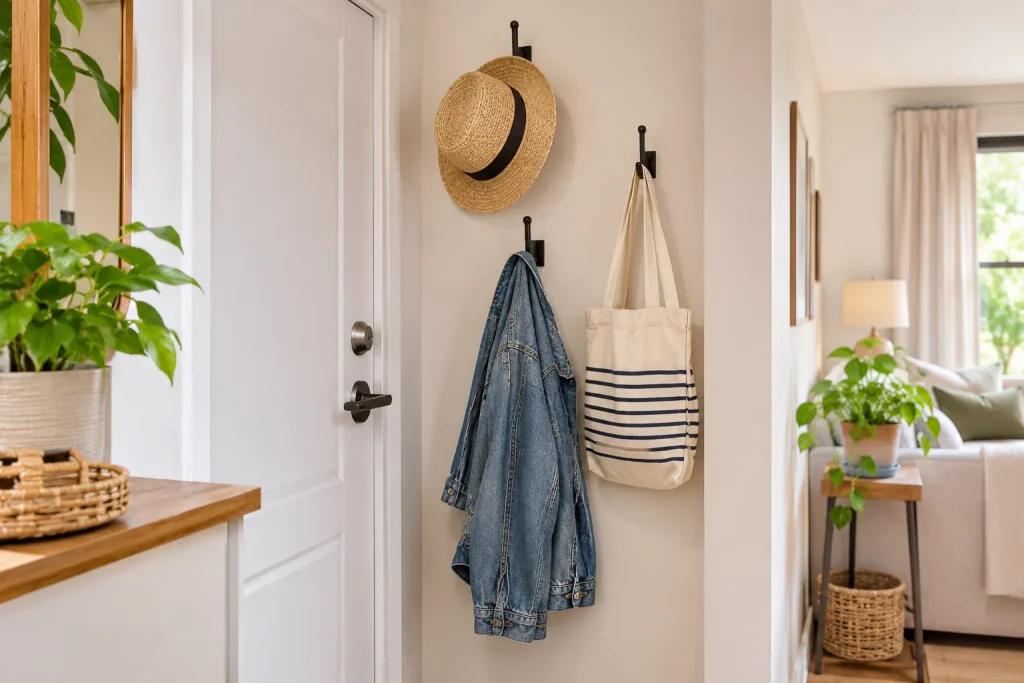
2. Stagger Individual Hooks on a Narrow Wall
Not every entryway has enough uninterrupted wall space for a horizontal rail.
If you’re working with a narrow strip beside the door or between two doorframes, try installing two or three individual hooks at different heights.
A higher hook can hold a hat or small tote, while a lower one accommodates a shorter jacket. Check how the items overlap before deciding on the final positions.
This arrangement works best with a few carefully chosen belongings. Hanging several bulky coats vertically can still make the wall feel crowded.
3. Add a Shallow Floating Shelf for Keys and Mail
If keys, sunglasses, and wallets keep ending up on the kitchen counter, a small floating shelf near the front door may be all you need.
For a narrow entryway, a shelf roughly 4 to 6 inches deep is a useful starting point, provided it holds your essentials and leaves comfortable clearance.
Add a shallow tray for keys and a designated place for incoming mail.
Keep decorative items to a minimum. A shelf crowded with plants, candles, and picture frames won’t be particularly useful when you’re trying to put things down after a long day.
4. Combine a Shelf and Hooks in One Unit
A wall-mounted shelf with hooks underneath is useful when you need several kinds of storage but only have room for one fixture.
Use the upper shelf for a lightweight basket of hats or gloves. The hooks below can hold jackets, reusable shopping bags, or a compact umbrella.
Before buying, check the space between the shelf and hooks. Some designs look practical online but leave very little room for bulky clothing.
Also consider what will hang underneath. A long coat may cover a shoe cabinet or another storage area below it.
One properly positioned combination unit often works better than several organizers competing for the same wall.
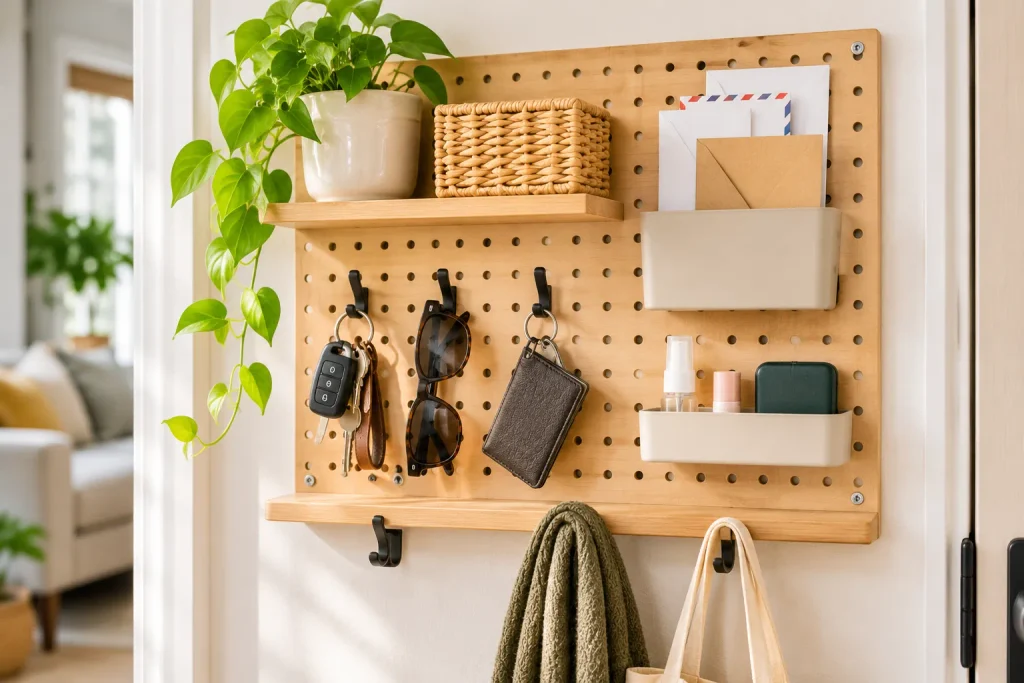
5. Use a Pegboard for Small Everyday Essentials
A compact pegboard is a flexible option for apartments where storage needs change.
You can rearrange hooks, clips, small containers, and ledges without replacing the entire organizer.
For example, keep keys on one hook, sunglasses in a small bin, and headphones beside your wallet. Everything is visible and easy to grab on the way out.
The important part is leaving breathing room between items. A pegboard packed with accessories can become visual clutter rather than a useful organizing system.
This solution works particularly well for small belongings, not heavy coats or loaded backpacks unless the specific system is rated and installed for those loads.
6. Mount Slim Shoe Cabinets Along an Empty Wall
Shoes are often the biggest source of floor clutter near an apartment door.
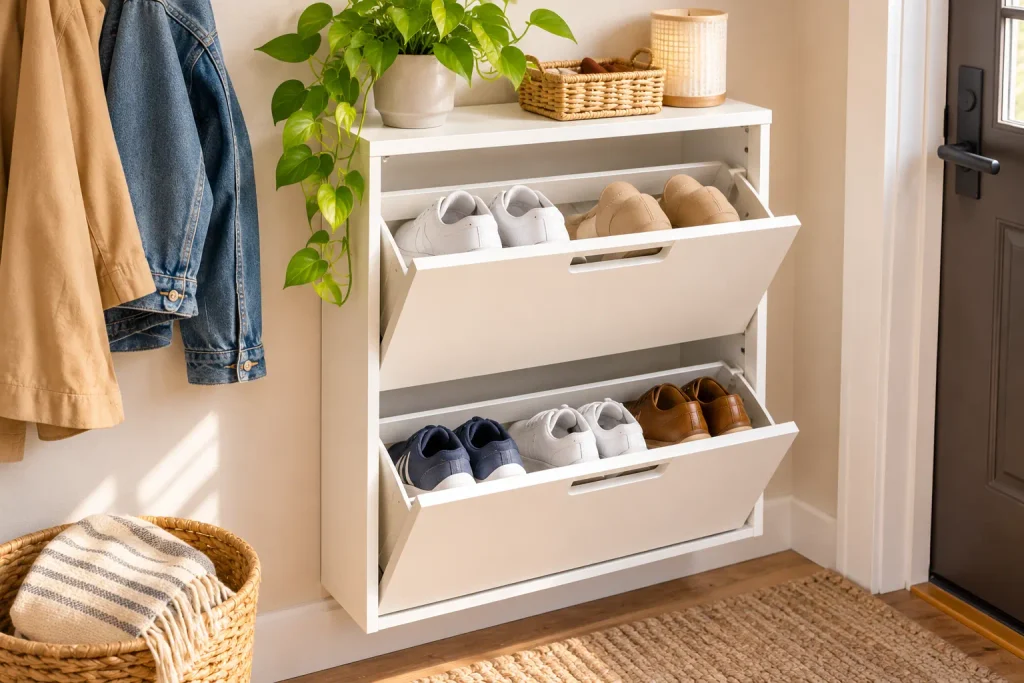
A shallow wall-mounted shoe cabinet can keep everyday footwear contained without the depth of a traditional shoe rack.
Look for designs with tilting or vertical compartments. Before purchasing, check the cabinet’s depth when closed and how far its doors extend when opened.
Also measure your shoes. Bulky sneakers, work boots, and high-top styles may not fit some slim compartments.
Wall-mounted shoe cabinets require appropriate fasteners and structural support. Some products are floor-standing units that must be anchored against tipping, rather than suspended from the wall. Follow the exact installation requirements and don’t attempt to hang a heavy cabinet with removable adhesive strips.
7. Install a Wall-Mounted Mail Sorter
Mail has a way of spreading from the entryway to the dining table and eventually the kitchen counter.
A small wall-mounted sorter near the door can stop that cycle.
Choose a simple design with two compartments: one for papers requiring action and another for items you need to keep temporarily.
Sort incoming mail regularly rather than letting the organizer become permanent storage.
If your apartment receives very little physical mail, skip the large multi-pocket systems. A slim letter holder may be enough.
The point is to create one clear landing place, not another collection of paperwork.
8. Choose a Mirror With Built-In Storage
In a studio apartment, the front door may open directly into the main living space. Every visible fixture matters.
A wall mirror with an integrated shelf or small hooks can provide useful storage without making the entrance look like a utility area.
Use the shelf for a wallet, keys, or sunglasses. Some designs also offer concealed compartments for small accessories.
Choose a mirror with storage features you’ll actually use. A decorative mirror with a tiny ledge may look attractive but won’t solve a serious clutter problem.
Secure installation is especially important for mirrors mounted near frequently used doorways.
9. Stack Narrow Wall Cubbies Vertically
When an entryway has more height than width, vertical cubbies can make good use of an awkward wall section.
Two or three small cubbies stacked above one another can hold folded scarves, hats, reusable bags, or lightweight accessory baskets.
Give each compartment a purpose rather than filling every space with miscellaneous belongings.
Keep daily essentials at a comfortable reaching height. Higher compartments are better suited to lighter items used occasionally.
If the cubbies are open, avoid stuffing them completely. Being able to see and remove what you need is more useful than squeezing in another basket.
10. Try Fold-Down Hooks for a Tight Walkway
Fold-down hooks are particularly useful in narrow entryways where permanent protrusions can become obstacles.
When unused, the hooks sit relatively flat against the wall. Open them when you need somewhere to hang a guest’s coat or an extra shopping bag.
They’re a sensible option for occasional storage rather than an everyday collection of bulky outerwear.
Keep in mind that a folded hook saves space only when nothing is hanging from it. A winter jacket will still project into the walkway.
For very tight hallways, test the clearance with your actual belongings before installing the hooks.
11. Create Two Hook Heights for Shared Entryways
A single crowded row of hooks isn’t always convenient when several people share an apartment.
Try arranging hooks at two heights. Adults can use the upper level, while children have reachable hooks for jackets and lightweight backpacks.
Even without children, a lower row can hold reusable grocery bags while the upper row remains reserved for coats.
Leave enough separation that long jackets don’t cover everything underneath.
This small change makes it easier for each person to put belongings away without moving someone else’s things first.
12. Add a Wall Basket for Gloves and Small Accessories
Hooks are useful for bags and coats, but loose items such as gloves, beanies, and scarves need a different solution.
A shallow wall-mounted basket keeps them together without using shelf or floor space.
Wire baskets make contents easy to see, while solid-sided containers conceal smaller items.
Choose a basket that doesn’t stick too far into the hallway. One shared basket may be more practical than assigning several containers to individual family members.
In colder climates, let damp gloves and scarves dry before putting them away. A closed basket isn’t a good place for wet winter accessories.
13. Make a Wall Station for Pet-Walking Gear
If you have a dog, a small dedicated station near the front door can save the daily search for leashes and waste bags.
Install a couple of suitable hooks for the leash and harness, then add a compact container for extra waste-bag rolls.
You don’t need an elaborate organizer. The goal is simply to keep walking essentials together.
Position the hooks away from the door handle so straps don’t get caught when someone enters or leaves.
If your pet tends to chew or grab hanging items, keep the station out of reach.
14. Use High Wall Shelves for Occasional Items
The upper section of an entryway wall can provide useful storage when lower space is already occupied.
A shallow shelf above a coat rail might hold a lightweight basket of seasonal accessories or spare reusable bags.
Keep rarely used items up high and daily essentials within easy reach.
Avoid storing heavy boxes, fragile decorations, or unstable piles overhead. Shelves must be properly secured, and stored belongings shouldn’t be at risk of falling onto people walking below.
High storage is most useful when it reduces clutter without making the entryway harder or less safe to use.
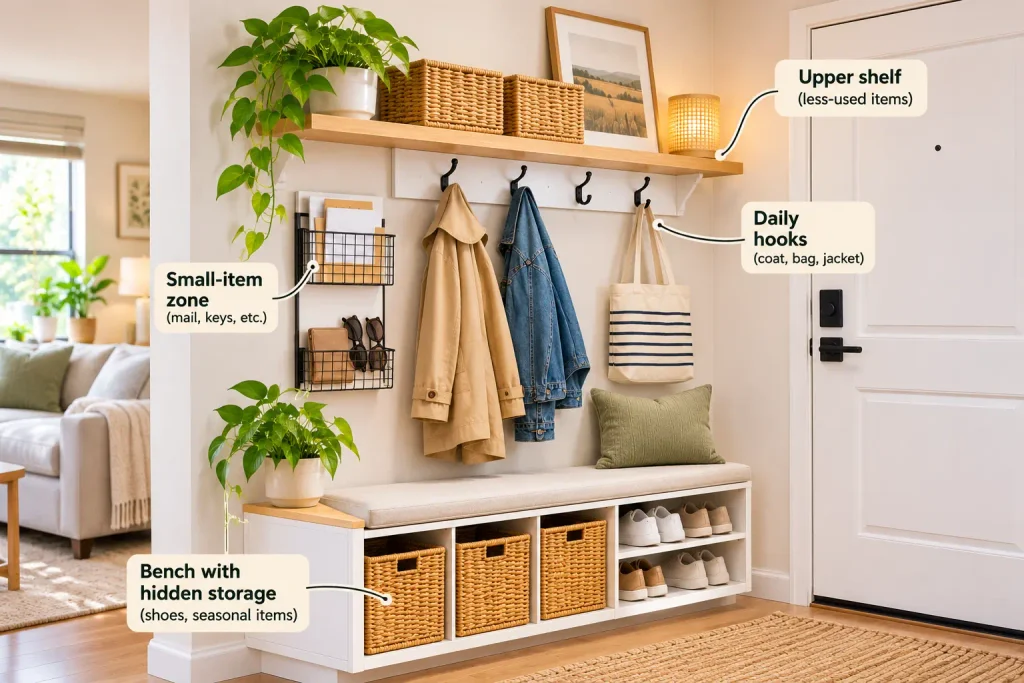
15. Build One Compact Entryway Storage Wall
When your apartment needs storage for coats, shoes, keys, and bags, consider concentrating those functions in one section of wall.
A simple setup might combine a shallow shelf for keys, a secure hook rail for outerwear, and a slim shoe cabinet below if the space and installation requirements allow.
This creates a clear storage zone rather than scattering small organizers across several walls.
It can work especially well in apartments where the entrance opens into the living room.
You don’t need every component. Start with the two biggest sources of clutter and build around them.
The best entryway storage wall is one that handles your everyday routine while leaving enough open space to move comfortably.
Which Wall-Mounted Storage Setup Works Best for Your Apartment?
The right solution depends on what makes your entryway difficult to use.
| Entryway problem | Storage to consider |
|---|---|
| Narrow hallway | Staggered hooks or a shallow floating shelf |
| No coat closet | Peg rail for daily outerwear |
| Shoes covering the floor | Securely installed slim shoe cabinet |
| Studio with no separate foyer | Compact storage wall |
| Keys and small items disappearing | Floating shelf or pegboard |
| Shared family entryway | Hooks at two heights |
| Rental with no drilling allowed | Suitable removable hooks for lightweight items |
If you aren’t sure where to start, identify the three belongings most likely to end up on the floor, a chair, or the kitchen counter.
Those items usually tell you what storage your entryway actually needs.
Can You Use Wall-Mounted Entryway Storage in a Rental?
Yes, although the installation method matters.
Removable adhesive hooks can be useful for lightweight items such as keys, hats, or small bags when drilling isn’t permitted.
However, weight limits vary by product. According to Command’s official guidance, proper surface preparation and following the product’s installation instructions are essential. Certain surfaces, including wallpaper and heavily textured walls, aren’t suitable for many adhesive products.
Never assume that using additional strips makes an organizer capable of supporting heavier loads.
For shelves, coat rails carrying heavy bags, and wall-mounted cabinets, use the installation method specified by the manufacturer. That may require screws, suitable anchors, or attachment to structural framing.
If those installations aren’t allowed under your lease, choose another storage approach rather than improvising an unsafe mounting method.
Remember that removable doesn’t always mean damage-free on every painted surface.
How to Keep Wall-Mounted Entryway Storage From Looking Cluttered
Getting belongings off the floor helps, but an overloaded wall can make an entryway feel just as crowded.
Three habits make the biggest difference.
Keep only current-season outerwear near the door. Jackets you rarely wear don’t need to occupy prime hook space.
Contain small accessories. One tray for keys or a basket for gloves is usually more useful than several containers spread along the wall.
Leave some wall visible. You don’t have to fill every empty space. A little separation between storage pieces keeps the entryway visually calmer, especially when it’s part of an open-plan living room.
If your new organizer is already overflowing, consider moving less-used belongings elsewhere before adding more hooks.
Common Wall-Mounting Mistakes to Avoid
A few installation decisions can make even attractive entryway storage inconvenient.
- Mounting too close to the door: Test the full door swing with coats or bags hanging in place.
- Ignoring loaded weight: Backpacks and work bags can be considerably heavier when filled.
- Choosing deep shelves: Check how far the shelf and its contents extend into the walking path.
- Using unsuitable hardware: Match fasteners to the wall construction, fixture, and expected load.
- Overloading the entryway: Keep rarely used shoes, extra bags, and off-season clothing somewhere else.
Wall storage should never obstruct the path needed to enter or leave your apartment, or access to required safety equipment.
A Small Entryway Doesn’t Need a Full Storage Wall
Good apartment entryway storage isn’t about fitting the most organizers onto a wall.
For some homes, a short peg rail will solve most of the problem. Others may need a shallow shelf, a few individual hooks, or a properly mounted shoe cabinet.
Start with what you use every day, measure the space carefully, and choose solutions that don’t crowd the walkway.
A few thoughtful changes can make the entrance easier to use without taking up another inch of floor space.