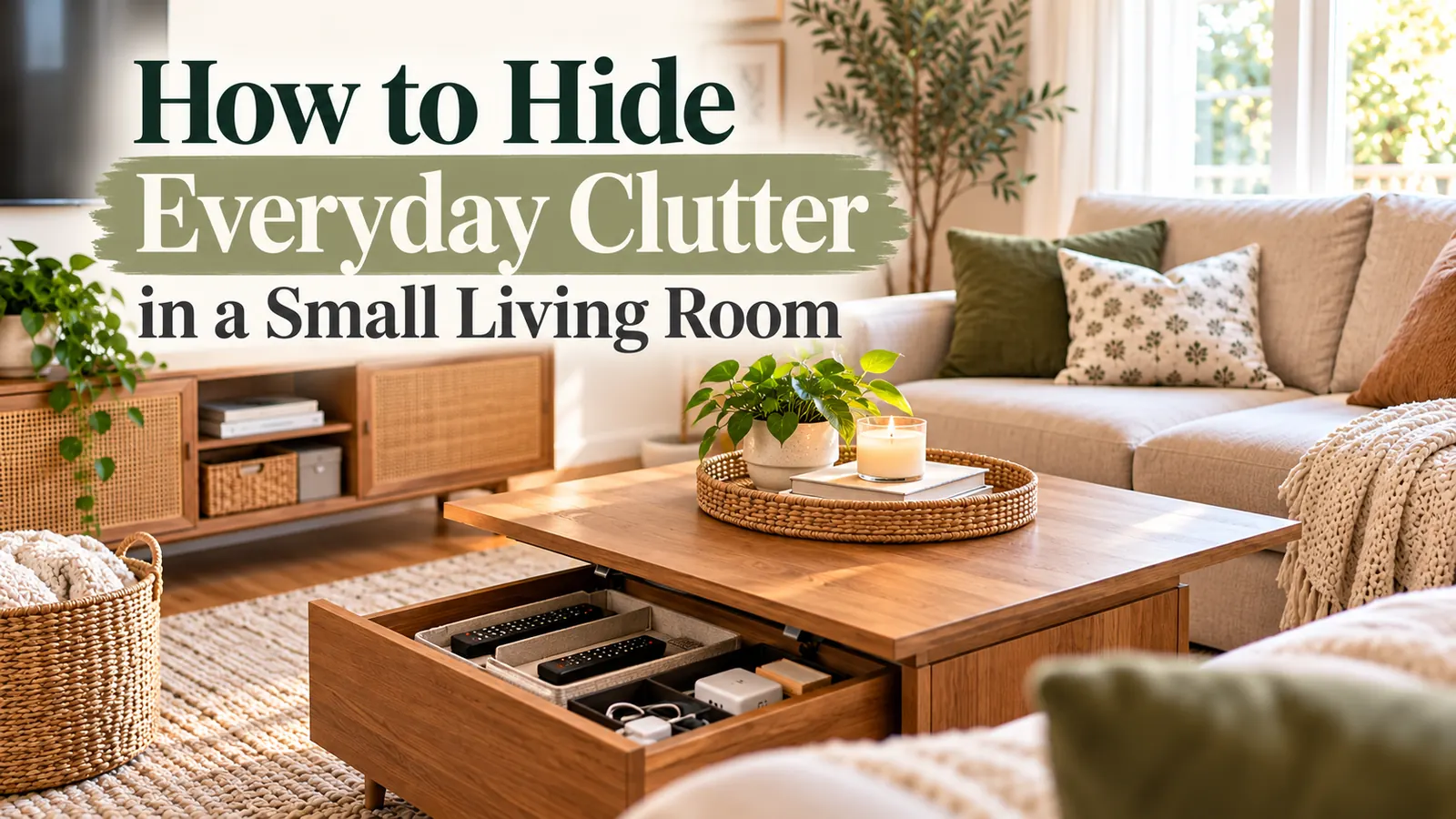
How to Hide Everyday Clutter in a Small Living Room
In a small living room, clutter rarely needs to be dramatic to take over the room. A remote, two charging cables, yesterday’s mail, and one unfolded blanket may be all it takes for every visible surface to feel occupied.
That does not necessarily mean you need more storage.
Good living room clutter organization starts by noticing which items repeatedly land in the room, where they are used, and how easy they are to put away. The goal is not to make your living room look untouched. It is to make everyday clutter easy to contain, easy to hide, and easy to reset.
Why Everyday Clutter Feels Bigger in a Small Living Room
Living rooms collect an unusual mix of belongings because they serve so many purposes.
You might watch TV, read, work on a laptop, fold laundry, play with the kids, charge devices, entertain guests, and relax with a pet in the same space.
Each activity brings its own small group of objects.
In a larger home, some of those things may migrate to an office, playroom, mudroom, or family room. In a small home or apartment, the living room often has to absorb several functions at once.
If your living room also doubles as a workspace, it helps to give work supplies their own small zone rather than allowing laptops, notebooks, and chargers to spread across the room. A simple approach to organizing a home office within the living room can keep work clutter from becoming permanent living-room clutter.
There is also less visual breathing room.
Five objects spread across a large room may barely register. Put those same five objects on a small coffee table and one narrow console, and suddenly every surface looks occupied.
That is why learning how to hide living room clutter is less about squeezing in as many containers as possible and more about controlling where everyday items are allowed to land.
Start With the Clutter That Actually Belongs in the Living Room
Before hiding anything, separate what is currently in the room into three simple groups:
- Used here: remotes, current books, blankets, game controllers, chargers, toys, or pet items.
- Belongs somewhere else: shoes, laundry, dishes, paperwork, or work supplies that already have another home.
- No longer needs a home: outdated magazines, dead batteries, empty packaging, broken toys, unused cords, and other items you can discard or donate.
This prevents one of the most common small living room decluttering mistakes: creating permanent storage for things that should not be living in the room at all.
For example, a beautiful lidded basket does not solve the problem if it slowly fills with receipts, old charging cables, paperwork, loose toys, and objects nobody knows what to do with.
You have simply created hidden clutter.
If the room is overloaded before you begin, remove obvious trash, relocate things that belong elsewhere, and edit what you no longer use before creating additional storage.
Once the unnecessary and misplaced items are gone, it becomes much clearer what genuinely needs a living-room home.
Give Recurring Clutter a One-Step Home
One of the most useful everyday clutter solutions is to make each item’s home require as few steps as possible.
If you use a TV remote every evening, storing it inside a decorative box with a tight lid, behind a cabinet door, on a high shelf sounds tidy but adds unnecessary effort.
Eventually, the remote ends up back on the sofa.
Instead, ask:
Where do I naturally use this item, and what is the easiest possible place to return it?
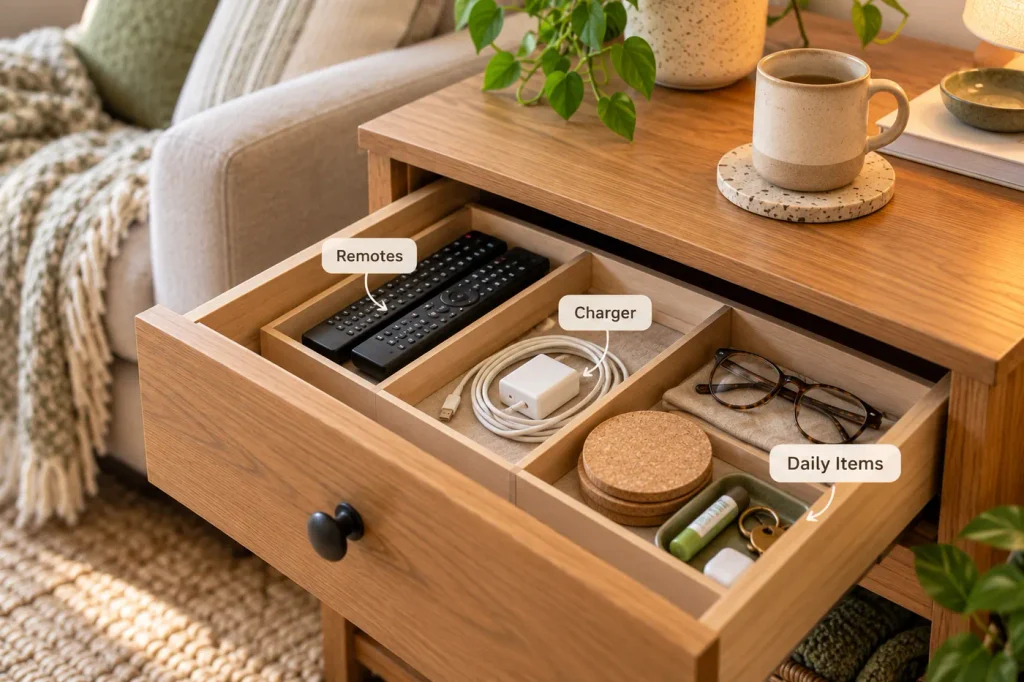
A shallow tray beside the sofa might work better for remotes.
A basket beside the reading chair may work better for current books.
A drawer next to the outlet may work better for charging cables.
The closer the storage is to the activity, the easier your living room clutter organization system will be to maintain.
Quick Guide: What Should Go Where?
| Everyday clutter | Best type of home | Avoid |
|---|---|---|
| Remotes | Small tray or shallow drawer | Large miscellaneous basket |
| Chargers | Drawer or cable spot near seating | Moving chargers between rooms |
| Temporary tray near where it enters | Permanent coffee-table pile | |
| Blankets | Easy-drop basket or compartment | Complicated folding system |
| Toys or pet gear | One container per activity | One giant mixed bin |
| Wrong-room items | Portable relocation basket | Giving them permanent living-room storage |
The important part is not whether every container matches. It is whether the system makes putting things away easier than leaving them out.
8 Ways to Hide Everyday Living Room Clutter
1. Give Remotes One Dedicated Landing Spot
Remotes are tiny, frequently used, and surprisingly effective at making a coffee table look messy.
Choose one spot for all of them.
This could be a shallow tray, the top section of a side-table drawer, or a small open box inside your media cabinet.
Avoid scattering remotes between multiple drawers or baskets. If everyone knows there is only one place to look, they are also more likely to return them there.
If the remote still ends up between the sofa cushions every night, the storage spot may simply be too far away.
Move it closer to where people actually sit.
2. Hide Chargers Where You Actually Use Them
Charging cables often become permanent visual clutter because the devices they serve are used constantly.
Instead of carrying chargers back and forth from another room, create a charging spot near the sofa or chair where phones and tablets are actually used.
A side table with a drawer works well because the cable can disappear when it is not needed.
If you already have a closed media cabinet, one small section can hold chargers and power banks.
The important part is to avoid creating a giant electronics basket filled with unidentified cords. Keep only the chargers currently used in the room here and store backups elsewhere.
3. Use One Closed Container for Coffee-Table Clutter
A coffee table becomes a clutter magnet when every small object is allowed to live on top of it individually.
Instead, contain the few things that legitimately stay there.
One small lidded box might hold a remote, reading glasses, lip balm, and coasters.
When the lid closes, the surface immediately looks calmer.
The container also creates a natural limit. If it is full, something needs to leave rather than another organizer being added.
If you have already used the obvious drawers and cabinets, look upward before adding another piece of furniture. A few carefully chosen shelves or wall-mounted solutions can create extra storage, but the goal is to use wall space without making the room feel busier.
4. Give Blankets an Easy Drop-In Home
Throw blankets are useful, cozy, and bulky.
They are also much more likely to be put away when storage does not require careful folding.
A floor basket, storage ottoman, or nearby compartment can work well for blankets that are used daily.
Think “drop in” rather than “fold perfectly.”
Seasonal or rarely used blankets should live somewhere else so the everyday container does not overflow.
5. Stop Mail and Paperwork From Settling in the Living Room
Paper clutter often looks like a living-room problem even when the real problem starts somewhere else.
Mail enters through the front door. School papers come out of a bag. Receipts arrive in pockets. Then everything gets placed on the nearest flat surface.
Instead of building a filing system beside the sofa, intercept paper closer to where it enters the home.
Create a small landing spot for incoming items and decide what needs action, filing, recycling, or shredding.
If paperwork still regularly reaches the living room, keep one slim temporary tray rather than letting loose sheets spread across the coffee table.
The idea is to control the flow, not give paper permission to permanently live in the room.
6. Contain Toys, Games, and Pet Gear by Activity
When multiple people use a small living room, one giant miscellaneous basket can become frustrating very quickly.
Instead, group items by activity.
You might have one basket for dog toys, one bin for building toys, or one shelf for board games.
The exact categories will depend on your household, but each one should have a clear boundary.
This makes cleanup faster because you are not carefully sorting every individual item. You are simply returning each category to its container.
7. Hide the Visually Messy Categories, Not Everything
Some belongings simply create more visual noise than others.
Charging accessories, game controllers, paperwork, toys, craft supplies, spare cables, and small electronics often look busy even when neatly arranged.
These are strong candidates for drawers, cabinets, boxes, and baskets.
Books, plants, ceramics, and a few favorite objects can stay visible.
This is where many living room organization ideas go wrong: either everything is left on display or everything is hidden.
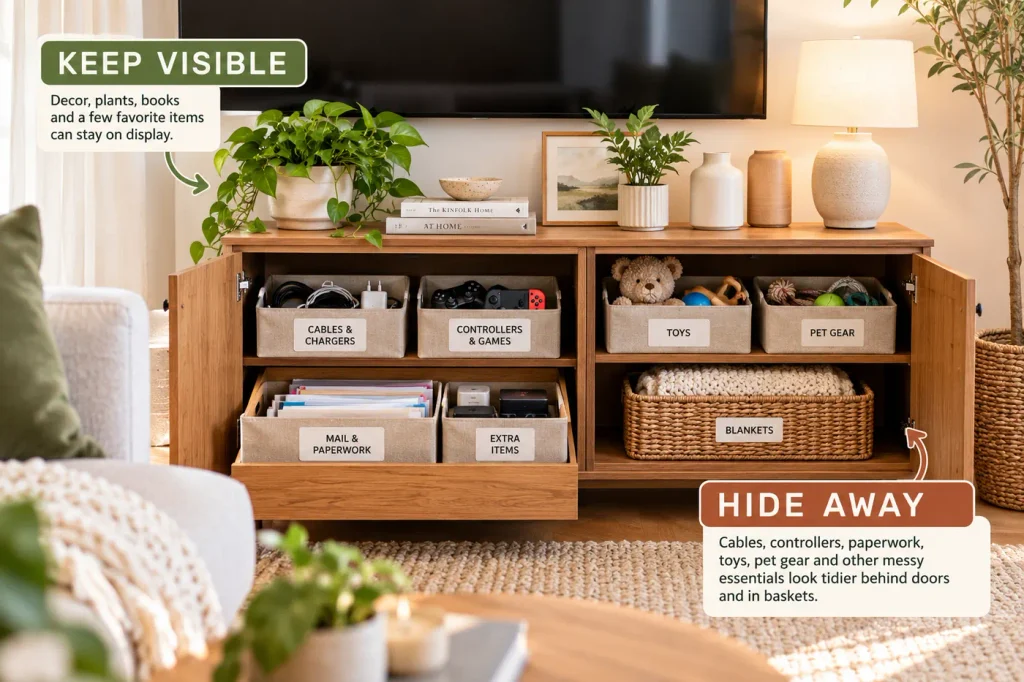
A calmer room usually needs a balance.
If you are unsure which categories should stay on shelves and which should disappear behind doors, it helps to think deliberately about what works better as open storage and what belongs in hidden storage rather than treating every shelf or cabinet the same way.
Small hotel rooms use a similar principle especially well. They tend to keep only a few useful or attractive items visible while less attractive necessities disappear into drawers, wardrobes, or compact cabinets. Borrowing a few small-space organizing ideas from well-designed hotel rooms can be useful when you want a living room to feel functional without looking crowded.
8. Create a Temporary “Belongs Elsewhere” Basket
Some clutter does not need a new living-room home at all.
It just needs to leave.
A small portable basket can collect items that belong somewhere else: socks, bedroom toys, a water bottle, a hairbrush, or something that needs to go back to the kitchen.
During your reset, carry the basket through the home and return the contents.
There is one important rule:
Empty it regularly.
Otherwise, it becomes another permanent miscellaneous bin.
Match Storage to How Often You Use the Item
One of the simplest ways to improve living room clutter organization is to organize by frequency rather than by what looks best in a photo.
🕛 Daily-use items
Keep them within easy reach.
Think remotes, current chargers, reading glasses, everyday blankets, or a child’s favorite toys.
These should require almost no effort to access or return.
📆 Weekly-use items
They can live slightly farther away or behind a door.
Board games, hobby supplies, extra device accessories, or entertaining items might fit into cabinets or higher shelves.
🗓️ Occasional items
Do not give your best living-room storage to things you use a few times a year.
Seasonal decorations, archived paperwork, rarely used electronics, and sentimental objects may belong in another zone entirely.
The most useful storage spaces should go to the things that create clutter on an ordinary day.
Do Not Let Hidden Storage Become Hidden Clutter
Being able to close a drawer does not automatically mean the drawer is organized.
Hidden storage works best when each container has a specific purpose and a physical limit.
A remote tray should hold remotes.
A blanket basket should hold blankets.
A toy bin should contain one manageable category of toys.
A media drawer should not quietly become the place where batteries, manuals, random cables, receipts, pens, sunglasses, and mystery objects go to disappear.
When a container starts overflowing, resist adding another container immediately.
Empty it first.
You may discover duplicates, items that belong elsewhere, or things you no longer use.
In a small room, storage limits can actually help. They keep everyday clutter from expanding indefinitely.
Try a 5-Minute Living Room Reset
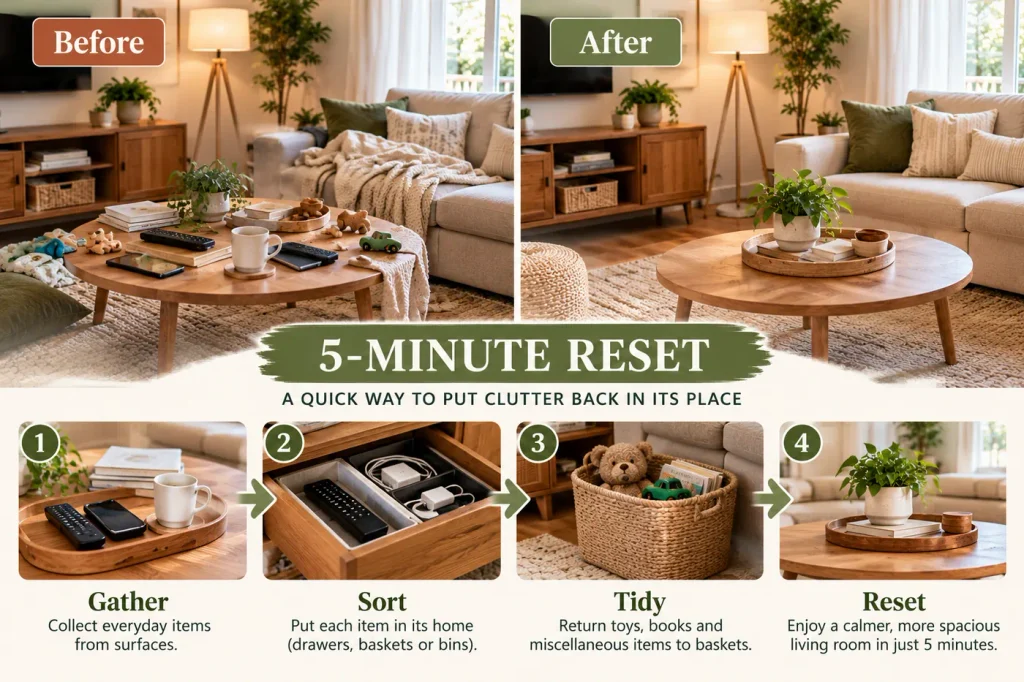
Even the best everyday clutter solutions need a quick reset.
At the end of the day:
- Clear anything that does not belong on the coffee table or sofa.
- Return remotes, chargers, books, toys, and blankets to their homes.
- Remove obvious trash or recycling.
- Add wrong-room items to the relocation basket.
- Straighten the main visible surfaces.
You are not cleaning the whole room. You are simply restoring the organizational baseline.
If this regularly takes much longer than five minutes, look at what slows you down.
If the remote never makes it back to its drawer, move the landing spot closer.
If the blanket basket is always overflowing, reduce what lives there.
If the relocation basket is always full, some belongings may need better homes elsewhere.
What a Clutter-Resistant Living Room Actually Looks Like
A well-organized small living room does not need to look minimal, staged, or empty.
There may still be a blanket on the sofa.
A book may be open beside your chair.
A child may have toys on the floor while playing.
Real life creates temporary mess.
The difference is that temporary mess has somewhere to go when the activity ends.
That is the real purpose of living room clutter organization: not hiding evidence that people live in the room, but making it easy to restore order without moving piles from one surface to another.
Start with the objects that appear every day. Give those items the easiest possible homes, hide the visually messy categories, and keep wrong-room clutter moving instead of storing it permanently.
When putting things away takes only a few simple movements, a small living room becomes much easier to keep calm.