
Small Living Room Storage That Does Not Look Like Storage
A small living room can run out of storage surprisingly fast. There are blankets, remotes, chargers, books, games, work supplies, toys, and all the little things that seem to migrate toward the sofa.
The obvious solution is to add more storage.
But in a small room, that can create a second problem: the storage itself starts to look like clutter.
Stacks of bins, rows of baskets, utility carts, and extra shelving may technically give everything a place while making the room feel busier than before.
The best small living room storage often works differently. It hides inside furniture you already need, blends into the decor, or quietly uses space that would otherwise go unused.
Instead of asking, “Where can I fit another organizer?” try asking:
Can something already in this room do two jobs?
That shift can create useful storage without making your living room look like a storage room.
The Trick: Make Storage Do Another Job
When floor space is limited, every piece of furniture has to earn its footprint.
A coffee table already takes up space, so a coffee table with drawers gives you storage without adding another object. An ottoman can provide seating, a place to put your feet, and a compartment for blankets. A closed console can hold electronics while hiding cords, games, and household supplies.
This is why multifunctional living room storage works so well in a small space: you are replacing a single-purpose piece rather than adding more furniture.
Before buying an extra cabinet or basket, look at what is already taking up space.
Could the open side table become one with a drawer?
Could the decorative bench contain storage?
Could the coffee table hide the things currently sitting on top of it?
Often, the least noticeable storage is storage built into something the room needed anyway.
12 Small Living Room Storage Ideas That Hide in Plain Sight
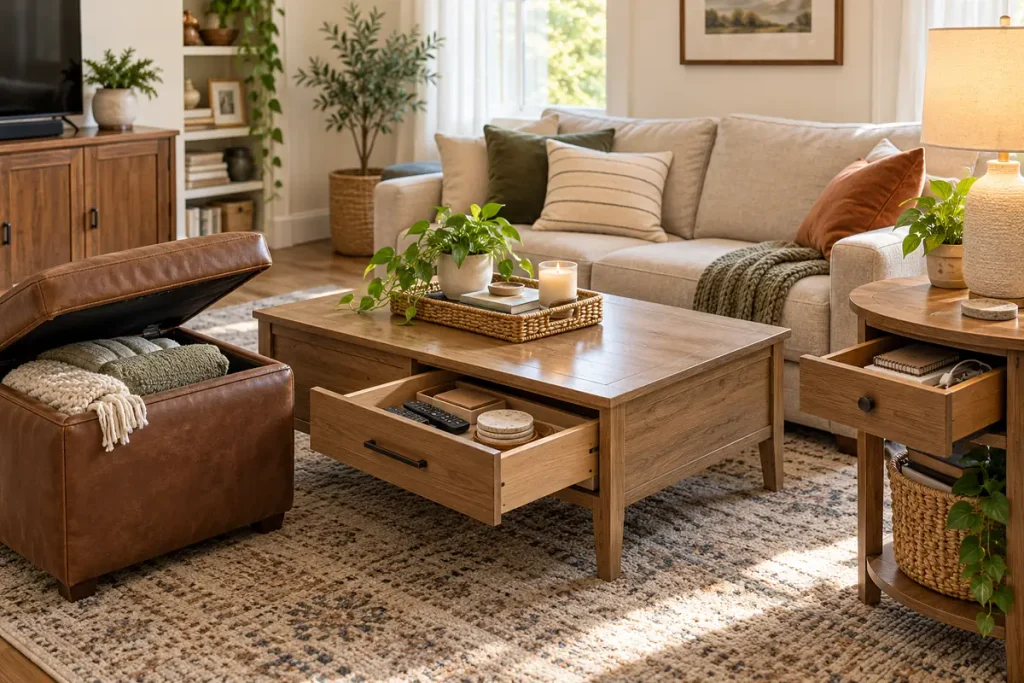
1. Choose a Coffee Table With Real Closed Storage
The coffee table sits in the middle of the living room, which makes it valuable storage territory.
Look for drawers, lift-up tops, or enclosed compartments rather than another open shelf that simply puts more objects on display.
A drawer works especially well for things you reach for while sitting down: remotes, charging cables, coasters, reading glasses, game controllers, and a current book.
The key is to give the compartment a specific job. A large hidden cavity can become just as chaotic as an exposed surface if everything gets tossed inside.
If your current table needs replacing anyway, this is one of the easiest ways to increase hidden living room storage without increasing the furniture footprint.
2. Swap a Basic Ottoman for a Storage Ottoman
An ottoman is another piece that can quietly work much harder.
A storage version can hold throw blankets, extra pillow covers, board games, or occasional items while still functioning as a footrest or extra seat.
For the room to feel intentional rather than storage-heavy, choose one that looks like normal upholstered furniture. Fabric, leather-look finishes, woven textures, and simple silhouettes usually blend more naturally into a seating area than a visibly utilitarian container.
One caution: do not treat a deep ottoman as a home for dozens of unrelated small objects. It is most useful for larger categories that are easy to lift in and out.
3. Let Your Media Console Hide More Than Electronics
A media console does not have to store only television equipment.
If yours has doors or drawers, part of it can become home to games, chargers, headphones, small exercise equipment, craft supplies, paperwork, or other things your household actually uses in the living room.
Closed fronts make a major visual difference because they allow one calm piece of furniture to replace several smaller organizers.
Use the easiest-to-reach sections for everyday items and reserve lower or deeper compartments for things you use less often.
If paperwork or computer accessories keep migrating into the console, it may be a sign that you need a home office that shares the living room rather than asking general storage to absorb work supplies.
4. Use a Side Table With Drawers Instead of an Open Base
Small open side tables look airy, but they offer almost no help with the objects that naturally collect beside a sofa.
A compact table with one or two drawers can hide the remote, charger, notebook, tissues, pens, and other small necessities while keeping the tabletop mostly clear.
You do not need a large cabinet-style nightstand in the living room. Even one shallow drawer can absorb a surprising amount of visual clutter.
This is a good example of storage that does not need to announce itself. To a guest, it is simply a side table.
5. Turn a Window Bench Into Hidden Storage
If your living room has a bay window, low window ledge, or unused stretch beneath a window, a storage bench can combine seating and concealed storage in one zone.
Drawers are useful when you want easy access without lifting cushions. A hinged seat works well for larger items that are used less frequently.
Keep the scale appropriate to the room. A huge bench packed into a tiny living room can cancel out the space-saving benefit.
The goal is not to fill every empty inch with cabinetry. It is to identify places where storage can replace another function, such as extra seating, rather than compete with it.
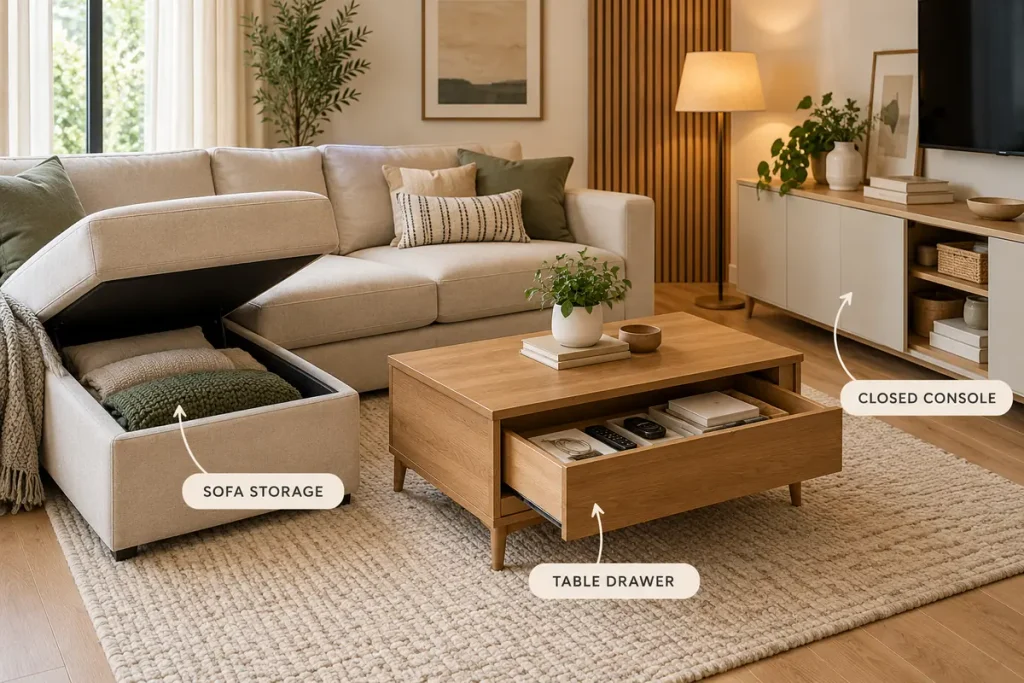
6. Choose a Sofa With Storage Under the Seats
If you are already replacing a sofa, built-in storage is worth considering—especially in an apartment without many closets.
Some sofas and sectionals include lift-up seat compartments or storage beneath a chaise. That space is well suited to bulky but lightweight items such as blankets, guest bedding, seasonal pillow covers, or rarely used soft furnishings.
This is storage you can barely see even when standing in the room.
However, replacing a perfectly good sofa solely to gain storage rarely makes sense. Multifunctional furniture is most useful when it replaces something you already need to buy.
7. Use a Console That Looks Like Furniture, Not an Organizer
A narrow console or credenza can create a useful closed-storage zone without looking like a bank of plastic drawers.
This works particularly well along an empty wall, beneath artwork, or in the transition between the living room and dining area.
Choose a piece that relates to the rest of your furniture through wood tone, shape, hardware, or color. It does not need to match exactly, but it should feel like part of the room.
Inside, it can hold less attractive necessities.
Outside, it still reads as furniture.
That distinction is important in a small room, where too many visibly different storage systems can make the space feel fragmented.
8. Hide Small Items Inside Decorative Boxes
Not everything needs a piece of furniture.
A decorative box on a shelf or console can hide small objects that would otherwise create a messy cluster: spare chargers, matches, adapters, batteries, cards, or gaming accessories.
The trick is moderation.
One or two boxes that work with the room can look intentional. An entire shelf filled with differently sized containers begins to look like an organizing system again.
Choose boxes because they solve a real category, not because an empty shelf seems to need another container.
9. Use Lidded Baskets Where Texture Adds to the Room
Baskets are useful, but they are most successful when they behave like decor rather than becoming the default destination for everything.
A large woven basket can work beautifully for blankets, extra cushions, or a single bulky category. A lidded version hides the contents completely.
Natural textures can also soften a room dominated by hard furniture surfaces.
What you want to avoid is a collection of baskets for unrelated odds and ends. Once every corner contains a different basket, the room starts to communicate “storage” very loudly.
Use fewer, larger containers with clearly defined jobs.
10. Fill an Awkward Nook With One Furniture-Like Cabinet
A narrow recess or awkward corner may be able to hold a slim cabinet that looks far calmer than several small containers scattered around the room.
Closed doors are particularly helpful for categories that are visually busy: craft supplies, children’s activities, cables, paperwork, pet supplies, or household overflow.
But measure before you buy.
A cabinet that technically fits can still make circulation uncomfortable or visually crowd a doorway.
Before adding anything to an awkward spot, check for wasted storage space first. What looks like an empty corner may be genuinely useful—or it may need to stay empty so the room can breathe.
11. Let a Storage Bench Replace Extra Seating
If you occasionally need another seat but cannot justify keeping an extra chair in a small living room, a storage bench can solve both problems.
Place one along a wall, under a window, or behind a dining-living transition if the layout allows.
Inside, keep items that do not require constant access. On top, add a cushion or one or two pillows so the piece feels like furniture rather than a storage trunk.
This works best when the bench replaces something—not when it joins a coffee table, ottoman, side tables, chairs, and several other pieces competing for the same small floor plan.
12. Use the Space Under Existing Furniture—Without Making It Obvious
The space beneath a sofa, console, or other raised furniture can sometimes hold shallow storage.
The important phrase is without making it obvious.
Clear plastic tubs sticking out from beneath the sofa may increase capacity, but they also make the room feel more like a storage zone.
Choose low containers that disappear completely behind the furniture line whenever possible, and use them for items you do not need every day.
If the storage remains visible, it may be better to rethink the approach or choose a container that visually belongs in the room.
What Makes Storage Look Like Clutter?

Storage can be perfectly organized and still make a small living room feel busy.
The problem is often not how many things you own, but how many visual storage signals the room contains.
A cube unit with six fabric bins. Three baskets beside the sofa. Clear tubs beneath a console. A rolling cart. Hooks on the wall. Open shelves full of little containers.
Each solution may work individually, yet together they create a room dominated by organizers.
A calmer approach is to consolidate.
Instead of five small storage pieces, one larger closed cabinet may do the job better. Instead of adding a basket beside an open side table, replacing the table with a drawer version may remove an object from the room.
Also pay attention to exposed contents. Cables, colorful packaging, toys, paperwork, electronics, and other visually mixed categories generally create more visual noise than books, ceramics, plants, or a few decorative objects.
That does not mean everything must disappear behind a door. It means closed storage is particularly valuable for the categories you do not actually want to look at.
What Should Be Hidden—and What Can Stay Visible?
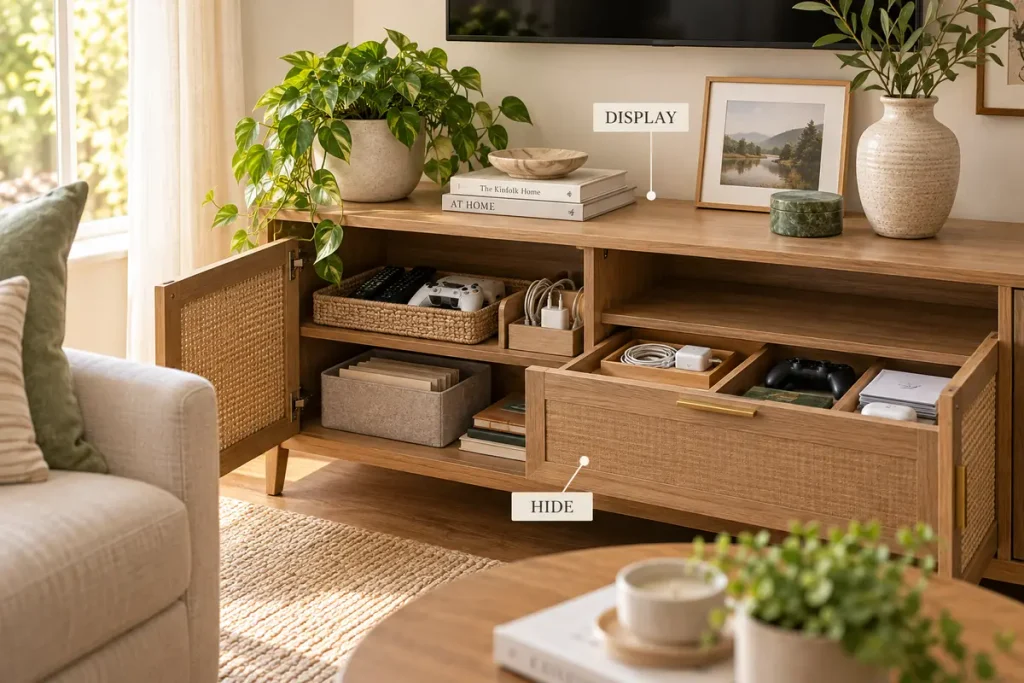
A simple way to decide is to ask whether seeing an item contributes something to the room.
A favorite book collection, a beautiful ceramic bowl, framed photos, plants, and a few objects you genuinely enjoy can make the space feel personal.
A tangle of charging cables probably does not.
Neither does a stack of instruction manuals.
Hidden storage is especially useful for everyday practical objects that are necessary but visually distracting.
Open storage works better for objects you intentionally want to see.
Most living rooms benefit from a combination of the two. Trying to display everything creates visual noise, while hiding absolutely everything can make a home feel strangely impersonal.
The goal is selective visibility.
Before You Buy More Living Room Storage
First, decide exactly what needs a home.
Do not start with an empty cabinet and then look for things to put inside it.
Gather the category that is causing the problem. Remove anything that belongs elsewhere or no longer needs to stay. Then estimate how much storage the remaining items actually require.
Next, consider how often you use them.
Daily items need storage that opens easily and sits close to where the activity happens. Weekly items can tolerate a drawer or cabinet. Seasonal items can go deeper or lower.
Finally, look for something already occupying the room that could be replaced with a storage version.
Replace before you add.
That one rule can prevent a lot of overcrowding in a small living room.
Make the Storage Easy to Reset
Storage only works if putting things away feels easy at the end of a normal day.
If every object has to be folded perfectly, stacked in a precise order, or moved past three other things before it can be returned, the system may look good after organizing day but fail during the week.
Keep the most-used items close to where they are used. Give them enough room that putting them back does not require rearranging the whole compartment.
And if the room still tends to accumulate cups, blankets, chargers, books, and small objects by evening, an easy living room reset can help the storage system stay functional without turning tidying into a major project.
The Goal Is Not to Hide Everything
A successful small living room does not have to look empty.
It should still contain books you love, a blanket you actually use, family photos, plants, artwork, and signs that real people live there.
Good storage simply gives the less attractive necessities somewhere to disappear.
When storage is built into the furniture, coordinated with the room, and assigned to specific categories, organization becomes part of the design rather than something layered on top of it.
And in a small space, that may be the most useful storage trick of all:
Make the room look furnished—not stored in.