
What to Remove Before You Buy More Storage
A crowded cabinet has a way of making a new set of bins look like the obvious solution.
So does a bedroom with nowhere to put sweaters, a living room full of small objects, or a bathroom vanity that seems to run out of room overnight. Add another basket. Install another shelf. Find a skinny cart that fits beside the cabinet.
Sometimes that is exactly what the space needs.
But in a small home, adding storage too early can solve the wrong problem. You may end up giving permanent space to duplicates, forgotten purchases, items that belong in another room, and things you were never particularly interested in keeping.
That is why it usually makes sense to declutter before organizing.
You do not need to empty your entire home or become a minimalist before buying a single basket. The goal is simpler: remove the things that are distorting your storage needs first. Then you can see what the space actually has to hold.
Here is what to look for before you decide you need more storage.
Why More Storage Is Often the Wrong First Move
Storage creates capacity. It does not reduce inventory.
The National Association of Productivity & Organizing Professionals (NAPO) describes professional organizing as a process involving evaluation, decision-making, and action around belongings and spaces. That is a useful reminder: deciding what deserves a place in your home matters just as much as finding somewhere to put it.
That distinction matters much more in a small home than it does in a house with a spare basement, deep closets, and unused cabinets.
Imagine a bathroom drawer holding four half-empty lotions, expired products, hotel toiletries, two broken hair clips, duplicates of things you forgot you owned, and the products you actually use each morning.
A drawer organizer can divide all of that beautifully.
The drawer is still too full.
Decluttering changes the amount the space has to hold. Organizing decides where the remaining items should live. Storage products come later, when you know there is a genuine containment problem left to solve.
The order is important:
Remove → group → assign a home → measure → add storage only if needed.
Starting at the other end often means buying containers for belongings that would have left the house anyway.
1. Remove the Things That Obviously Shouldn’t Be Stored
Begin with the easiest layer.
Before making decisions about sentimental items or possessions you might use someday, remove things that have no real case for taking up storage space.
Look for:
- Empty packaging
- Expired products
- Broken items you are not realistically repairing
- Missing-piece sets
- Old paperwork you no longer need
- Dried-out craft supplies
- Worn-out linens
- Containers without lids
- Lids without containers
- Electronics or cables that no longer work with anything you own
This is the fastest way to reveal hidden capacity.
A shelf that looked completely full may turn out to have usable room once the obvious debris disappears.
Do this before measuring for baskets or drawer organizers. Otherwise, you are measuring the space required by your clutter rather than the space required by your life.
Not everything you remove needs to go in the trash. The EPA’s household waste reduction guidance recommends donating or selling usable belongings and disposing of certain household materials properly. Set aside items for donation, recycling, or appropriate disposal as you declutter, rather than letting them become another pile to store.
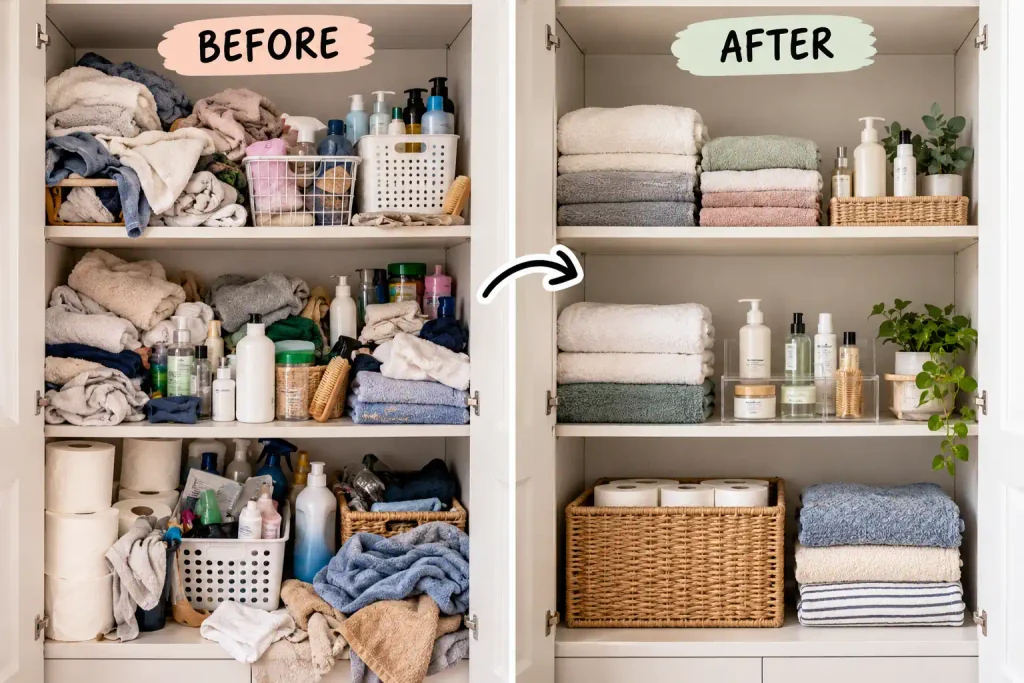
2. Get Duplicates Down to a Useful Number
Duplicates are one of the quietest storage problems in a small home.
One pair of scissors in the kitchen and another at a desk may be useful. Seven pairs scattered across different drawers probably are not.
The same pattern shows up with reusable shopping bags, mugs, food containers, water bottles, cleaning cloths, notebooks, charging cables, throw blankets, beauty products, and kitchen tools.
Gather similar items together before deciding how much storage the category needs.
You may discover that what looked like four separate storage problems is actually one oversized category.
The goal is not to keep only one of everything. It is to keep a quantity that reflects how your household actually functions.
Ask:
How many of these do we use between laundry cycles, grocery trips, dishwasher loads, or normal weekly routines?
That produces a much more useful limit than simply asking whether every individual item is still usable.
3. Remove Things That Belong Somewhere Else
Not everything making a space feel crowded is excess. Sometimes it is just in the wrong room.
A living room shelf may be holding paperwork that belongs near the desk, chargers that should live with electronics, toys that have drifted from a child’s room, or household tools that never found a proper home.
Before adding living-room storage, pull out anything whose main use happens elsewhere.
The same rule applies to multipurpose spaces. If your desk shares the living room, for example, only active work supplies should be competing for prime space. Creating a clear system for organizing a home office within the living room prevents office overflow from quietly becoming a living-room storage problem.
Relocating is different from hiding.
Do not carry a pile from one crowded room to another crowded room and call the first space finished. Give the category a logical home based on where it is actually used.
4. Question Your “Someday” Inventory
Small homes can hold surprisingly large collections of future intentions.
The jeans that may fit again.
The baking equipment for recipes you have not made in three years.
The fabric for a project you might start.
The guest bedding for guests you rarely have.
The packaging you saved because you may resell something.
The extra decor you might use after redecorating.
None of these items is automatically clutter. But “I may need it someday” should not automatically qualify something for permanent storage either.
Consider the cost of keeping it.
Not the purchase price, but the space cost.
If an object occupies half of your only bedroom shelf for three years while something you use every week has nowhere to go, the storage hierarchy is backwards.
A useful question is:
If I needed this six months from now and no longer owned it, how difficult or expensive would it actually be to replace?
Some items absolutely deserve the space.
Others are consuming today’s home for a hypothetical future.
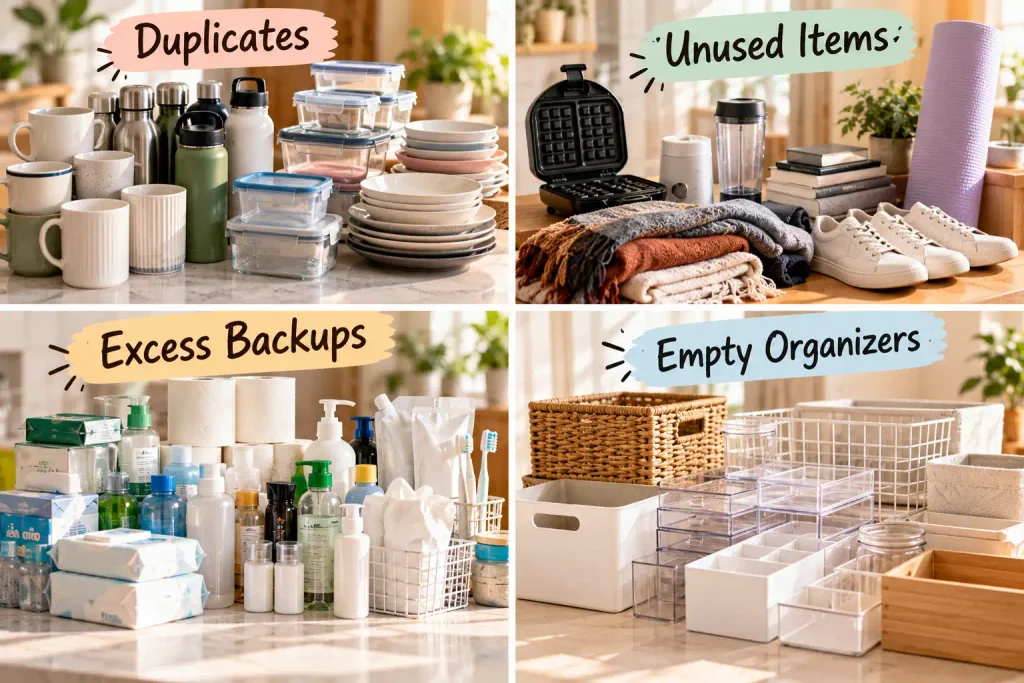
5. Cut Backups and Bulk Buys That Outgrew the Space
Buying in bulk can save money, but only when your home can absorb the inventory.
Ten rolls of paper towels tucked neatly into an existing cabinet may be sensible.
Ten rolls stacked beside the dining table because the cabinet is full are a different story.
Backstock becomes clutter when there is no defined space for it.
Check toiletries, cleaning supplies, pantry items, paper goods, pet supplies, laundry products, and household consumables. Keep enough backup stock to make your routine easier without turning several rooms into overflow storage.
This is especially helpful if you repeatedly buy something because you cannot see what you already own.
Before purchasing a bigger shelving unit, consolidate the category and use the existing supply.
You may need less storage simply because you stop storing six months of duplicates.
6. Remove Storage Products That Became Clutter
Storage products deserve to be decluttered too.
Small homes often accumulate:
- Baskets that no longer fit anywhere
- Empty plastic bins
- Drawer dividers from a previous setup
- Decorative boxes with no purpose
- Extra hangers
- Stackable organizers that did not work
- Small shelves waiting for the “right spot”
Keeping an organizer because it is an organizer does not make it useful.
In fact, empty bins can consume exactly the space you are trying to reclaim.
Pull unused storage products out of closets and cabinets. Keep only the pieces you have a realistic use for.
Then, before buying anything new, see whether one of those existing containers solves the problem.
The cheapest organizer is often the one you already own.
7. Reconsider Oversized Items
Sometimes the problem is not the number of things you own. It is their footprint.
A large serving platter used once a year can consume an entire kitchen shelf. An oversized hamper can block circulation in a tiny bedroom. A bulky filing cabinet may hold only one partially filled drawer.
Small homes benefit from paying attention to space efficiency, not just quantity.
Look for objects that require far more room than their usefulness justifies.
Can several mismatched food-storage sets become one stackable set?
Could an enormous laundry basket be replaced by a narrower version when it eventually wears out?
Could rarely used serving pieces be stored somewhere less accessible so daily items get the better shelf?
This is also where vertical storage can help—but only after you know what deserves to stay. If floor space is genuinely limited, you can use wall space without making the room feel busier by giving a small number of useful categories a deliberate place rather than covering every empty wall with shelves.
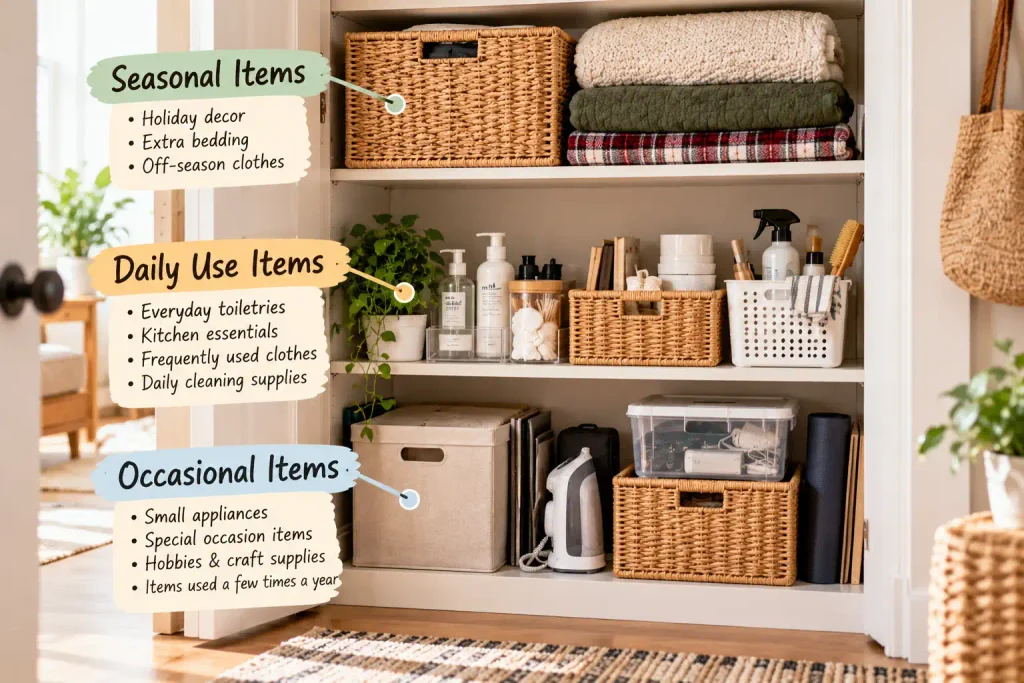
8. Separate Daily-Use Items From Occasional Items
Not every item needs equally convenient storage.
This mistake creates a surprising amount of crowding.
The waffle maker you use six times a year does not need the same accessibility as the coffee maker you use every morning. Extra towels do not need the same shelf position as the towels in current rotation.
Divide what remains into three simple levels:
- Daily or weekly use: Keep these easiest to reach.
- Occasional use: Store higher, lower, or farther back.
- Seasonal or rare use: Give these the least valuable storage locations.
This one change can make existing cabinets feel significantly more functional without adding capacity.
It also helps when deciding between visible and concealed systems. Frequently used, visually simple items can work well in the open, while mixed or irregular categories are often easier on the room when contained. A useful next step is deciding what works better as open storage and what belongs in hidden storage instead of defaulting to one approach throughout the room.
9. Let the Space Set the Limit
A container should hold a category.
It should not become permission for the category to keep expanding.
If one drawer is the designated home for dish towels, that drawer gives you a useful boundary. If the towels no longer fit comfortably, reconsider the towels before adding a second towel drawer.
The same principle works for:
- Books
- Shoes
- Toys
- Pantry snacks
- Beauty products
- Hobby supplies
- Cleaning products
- Seasonal decor
This is especially useful in small homes because physical boundaries make abstract decisions easier.
Instead of asking, “Do I like every one of these?”
Ask:
Which ones deserve the space available for this category?
That small change turns decluttering into a practical space decision rather than a test of whether an object is technically good enough to keep.
10. Shop Your Home Before Shopping for Organizers
Once the excess is gone, group what remains and see what you already have.
A shallow bowl can become an entryway catchall.
A small box can divide a deep drawer.
An unused basket can hold workout gear.
A tray can define a group of products inside a cabinet.
This does not mean every home has to be organized with recycled cardboard boxes. Buy a better-looking or more durable solution when it improves the space.
Just do not buy it before you understand the job it needs to perform.
Well-designed small spaces tend to use fewer, more intentional storage zones rather than a container for every object. You can see the same principle in small-space organizing ideas borrowed from well-designed hotel rooms: keep the things people actually need easy to access, reduce visual noise, and avoid filling every available surface simply because it exists.
11. Measure What Remains, Not What You Started With
This is the point where buying storage finally becomes useful.
Measure:
- The usable width
- The usable depth
- The height between shelves
- Door and hinge clearance
- Drawer depth
- Walking clearance around furniture
- The actual volume of the category you are storing
Then choose an organizer for a specific problem.
Not “I need more storage.”
Instead:
I need a container no more than 10 inches deep that keeps six baking supplies together on this shelf.
Or:
I need a narrow closed cabinet for the board games we decided to keep because the existing shelves are already assigned to books.
Specific storage problems produce better purchases.
Vague storage problems produce more stuff.

When More Storage Really Is the Right Answer
Decluttering is not a magic trick that makes every storage shortage disappear.
Sometimes you really do have more useful belongings than your existing storage can handle.
More storage probably makes sense when:
- Everything you are keeping has a clear use.
- Categories have already been consolidated.
- Duplicates and excess backstock are under control.
- Items already have logical zones.
- You are still stacking things unsafely or losing access to what is behind them.
- Everyday items have to remain on counters because no appropriate storage exists.
- The home has genuinely unused vertical, under-furniture, or concealed space.
At that point, additional storage is solving a defined physical problem rather than postponing a decluttering decision.
That is the difference.
A new shelf can be extremely useful when you know exactly what belongs on it.
It is much less useful when the plan is simply to make the current piles disappear.
A Quick Check Before You Buy Another Storage Product
Before adding a basket, cabinet, shelving unit, cart, or organizer, ask:
- What exact category will this hold?
- Have I removed broken, expired, unwanted, and duplicate items first?
- Does everything in the category actually belong in this room?
- Can I reduce excess backup stock?
- Do I already own a container that could work?
- Is unused storage space available somewhere else in the room?
- Have I measured the edited category and the space?
- Will this make things easier to access—or simply easier to hide?
If you can answer those questions clearly, you are probably ready to shop.
If you cannot, spend a little more time editing first.
The Small-Home Rule: Reduce Before You Add
A small home does not need endless empty space to feel organized.
It needs enough breathing room for the things you actually use.
That is why the most useful habit is not refusing to buy storage. It is refusing to buy storage before you know what deserves to be stored.
Declutter before organizing, group what remains, let the available space create reasonable limits, and then add containers or furniture only where a real gap remains.
You may still end up buying the basket.
But now it will hold something intentional instead of helping unnecessary clutter stay a little longer.