
Where to Store Toilet Paper in a Tiny Bathroom
A 12-pack of toilet paper can swallow half the storage in a tiny bathroom. Leave the spare rolls on the floor, and suddenly the space feels even tighter.
The trick isn’t finding a bigger organizer. It’s keeping just enough toilet paper close to the toilet and giving the rest a home somewhere else.
Whether you have a narrow gap beside the toilet, an empty wall, or a small vanity cabinet, these toilet paper storage ideas for small bathrooms will help you find a spot that stays dry, accessible, and out of the way.
The Best Toilet Paper Storage Spots at a Glance
Before buying anything, look at what your bathroom already has. A few inches beside the toilet might be more useful than an entire shelf across the room.
| Storage spot | Best for | Main consideration |
|---|---|---|
| Small floor basket | Easy access | Keep away from wet floors |
| Shelf above toilet | Limited floor space | Avoid deep, crowded shelves |
| Wall-mounted basket | No cabinet or vanity | Secure mounting |
| Under the sink | Hidden backup storage | Protect against leaks |
| Slim toilet paper stand | Narrow gaps | Check knee and foot clearance |
| Toilet tank | One or two spare rolls | Keep tank lid accessible |
| Narrow closed cabinet | Concealed storage | Allow room for doors |
| Back of the door | Renters and unused space | Check door clearance |
| Outside the bathroom | Bulk packages | Choose a dry, convenient location |
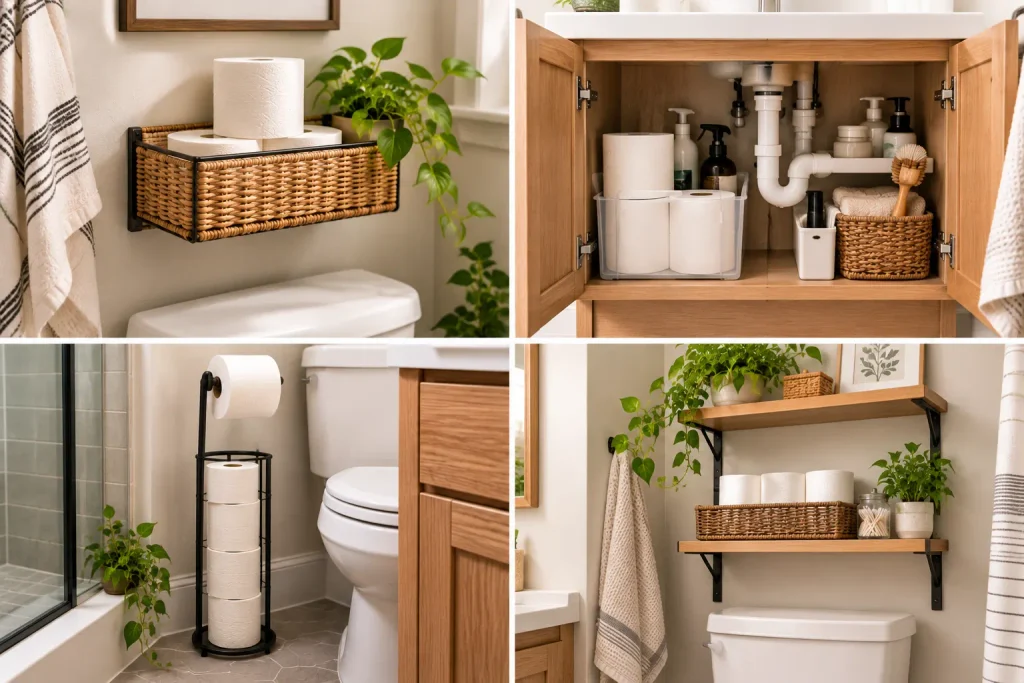
You probably only need one of these solutions, plus a separate place for the bulk package.
First, Decide How Many Rolls Actually Need to Stay in the Bathroom
A tiny bathroom doesn’t have to hold the entire package you bring home from the store.
Start with a simple division:
- One roll in use: On the regular toilet paper holder.
- Two or three backup rolls: Somewhere easy to reach near the toilet.
- The remaining package: In a linen closet, laundry cabinet, bedroom closet, or another dry storage area.
Adjust the number of backup rolls to your household. A busy family bathroom may need more than a guest bathroom used occasionally.
For example, if a 12-pack currently occupies most of the cabinet beneath your sink, moving nine rolls to a hallway closet could free that cabinet for everyday toiletries.
You haven’t added any storage. You’ve simply stopped asking the bathroom to hold everything.
9 Places to Store Toilet Paper in a Tiny Bathroom
1. Tuck a Small Basket Beside the Toilet
A small basket is often all you need when there’s a little room beside the toilet.
Choose one that fits two or three rolls rather than a large basket designed to hold the entire package. A narrow rectangular basket may fit against the wall better than a round one.
This is especially useful in a guest bathroom, where visitors shouldn’t have to search through cabinets for a replacement roll.
One detail matters: if the shower regularly leaves the floor wet, skip an open floor basket. Damp toilet paper isn’t worth the convenience.
2. Add a Shallow Shelf Above the Toilet
The wall above the toilet is often one of the few unused surfaces in a small bathroom.
A single shallow shelf can hold a compact basket of spare rolls without taking up floor space. It can also make better use of a blank wall without requiring a large shelving unit.
Keep the arrangement restrained. A deep shelf packed with towels, toiletries, and toilet paper may make the area feel more crowded.
Make sure the shelf is securely mounted, doesn’t interfere with using the toilet, and leaves enough clearance to access the tank.
If you’re planning to organize more than toilet paper in this area, consider other over-the-toilet storage options rather than automatically adding more shelves.
3. Mount a Small Basket on the Wall
A wall-mounted basket is a good middle ground between a floor basket and a shelf.
It holds the spare rolls in one place while leaving the floor clear for cleaning. You can position it beside the toilet at a comfortable height rather than reaching behind you or across the bathroom.
Look for a shallow basket that won’t protrude into the walkway.
For renters, some lightweight holders can be installed with bathroom-rated removable adhesive hardware, provided the surface and weight limits are suitable. Heavier baskets should be securely mounted according to their instructions.
4. Use a Small Bin Under the Sink
If your bathroom has a vanity, this may be the easiest way to keep extra toilet paper out of sight.
A small handled bin makes it easy to pull the rolls forward without rearranging everything beneath the sink.
But don’t squeeze the bin directly beneath plumbing connections. Leave shutoff valves accessible, and keep the paper away from any area that has leaked or collected condensation.
Imagine a vanity with cleaning products on one side and a small open area on the other. A removable bin holding four spare rolls can use that open area without turning the entire cabinet into toilet paper storage.
If the vanity is already full of things you use every day, though, move the bulk supply elsewhere.
5. Choose a Slim Vertical Toilet Paper Stand
Some bathrooms have an awkward narrow gap between the toilet and the wall. It’s too small for a cabinet but just right for a compact toilet paper stand.
Vertical stands can hold several spare rolls while using relatively little floor space. Some also combine the active roll holder and backup storage in one piece.
Before buying, check the full footprint, including the base.
A stand that fits the gap but sticks into your foot space will become irritating every time you use the toilet.
Also consider cleaning. If you have to move the stand constantly to mop or wipe the floor, a wall-mounted option may work better.
6. Keep One or Two Rolls on the Toilet Tank
The toilet tank can provide a little extra surface area when the bathroom has almost nothing else.
A small, stable tray or basket can hold one or two rolls without creating a messy stack.
This is best for bathrooms where the tank is away from shower spray and has a reasonably flat top.
Don’t place a large container there or block access to the tank lid. You’ll want to remove it easily if the toilet needs maintenance.
Think of this as backup storage for a couple of rolls, not a permanent home for a multipack.
7. Hide the Rolls in a Narrow Cabinet
If you prefer a bathroom with fewer things on display, a narrow cabinet can be worth the footprint.
A shallow cabinet can hide toilet paper alongside period products or a few other bathroom essentials. Keeping these supplies behind a door helps the room feel calmer, particularly when towels and toiletries are already visible.
But a cabinet isn’t automatically better than a basket.
Check whether there’s enough space to open the door and whether the cabinet will interfere with walking, sitting, or cleaning.
If the only available spot is a tight walkway, skip the cabinet. A couple of exposed rolls are less disruptive than furniture you constantly have to maneuver around.
8. Use the Back of the Bathroom Door
The back of the door can hold a compact hanging organizer when walls and cabinets are already occupied.
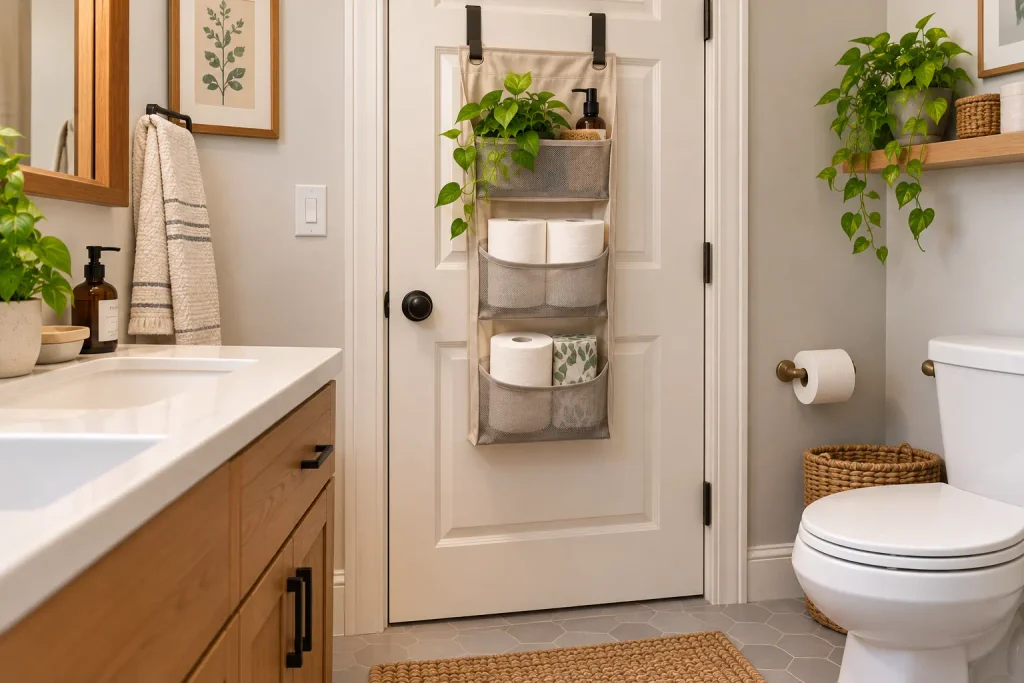
This is especially useful in rentals, where drilling may not be an option.
A small over-the-door organizer with pockets large enough for toilet paper rolls can work without adding another piece of furniture.
Choose a lightweight design and check that the door still closes properly. Thick hooks, bulky pockets, or a swinging organizer can make a narrow bathroom more awkward to use.
Also consider accessibility. This is better for backup rolls than for the roll someone needs immediately while seated.
9. Move the Bulk Package Outside the Bathroom
This may be the most useful change of all.
A bathroom with no vanity, a shower directly beside the toilet, and barely enough floor space for a trash can probably shouldn’t store a large package of toilet paper.
Keep one or two backups inside. Put the rest somewhere dry and easy to reach.
A hallway closet is ideal, but a bedroom closet shelf or laundry cabinet can work just as well.
If you buy toilet paper in large quantities, you can even divide the package between two storage spots rather than forcing it into one crowded cabinet.
The goal is to make refilling easy, not to keep every roll within arm’s reach.
Which Storage Setup Works Best for Your Bathroom?
Instead of choosing by appearance alone, start with your bathroom’s biggest limitation.
| Your bathroom | What to try |
|---|---|
| No vanity or cabinet | A small wall basket or shallow shelf, with bulk rolls stored elsewhere |
| Small vanity available | A removable bin beneath the sink, away from plumbing connections |
| Narrow gap beside toilet | A slim vertical stand that doesn’t interfere with sitting or cleaning |
| Shower close to toilet | Enclosed storage away from splash zones |
| Rental with limited wall space | A compact over-the-door organizer or suitable adhesive-mounted holder |
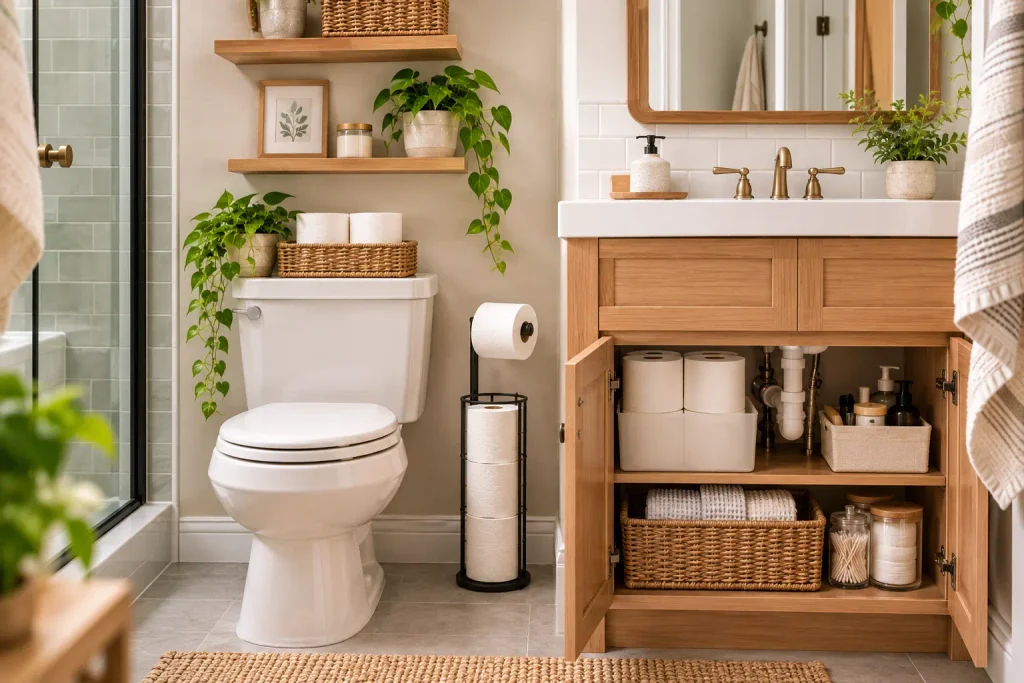
For a tiny rental bathroom with no vanity, for example, the simplest setup might be a regular toilet paper holder, two spare rolls in a wall-mounted basket, and the remaining package in a bedroom closet.
No additional floor storage required.
A Space-Saving Alternative: Wall-Hung Tissue Packs
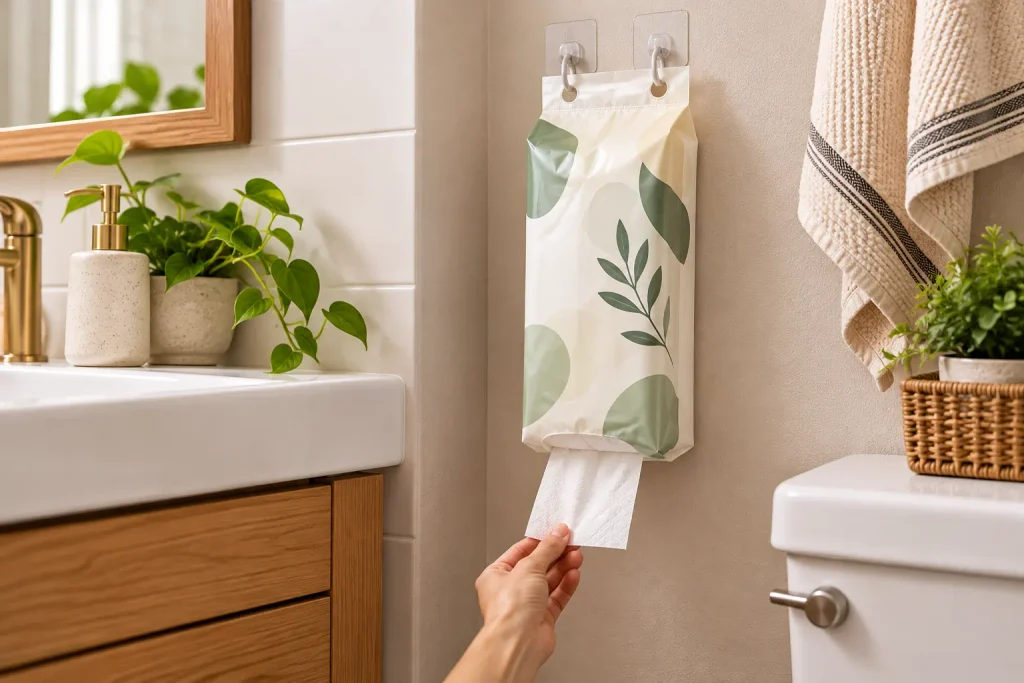
There’s another small-space idea worth borrowing from bathrooms in parts of Asia.
Some soft-pack tissue products have hanging holes near the top and a dispensing opening underneath. The entire pack can hang from small wall hooks, allowing sheets to be pulled out from the bottom.
It’s a clever use of vertical space. The pack stays off the counter and floor, doesn’t need a bulky dispenser, and can be replaced when empty.
The packaging also provides some protection from incidental contact, although it is not waterproof. The pack should still be kept away from direct shower spray and persistent moisture.
This format is less familiar in typical U.S. residential bathrooms than conventional toilet paper rolls, but the storage mechanism is worth considering when space is extremely limited.
There is one important distinction: many soft-pack products contain facial or multipurpose tissue, not toilet paper. Do not flush ordinary facial tissues or other paper products that aren’t intended to be flushed. If you want to use this setup as toilet tissue, choose a compatible product specifically designed for that purpose and follow its disposal instructions.
For renters, also check that the hooks are appropriate for the wall surface, the weight of a full pack, and humid conditions.
Keep Toilet Paper Dry and Easy to Reach
A clever storage spot isn’t useful if the rolls end up damp or nobody can reach them.
Avoid placing loose rolls on floors that regularly get wet, directly beside shower spray, or beneath plumbing connections that may leak.
Open baskets work best in consistently dry areas. If your bathroom stays humid for long periods, a closed container or storage outside the bathroom may be more practical. The same moisture problem matters when organizing towels in a humid bathroom, although towels need room to dry rather than sealed storage while damp.
And remember who uses the bathroom. A shelf above the toilet may look tidy, but at least one replacement roll should be easy for household members to reach.
A Small Bathroom Only Needs a Small Backup Supply
You don’t have to design your bathroom around a large package of toilet paper.
Find one dry, convenient spot for the next couple of rolls, then give the extras a home somewhere else. Even in a bathroom with almost no storage, that small change can make the space easier to use every day.