12 No-Drill Wall Storage Ideas for Renters
In a small rental, blank wall space can feel like storage you are not allowed to use. Traditional shelves usually mean screws, anchors, and holes—but those are not your only options.
The best no-drill wall storage ideas use removable adhesives, suction, tension, or other temporary mounting methods to move lightweight everyday items off crowded counters and floors.
The key is choosing the right method for both the surface and the load. A removable hook that works perfectly for keys is not automatically a safe way to support a shelf full of books.
Here are 12 renter-friendly ways to make your walls more useful without committing to permanent installation.
Before You Add Storage to a Rental Wall
“No drill” and “damage-free” are not exactly the same thing.
Removable storage can still cause problems when it is attached to peeling paint, wallpaper, textured plaster, an incompatible finish, or a surface the product was not designed for.
3M Command, for example, recommends using its adhesive products on clean, dry, smooth surfaces and cautions against using them on wallpaper, brick, rough concrete, or heavily textured walls. Weight limits and removal instructions also vary by product.
Before installing anything:
- Check your lease if wall attachments are restricted.
- Check the mounting product’s approved surfaces.
- Be especially cautious with older paint, delicate finishes, and wallpaper.
- Stay comfortably within the manufacturer’s stated weight limit.
- Avoid hanging heavy, fragile, valuable, or irreplaceable objects.
- Follow the removal instructions instead of pulling adhesive hardware straight away from the wall.
Think of temporary wall storage as light-duty organization, not as a universal replacement for properly anchored shelving.
12 No-Drill Wall Storage Ideas That Actually Use Your Walls
1. Build an Everyday Drop Zone With Removable Hooks
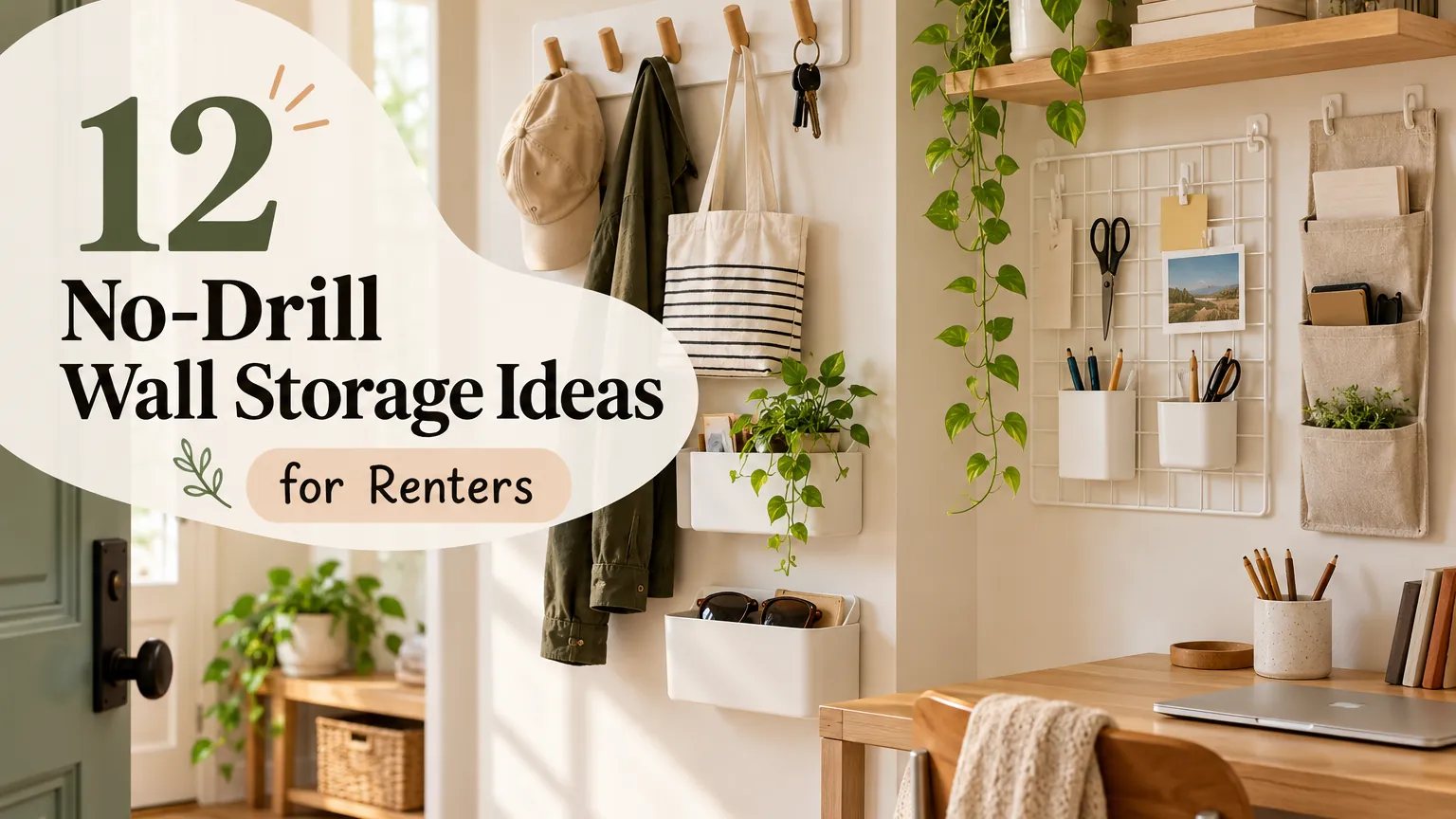
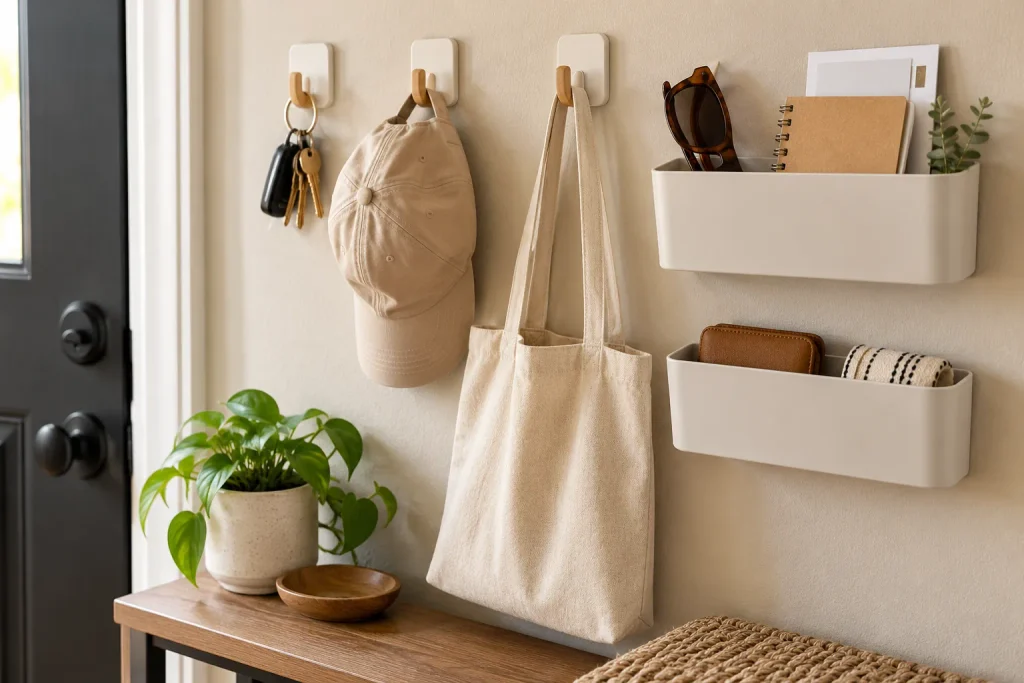
A short row of removable hooks can turn an otherwise unused strip of wall into useful everyday storage.
This works especially well near an entryway, beside a closet, or next to a desk.
Use the hooks for lightweight items you reach for constantly:
- Keys
- Caps
- Reusable shopping bags
- Dog leashes
- Headphones
- Lightweight totes
Instead of scattering hooks wherever something happens to fit, line them up intentionally at one height or create two short rows. The arrangement will look more like an organization system and less like temporary hardware.
Leave some breathing room between items, too. Filling every hook can make a tiny entryway feel more cluttered than it did before.
If the wall is only one part of your storage problem, there are plenty of broader renter-friendly storage options that use floors, furniture, closets, doors, and other overlooked areas without permanent remodeling.
2. Add Adhesive Baskets for Things That Cannot Hang
Hooks are useful, but many small items simply do not hang well.
Lightweight adhesive baskets or caddies can create a home for things that otherwise collect on a counter, desk, or dresser.
They can work for:
- Charging cables
- Remote controls
- Hair accessories
- Cleaning cloths
- Small toiletries
- Notebooks
One small basket beside a desk, for example, can hold the cables and accessories that usually spread across the work surface.
Give each basket one clear job rather than treating it like a floating junk drawer.
Also pay attention to the combined weight. Five very light items can become surprisingly heavy once they are all stored together.
3. Create a Modular Rail With Hooks and Small Containers
If several individual hooks start to look scattered, a lightweight no-drill rail system can make the wall feel more intentional.
Some temporary systems are designed to hold movable hooks, cups, or small containers along one horizontal rail.
A modular rail can work:
- Above a compact desk
- Beside an entry console
- Near a vanity
- In a lightweight craft station
Its biggest advantage is flexibility. You can rearrange small accessories without creating a completely new wall setup every time your needs change.
Check the mounting method before buying, though. Many rails that look renter-friendly in photos still require screws. Choose a system specifically designed for the temporary mounting method you intend to use.
4. Use a Small Adhesive Shelf Where a Full Shelf Would Be Too Much
Sometimes you do not need a conventional wall shelf at all.
A small adhesive shelf may provide just enough room for one or two lightweight essentials without taking floor space or requiring anchors.
Consider one:
- Beside the bed for a phone
- Near the front door for sunglasses
- Beside a desk for a small supply container
- Near a vanity for lightweight daily items
The smaller the shelf, the easier it is to keep its purpose clear.
Avoid gradually loading it with books, glass jars, heavy bottles, ceramic planters, or expensive electronics simply because there is still physical room on the shelf.
For temporary wall storage, a small dedicated landing spot is often more useful than trying to imitate permanent shelving.
5. Use Suction-Cup Storage on Smooth Tile, Glass, or Mirrors
In bathrooms and some kitchens, adhesive is not always necessary.
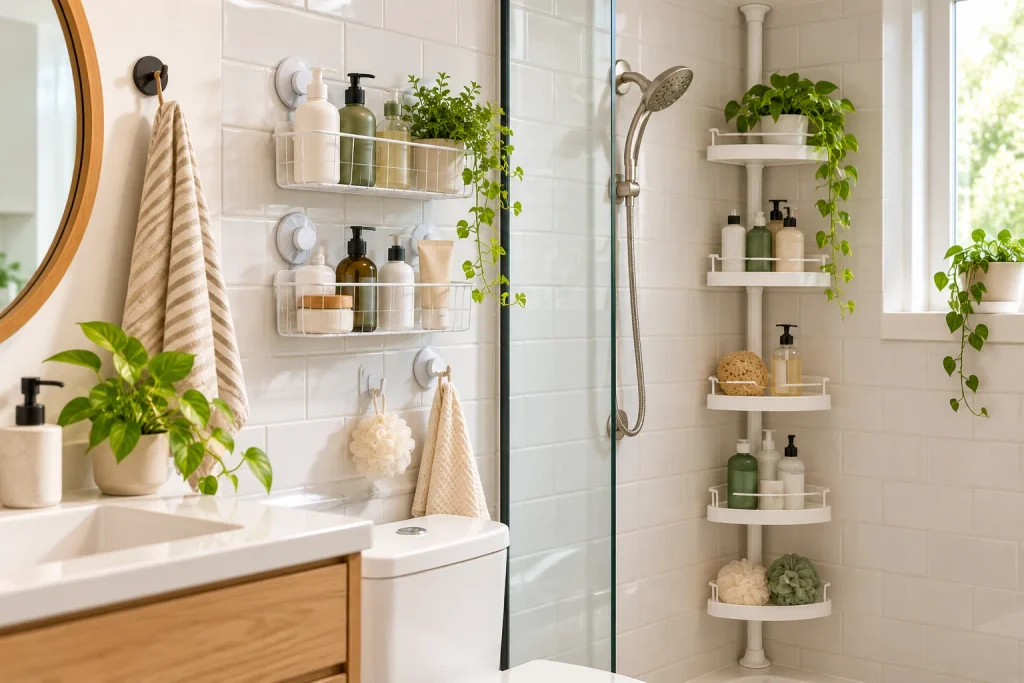
Smooth, nonporous surfaces can work with suction-mounted hooks, baskets, and small shelves.
IKEA’s TISKEN system, for example, is designed for smooth surfaces such as tile, glass, and mirrors and installs without drilling.
Suction storage can be useful for:
- Shampoo and body wash
- Razors
- Washcloths
- Toothbrush supplies
- Lightweight cleaning tools
- Small sink-side essentials
It can also be easier to reposition than an adhesive organizer when your routine changes.
The important limitation is the surface. Painted drywall, uneven tile, porous stone, grout lines, and textured finishes behave very differently from smooth glazed tile or glass.
6. Use Slim Wall Bins in Narrow Dead Space
Some of the most useful wall space in a small home is not a big blank wall. It is a strip that is too narrow for furniture.
Think about:
- Beside a vanity
- Between a desk and doorway
- Next to an entry console
- Beside a closet
- Between two pieces of furniture
A narrow removable bin or lightweight wall container can turn that awkward strip into storage for small everyday items.
Depending on the room, it might hold:
- Gloves and sunglasses
- Small cleaning cloths
- Notepads
- Hair accessories
- Charging cables
- Lightweight toiletries
This works best when the bin is shallow enough that it does not interfere with walking paths or make the room feel tighter.
The goal is to capture genuinely wasted wall space—not to fill every narrow gap just because you can.
7. Make a Lightweight Wall Pocket for Paper Clutter
Paper is relatively light, which makes it a good candidate for temporary wall storage.
A hanging file pocket or lightweight document holder can move paperwork off a tiny desk, console, or kitchen counter.
Separate pockets can hold categories such as:
- Incoming mail
- School papers
- Bills to review
- Receipts
- Coupons
- Documents that need action
Keep the system shallow.
If a wall pocket becomes a long-term filing cabinet, it will eventually get heavy and become another place where papers disappear.
Use it as a short-term processing station. Paper comes in, waits for action, and then leaves.
8. Try a Removable Wall Grid for Flexible Small-Item Storage
A lightweight grid can create a more flexible wall setup when you have several tiny items that need different kinds of holders.
Depending on the specific system, a grid may support:
- Small hooks
- Clips
- Lightweight cups
- Notes
- Cables
- Small craft or office supplies
This works particularly well above a desk or hobby station because the arrangement can change without moving the entire system.
The mounting method matters more than the grid itself.
Do not take a heavy conventional wire grid or pegboard and assume a few adhesive strips will make it safe. Use only a lightweight system that is specifically designed or approved for the temporary mounting method you are using.
9. Add a Floor-to-Ceiling Tension Storage System
Adhesive is not the only way to use a wall without drilling into it.
Some storage systems use tension between approved surfaces instead of fasteners.
A slim floor-to-ceiling tension pole can create several small shelves, hooks, or baskets while using very little floor area.
It can work beside:
- A desk
- A vanity
- A kitchen counter
- An entry console
- A dressing area
The system visually occupies wall space without actually being anchored into the wall.
This is especially useful when your problem is partly about height. If you have much more unused space above eye level than available floor area, renter-friendly vertical storage ideas can help you expand upward in other ways too.
Always follow the manufacturer’s required ceiling height, floor surface, placement, and load instructions for the particular tension system.
10. Hang a Lightweight Fabric Pocket Organizer Flat Against the Wall
Fabric storage keeps the organizer itself light before you put anything inside it.
A slim multi-pocket organizer can work well in a bedroom, home office, kids’ area, or hobby corner when you need several small categories within one compact wall zone.
Use the pockets for lightweight things such as:
- Socks or soft accessories
- Charging cables
- Craft supplies
- Small notebooks
- Hair accessories
- Kids’ art supplies
Choose a shallow organizer rather than a deep version that begins to sag away from the wall once filled.
This idea is also useful when hard plastic bins would make a small room feel visually heavy. A simple fabric organizer can blend into the wall more quietly.
11. Use a Tension Corner Tower in a Bathroom
Bathroom corners can be difficult to use because a conventional cabinet or wall shelf may take up too much space—or require drilling into tile.
A tension-mounted corner tower can add several small storage levels without permanent fasteners.
It is particularly useful when:
- The shower has no built-in niche.
- Bottles are collecting on the tub edge.
- The shower floor is crowded.
- You want a system that can move with you.
Keep only regularly used products in the baskets rather than filling every level with backups.
A small bathroom often feels more organized when fewer products are visible, not when every possible inch of storage is full.
As with any tension-mounted product, use it only within the installation conditions specified by the manufacturer.
12. Create a Small No-Drill Workstation Above a Desk
A compact desk often gets messy because every tool has to compete for the same small work surface.
Instead of installing heavy floating shelves, move just a few frequently used items onto the wall.
A simple workstation might combine:
- One removable hook for headphones
- One small wall pocket for active papers
- A lightweight cup for pens
- A slim memo board
- A cable holder
The key is restraint.
You are not trying to cover the wall with office storage. You are identifying the handful of items that repeatedly steal usable desk space and giving those items a nearby vertical home.
That can make a small living-room office or bedroom desk feel considerably easier to use without turning the wall into visual clutter.

Make One Wall Work Harder Instead of Using Every Wall
No-drill storage can create a new problem if temporary organizers end up scattered across every available surface.
A better approach is to create one or two intentional storage zones.
For example, a small entry wall might contain:
- Three removable hooks
- One shallow mail pocket
- One lightweight catch-all basket
A desk wall might contain:
- Headphone storage
- A paper pocket
- One supply cup
Grouping related functions makes temporary storage look more deliberate and easier to maintain.
It also leaves some blank wall space, which matters in a small room. An empty section of wall is not necessarily wasted space; sometimes it is what keeps the room from feeling crowded.
Which No-Drill Storage Method Works for Your Wall?
Different mounting methods solve different problems.
| Method | Best For | Best Surface or Location | Load Approach |
|---|---|---|---|
| Removable hooks | Items with handles or loops | Manufacturer-approved smooth walls | Light |
| Adhesive baskets | Small loose essentials | Manufacturer-approved smooth walls | Light |
| Small adhesive shelves | A few small items | Manufacturer-approved smooth walls | Light |
| Suction storage | Bathroom and sink areas | Smooth tile, glass, mirrors | Light |
| Removable wall grid | Office or hobby supplies | Product-approved mounting surface | Light |
| Tension systems | Larger vertical storage zones | Product-specific floor, ceiling, or corner setup | Follow product rating |
| Fabric wall pockets | Soft goods and small accessories | Appropriate temporary mounting surface | Light |
Start with the surface, then consider what you need to store, and only then choose the mounting method.
Buying an organizer first and trying to force it onto the wrong wall is much more likely to end badly.
Where No-Drill Wall Storage Is Most Useful
Look for places where lightweight everyday items repeatedly occupy a surface you need for something else.
An entry wall can take pressure off a console. Bathroom tile may hold daily shower products. A bedroom wall can absorb a few accessories that normally land on a dresser. A desk wall can free up valuable workspace.
You do not need no-drill storage in every room.
Start with the one area where moving a few small items off the floor, counter, or furniture would make the biggest difference.
What Should You Avoid Hanging With Temporary Wall Storage?
No-drill systems work best when you respect their limits.
Be especially cautious with:
- Heavy books
- Large glass objects
- Expensive electronics
- Heavy ceramic planters
- Large mirrors unless the specific system is rated for them
- Valuable or irreplaceable objects
- Anything positioned where a fall could injure someone
3M Command also advises against using certain temporary hanging products for valuable or irreplaceable items and emphasizes following the installation and weight-rating instructions for the specific product.
When in doubt, let the floor support the heavy storage and use the wall for lighter organization.
A No-Drill Wall Still Needs a Plan
The biggest advantage of no-drill wall storage is not that it lets you attach as much as possible to a rental wall.
It gives you another place to put a few carefully chosen things when counters, floors, and furniture are already doing too much work.
Use removable hooks for things that naturally hang. Use baskets and pockets for lightweight loose items. Save suction systems for compatible smooth surfaces and tension storage for products specifically designed to work that way.
Most importantly, match the storage method to the surface and the load.
Done well, one previously unused wall can take pressure off the rest of a small home without turning the room into a wall of organizers—or requiring you to drill a single hole.