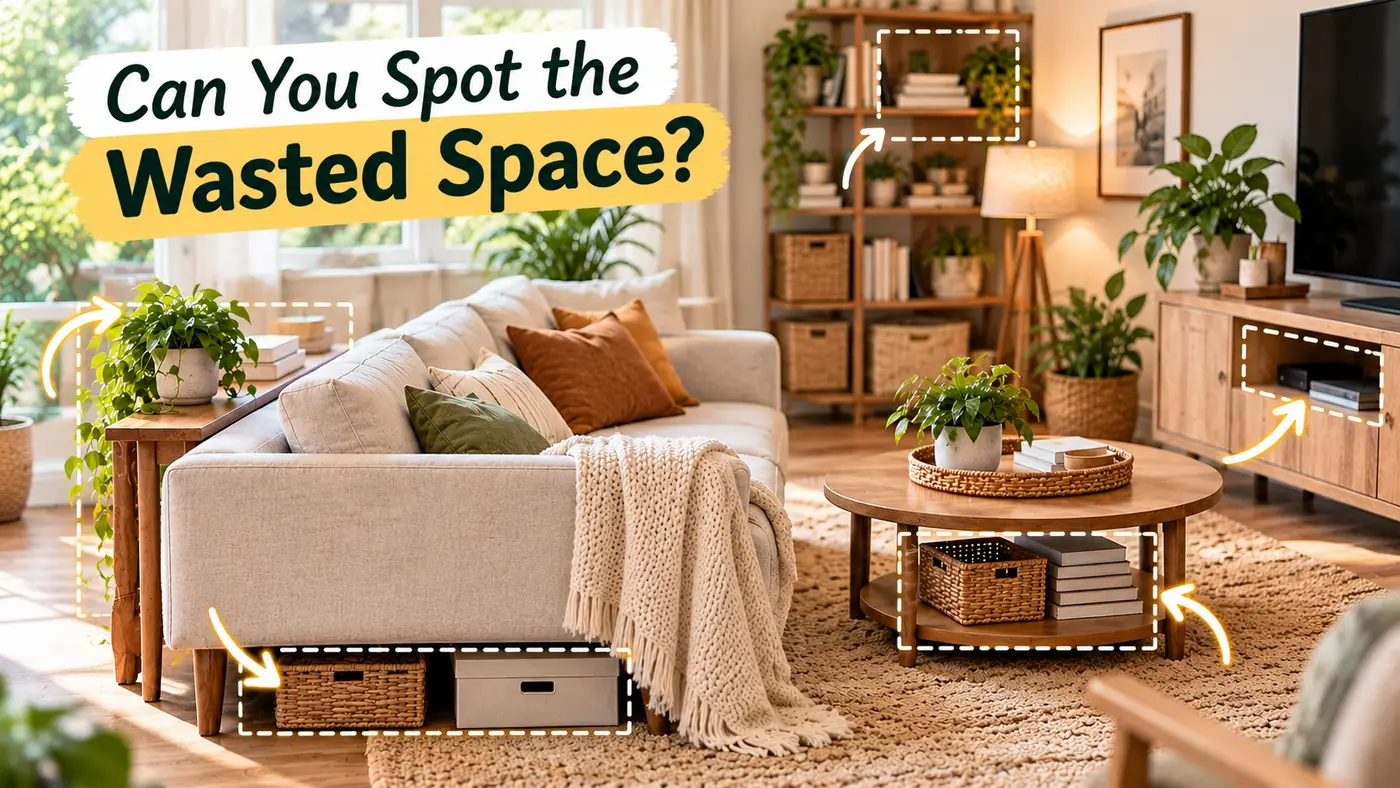
Can You Spot the Wasted Space? A Small Living Room Storage Audit
A small living room can feel short on storage even when there is technically space left to use.
The problem is that wasted space is not always obvious. It may be the gap beneath a piece of furniture, the empty wall above a console, or a cabinet that is full but uses its capacity poorly.
Before adding another basket, shelf, or storage ottoman, it helps to see what your room is already giving you.
This small living room storage audit walks through the room one zone at a time so you can spot overlooked capacity, inefficient storage, and areas that could work harder without making the space feel crowded.
What Counts as Wasted Space in a Small Living Room?
Wasted space is not simply empty space.
Some empty space is useful. Clear pathways, open walls, and breathing room around furniture can make a small living room feel calmer and easier to use.
For this audit, think of wasted space as space that could solve a real storage problem but currently does not.
That might include:
- inaccessible space behind furniture
- useful vertical space in a storage-heavy zone
- oversized containers holding very little
- deep cabinets where things disappear at the back
- furniture taking up floor space without doing enough
- easy-to-reach storage filled with rarely used items
- several small clutter catchers doing the job of one better system
The goal is not maximum storage density. It is better use of the space you already have.
Before You Start: Audit What You Have, Not What You Could Buy
For the first pass, do not shop.
Walk through the room exactly as it functions now and look for three things:
- Empty capacity: Where is usable space doing nothing?
- Storage friction: Where is storage available but awkward to use?
- Wrong-location storage: What is taking up valuable living room space even though you rarely need it there?
You may discover that the room does not need substantially more storage. It may simply need its existing capacity redistributed.
The Small Living Room Storage Audit
Work through these ten areas one at a time. You do not need to reorganize anything yet.
For now, you are diagnosing.
1. Look Under the Furniture
Start low.
Check beneath the sofa, media console, benches, and other furniture with clearance underneath.
Ask:
Is this usable space, or is it better left open?
A narrow gap under a low sofa may not be practical. But a generous space beneath a raised console or bench could hold flat, low-frequency items without adding another piece of furniture.
Accessibility matters too.
If using the space means moving heavy furniture every time, it is not useful everyday storage. If something can slide in and out easily, the same area becomes much more functional.
Also check what is already underneath. Forgotten objects and empty boxes do not count as storage just because they are out of sight.
2. Check the Space Behind the Sofa
Now look behind the largest piece of furniture.
In many small living rooms, the sofa leaves an awkward strip of unused floor space.
Sometimes that gap should stay empty for circulation or cleaning. But if there is already meaningful space there, ask whether it could perform a specific job.
Could it hold something slim? Could an item that currently floats around the room live there instead?
If this is one of your biggest opportunities, explore behind sofa storage that uses the gap intentionally without making the room harder to move through.
3. Audit the Walls Above Furniture
Next, look up.
Scan the walls above your sofa, media unit, desk, sideboard, and other low furniture.
Small rooms often run out of floor area before they run out of wall area. That makes vertical space worth checking—but not automatically filling.
Ask:
- Is the wall completely unused?
- Would storage here serve items already used in this zone?
- Is there enough visual breathing room?
- Would adding storage improve function or simply make the room busier?
A blank wall is not a storage failure.
Use vertical space only when it solves a real need.

4. Inspect Corners That Do Nothing
Check each corner.
Most will fall into one of three groups:
- intentionally empty
- occupied by something useful or decorative
- filled with something that does not quite belong
The third group deserves attention.
An overflowing basket beside the sofa may signal that the corner has become a dumping ground. A plant or floor lamp, on the other hand, is not wasting space just because it does not store anything.
Small-home organization should support the room, not turn every available inch into storage.
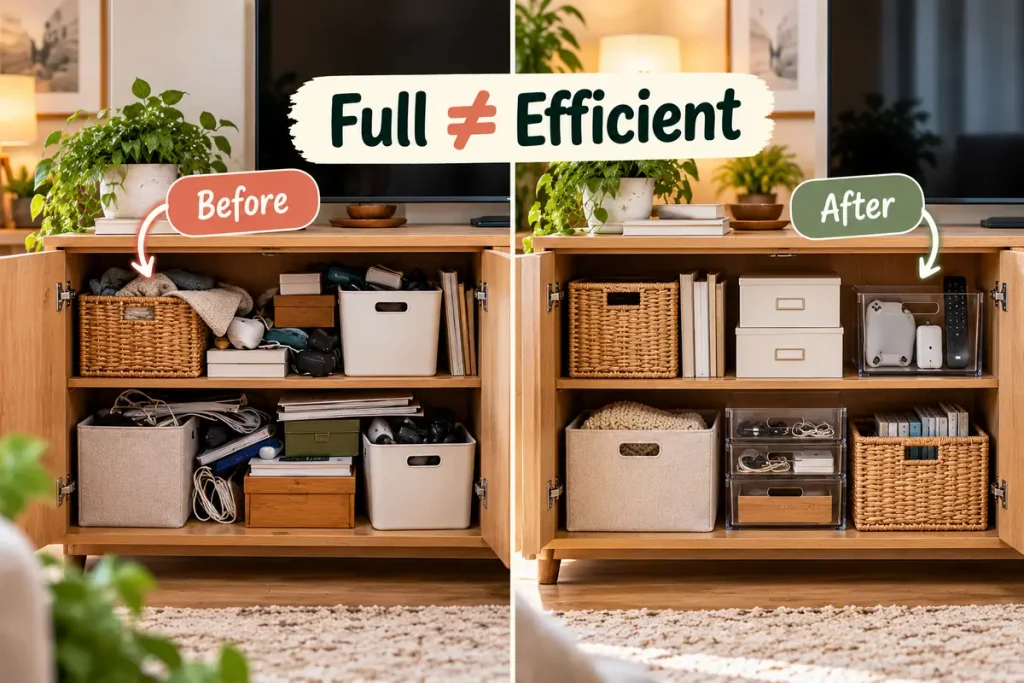
5. Look Inside Your Existing Storage
Open every drawer, cabinet, basket, bin, and storage compartment.
Do not ask only:
“Is it full?”
Ask:
“Is the space inside being used well?”
Look for:
- containers much larger than their contents
- empty vertical space above short items
- deep shelves with inaccessible back rows
- unrelated categories mixed together
- storage filled with items that belong elsewhere
- unnecessary containers inside larger containers
A cabinet can look full while still wasting a surprising amount of capacity.
Before adding something new, make sure existing storage is earning its footprint.
6. Audit the Coffee Table and Side Tables
Every piece of furniture in a small living room uses valuable floor space.
Start with the coffee table.
Does it support how you actually use the room? Does it provide useful function, or has it become a large surface that mainly collects objects?
Then check the side tables.
Not every table needs drawers or shelves, but if storage is genuinely tight, ask whether a large piece is doing enough for the space it occupies.
A useful question is:
Could one piece do the work currently performed by two?
The goal is not to replace everything with storage furniture. It is to avoid giving valuable floor area to furniture that contributes very little.
7. Check the TV and Media Zone
Media areas tend to collect more than televisions.
Remotes, controllers, chargers, headphones, cables, and small electronics often accumulate here.
Audit both the storage and what is occupying it.
Is a large console mostly empty inside?
Are open shelves filled with decor while electronics pile up elsewhere?
Is closed storage taken up by cables or devices you no longer use?
Prime storage near the sofa should support the things you regularly use there.
If your audit leads to taller furniture or heavy storage units, keep safety in mind. The U.S. Consumer Product Safety Commission recommends anchoring TVs and furniture such as bookcases and dressers to reduce tip-over hazards, especially where children may climb furniture.
8. Look for Storage That Is Holding the Wrong Things
A cabinet can be perfectly organized and still be wasting prime space.
For example, your easiest-to-reach storage might contain holiday decor, old photo albums, or rarely used games while blankets, toys, and remotes stay out because they have nowhere convenient to go.
That is not always a capacity problem.
It is often a storage priority problem.
Prime living-room storage should favor items used in the living room, especially things needed frequently.
If toys are the category causing the most overflow, focus on toy storage for a small living room that can be put away quickly instead of scattering several small bins across the room.
9. Find the “Almost Storage”
Some of the best opportunities are spaces that are already halfway to becoming useful storage.
Look for:
- an empty lower shelf
- unused space beneath a console
- a nearly empty drawer
- an ottoman with an unused interior
- a basket holding only one or two items
- shelving filled mostly with decorative filler
These areas are often better places to start than completely new storage projects.
Try to reclaim capacity before creating more.
10. Audit Your Visual Space Too
Storage can work physically and still make a small room feel crowded.
Open shelves packed edge to edge may hold plenty but create visual noise. Five small baskets may organize five categories while still making the room look busier than one concealed storage zone would.
Step back and look at the room from the doorway and from your usual seat.
If every wall, tabletop, shelf, and corner is holding something, adding more visible storage may solve one problem while creating another.
The best storage system is not always the one that holds the most.
It is the one that helps the room stay functional without making it feel overloaded.
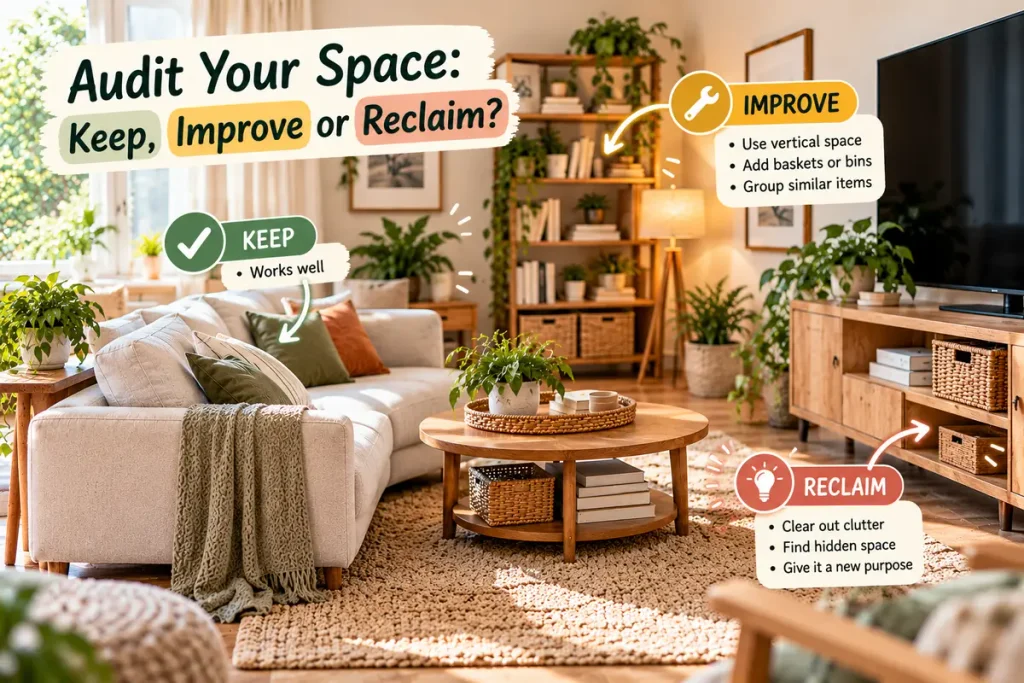
Score Each Problem: Keep, Improve, or Reclaim
Once you have walked through the room, label each area:
Keep
The space already works.
Items are easy to reach, the category makes sense for the location, and the storage does not interfere with circulation or visual calm.
Leave it alone.
Improve
The location makes sense, but the setup could work harder.
Maybe a container is too large. Perhaps a shelf has unused height, or one drawer has become a miscellaneous catch-all.
Improve the system without changing the whole room.
Reclaim
The space is being used badly enough that it should be reconsidered.
This might be a cabinet full of rarely used items, a bulky storage piece that barely stores anything, or a clutter basket occupying a valuable corner.
These are usually your highest-potential areas.
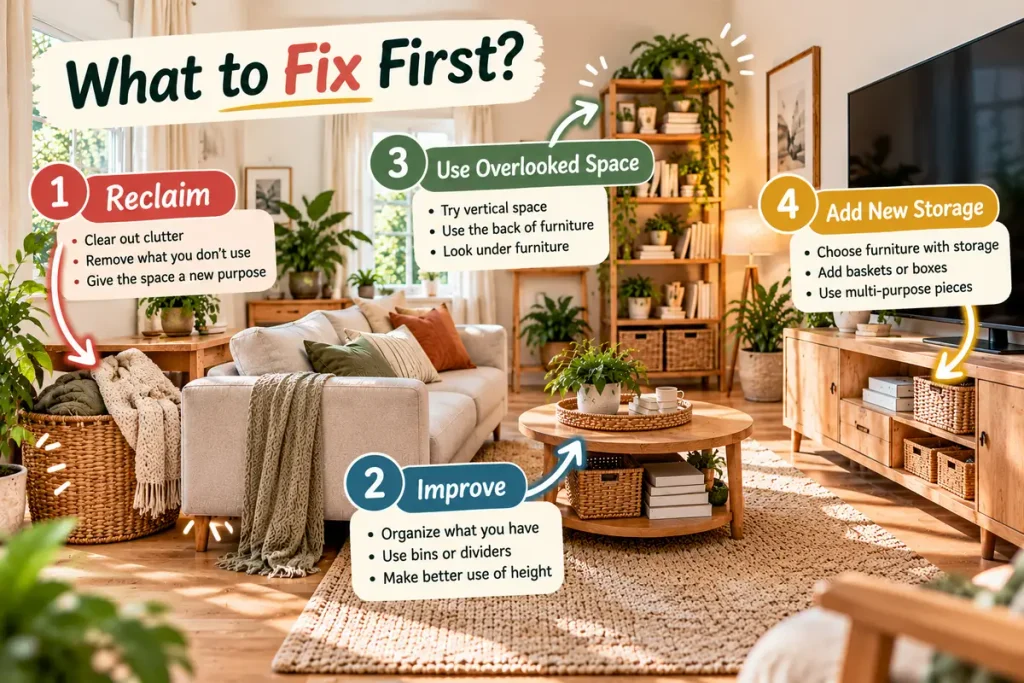
What Should You Fix First?
Do not try to fix every problem at once.
Start with the change that gives you the biggest functional return with the least disruption.
A practical order is:
First, reclaim existing storage.
Remove things that do not belong in prime living-room space.
Second, improve inefficient storage.
Fix oversized containers, mixed categories, and inaccessible shelves.
Third, use overlooked capacity.
Consider under-furniture, behind-sofa, or vertical storage only when you know exactly what needs a home.
Finally, add something new.
If the storage itself is working but the room keeps drifting back into clutter, a simple living room reset routine may help more than another organizer.
Before You Buy Another Storage Product
By now, you should know what your room actually lacks.
Instead of thinking:
“I need more living room storage.”
You can define the problem more clearly:
“I need concealed storage for two throws and a few controllers beside the sofa.”
Or:
“I need a better way to use the space above this cabinet.”
Or perhaps:
“I do not need more storage. I need to move rarely used items out of this room.”
That level of specificity makes it much easier to avoid buying organizers that become clutter themselves.
A 5-Minute Final Walk-Through
Stand at the entrance to the room one more time.
Look low.
Look high.
Check behind the sofa.
Open the cabinets.
Then ask:
- Is valuable storage holding things we rarely use here?
- Is any container taking up more space than its contents require?
- Is there overlooked space that could solve a specific problem?
- Is any piece of furniture consuming more room than the function it provides?
- Would adding storage improve the room—or simply fill another empty spot?
You do not need to use every inch.
A successful small living room still needs clear pathways, comfortable seating, open sightlines, and places where your eyes can rest.
The purpose of a small living room storage audit is not to squeeze maximum capacity from the room. It is to make sure the space you already use is working hard enough—so you can stop searching for more storage and get more from the living room you already have.