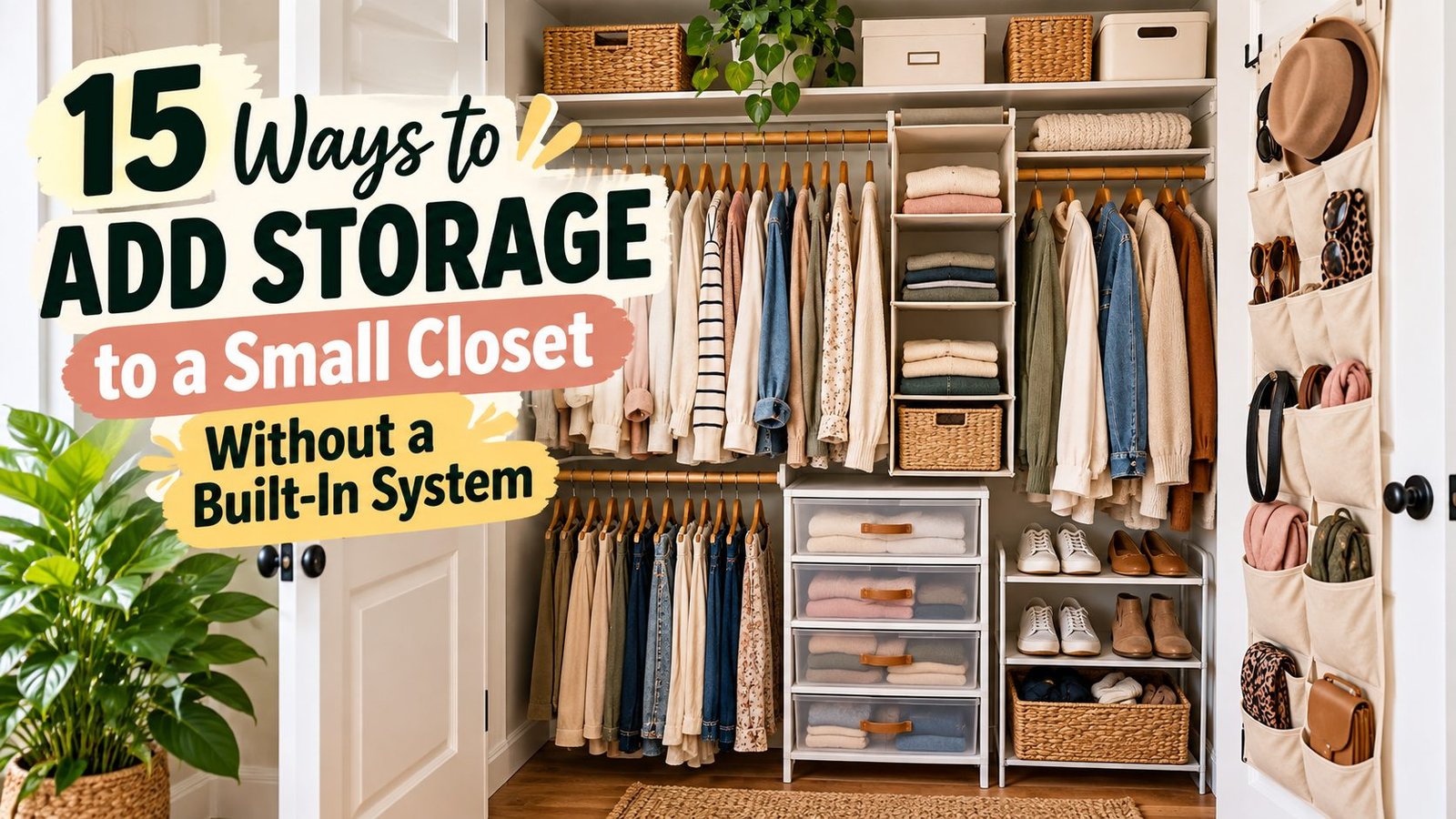
15 Ways to Add Storage to a Small Closet Without a Built-In System
A small closet does not need a custom built-in system to become more useful.
Many basic closets have little more than one rod and one upper shelf, leaving usable space underneath clothes, above the shelf, on the floor, and even behind the door.
The goal is not to fill every empty inch with organizers. It is to find the storage your closet is missing and add the simplest component that solves that problem.
Here are 15 ways to add useful storage without installing a full built-in system.
Before You Add Storage, Find the Closet’s Empty Zones
Before buying anything, take a few measurements.
Measure the usable width and depth of the closet, the distance from the existing rod to the floor, and the clearance around the door. If you have sliding doors, pay particular attention to how much of the closet opening is actually accessible at one time.
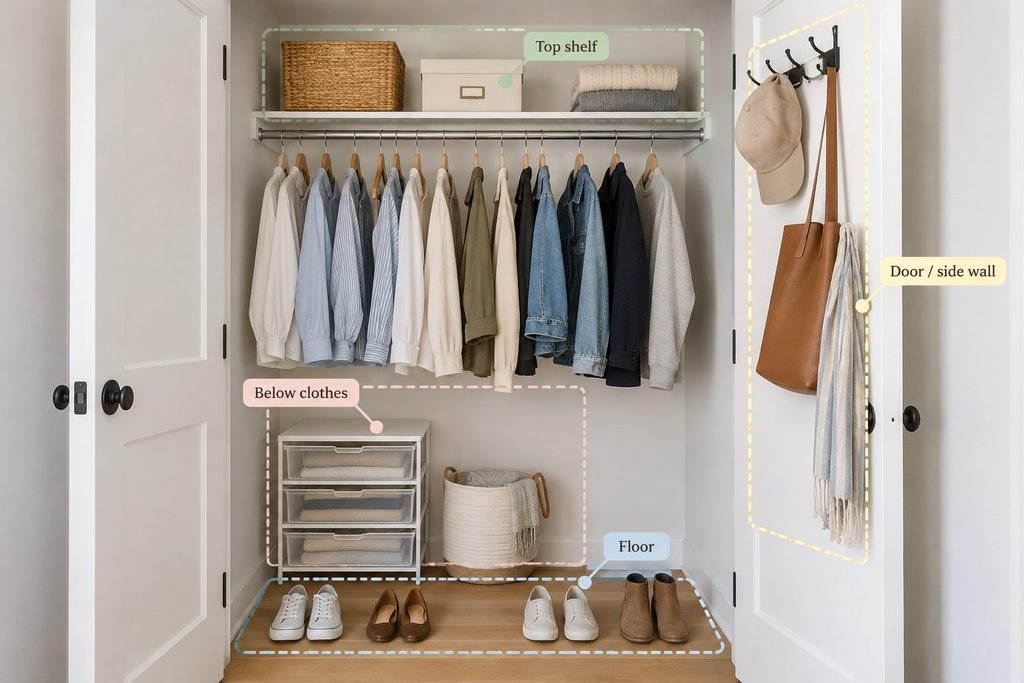
Then look for four common underused areas:
- below short-hanging clothes
- above the existing shelf
- on the closet floor
- behind the door or along a side wall
Also note which clothes need full hanging height. Dresses, long coats, and jumpsuits should not lose their space just because a second rod technically fits underneath.
A useful rule for a small closet is:
Do not ask, “Where can I fit another organizer?” Ask, “Which empty space could solve a storage problem I already have?”
That keeps the closet functional instead of simply making it fuller.
15 Ways to Add Storage to a Small Closet Without a Built-In System
1. Add a Second Hanging Rod
If most of your hanging wardrobe consists of shirts, blouses, folded pants, or skirts, the space underneath them may be doing almost nothing.
A hanging double rod attaches to the existing closet rod and creates a second hanging level underneath. This is one of the simplest ways to use the vertical space in a rod-only closet without rebuilding the interior.
Do not double-hang the entire closet automatically, though. Keep one section at full height for dresses or longer garments.
✔️ Best for: closets with lots of short-hanging clothes.
2. Hang a Shelf Organizer From the Existing Rod
A hanging fabric or structured shelf organizer can create a column of shelves without installing anything on the wall.
Use one for sweaters, jeans, workout clothes, small bags, or other items that are awkward to hang but need to remain visible.
The tradeoff is that every hanging organizer consumes some rod width. In a very narrow closet, that may not be worthwhile if hanging space is already your biggest constraint.
Instead of choosing the largest organizer that fits, choose the smallest one that gives your folded clothes a clear home.
✔️ Best for: closets with plenty of rod width but almost no shelving.
3. Put a Small Drawer Unit Under Short-Hanging Clothes
The area below shirts is often tall enough for something more useful than a pile of shoes.
A narrow freestanding drawer unit can give underwear, socks, pajamas, workout clothing, or folded T-shirts a proper home without adding a full dresser to the bedroom.
Measure carefully before buying. Make sure the drawers can fully open past the closet doors and that hanging clothes will not drape over the top.
If you add a freestanding drawer unit, follow the manufacturer’s assembly and anti-tip instructions.
✔️ Best for: bedrooms that need additional folded-clothing storage.
4. Use Stackable Shelves on the Closet Floor
Not every closet floor needs drawers.
A small freestanding shelf or stackable cubbies can be better when you need quick access to shoes, handbags, folded jeans, or storage baskets.
The advantage of stackable pieces is flexibility. You can start with one level and add another later if the closet can comfortably handle it.
Keep frequently used items on the easiest-to-reach level and avoid building a tower so tall that retrieving something from the bottom becomes annoying.
✔️ Best for: shoes, bags, and everyday items that benefit from open storage.
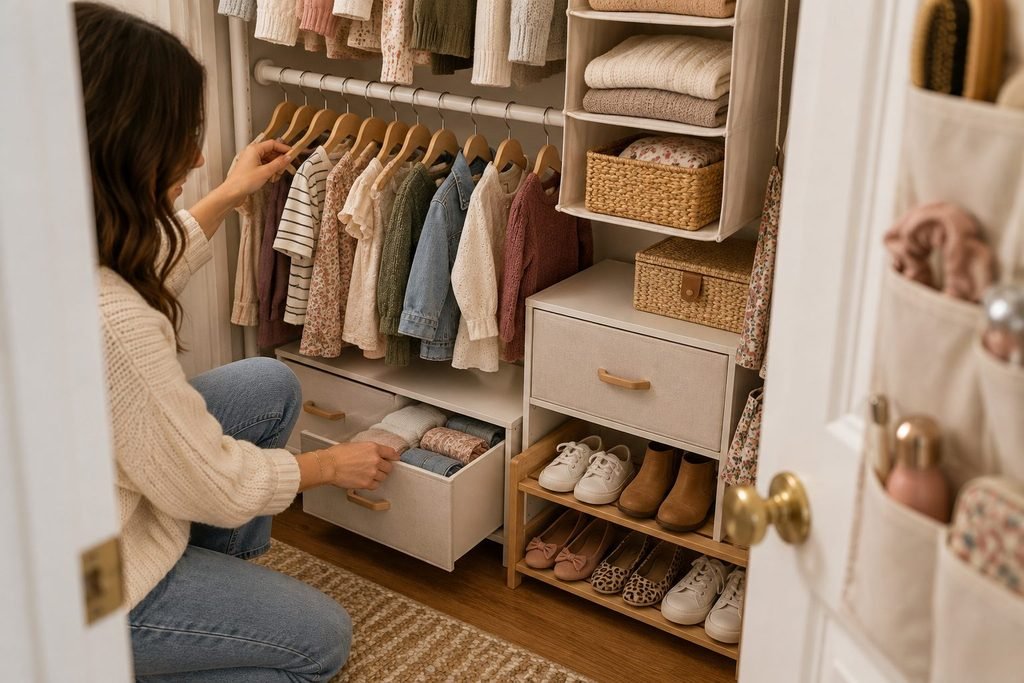
5. Add an Over-the-Door Organizer
The inside of a closet door can provide useful storage without taking away floor or shelf space.
Depending on what you own, an over-the-door organizer can hold:
- scarves
- belts
- hats
- small purses
- accessories
- slippers
- lightweight shoes
Pocket-style organizers are especially useful for small items that otherwise disappear into bins.
Before buying one, make sure there is enough clearance above the door and that the organizer will not hit shelves or clothing when the door closes.
If your closet uses sliding or folding doors, this idea may not be practical — and that is perfectly fine. Small-home storage works better when the organizer matches the architecture instead of fighting it.
6. Turn a High Shelf Into Usable Storage With Bins
One high shelf can technically hold a lot, but loose piles rarely make good use of it.
Instead, divide that shelf into a few clearly defined bins or baskets.
Store lighter, less frequently used categories there, such as:
- seasonal accessories
- extra handbags
- occasional-use clothing
- sentimental clothing you are keeping
- spare linens if the bedroom has nowhere else for them
Bins work particularly well on high shelves because you can pull down one category rather than rearranging an entire pile.
Avoid bins that are so deep that everything disappears into them. A container should make the shelf easier to use, not merely hide its contents.
✔️ Best for: infrequently used items and awkward upper shelves.
7. Add Shelf Risers Instead of Another Permanent Shelf
If a closet shelf has plenty of height but items only occupy the bottom half, a freestanding shelf riser can create a second level.
This works particularly well for:
- small handbags
- folded jeans
- sweaters
- shoe boxes
- accessories stored in shallow containers
Shelf risers are useful because they divide vertical space without requiring another permanent shelf.
Just remember that stacking upward only helps when both levels remain easy to access. If you have to remove three things to reach the lower level, the setup is too complicated.
8. Use Shelf Dividers to Create Vertical Sections
Sometimes the shelf itself is large enough — the problem is that everything falls into everything else.
Shelf dividers create separate lanes for folded sweaters, jeans, handbags, towels, or other categories.
Rather than creating one long stack, you might have:
Sweaters | Jeans | Bags
That small amount of structure can make an ordinary closet shelf much easier to maintain.
Use dividers selectively. A few useful sections are better than a dozen tiny compartments you have to keep perfectly arranged.
9. Add Hooks to an Empty Side Wall
Do not overlook the narrow side walls inside a reach-in closet.
A few properly installed hooks can hold things that are difficult to store anywhere else:
- belts
- robes
- tomorrow’s outfit
- small crossbody bags
- hats
- reusable tote bags
Hooks are particularly helpful because they make use of shallow vertical space that would not accommodate a full shelf.
For renter-friendly applications, removable hooks may be an option where appropriate, but always check the manufacturer’s surface, weight, removal, and installation instructions rather than assuming every adhesive product is suitable for every wall.
✔️ Best for: lightweight items used frequently.
10. Hang Accessories Vertically From the Rod
Rod space does not have to be reserved exclusively for clothing.
A slim hanging accessory organizer, multi-loop hanger, or series of S-hooks can turn a few inches of rod width into vertical storage for scarves, belts, tank tops, or lightweight bags.
This is particularly useful when you have plenty of height but very little horizontal room.
The important distinction is between compressing a category and simply hanging more stuff. If an accessory hanger becomes a dense knot of 25 scarves, it is no longer helping.
Aim for visibility and easy removal.
11. Use a Narrow Rolling Cart If the Closet Is Deep Enough
A rolling cart is not right for every closet, but it can work well in a deeper reach-in closet with an unobstructed strip of floor space.
A narrow cart can turn an awkward pocket into pull-out storage for folded clothes, accessories, small bags, craft supplies, or other bedroom items.
Check the geometry carefully.
A cart may fit inside the closet and still fail in real life because the door opening is too narrow to pull it out. Measure the usable opening, not just the closet’s interior dimensions.
This is one of those solutions that is excellent in the right closet and completely wrong in another.
12. Add Stackable Shoe Storage at Floor Level
Shoes spread quickly when the closet floor has no structure.
A low shoe rack, small stackable shelf, or front-opening shoe containers can create defined parking spaces while keeping the upper closet available for clothing.
Start by estimating how many pairs actually need to live in the closet.
If you regularly wear six pairs, you probably do not need a floor organizer designed for twenty-four.
Keeping the unit low also preserves the valuable area under short garments for hanging clothes above.
✔️ Best for: closets where shoes currently form an unstructured pile.
13. Use Tension-Rod Storage for Lightweight Items
A small tension rod can sometimes create useful temporary storage in narrow closet sections without becoming part of a permanent built-in system.
Depending on the closet layout, it might hold lightweight scarves, children’s clothes, accessories, or a few small hanging items.
Treat this as accessory storage, not a substitute for a load-bearing closet rod.
Follow the manufacturer’s stated dimensions, surface requirements, and weight limits, and do not position one where failure could damage fragile items underneath.
✔️ Best for: narrow gaps and lightweight categories.
14. Bring In a Freestanding Modular Shelf
If the closet is basically an empty box with one rod, a compact freestanding shelving unit can sometimes provide more useful structure than adding several small organizers.
A narrow modular piece can create space for:
- folded clothing
- baskets
- shoes
- bags
- linens
Choose something that leaves enough room to reach the rest of the closet.
Freestanding also does not automatically mean maintenance-free or anchor-free. If the manufacturer requires wall anchoring or other anti-tip hardware, follow those instructions. The U.S. Consumer Product Safety Commission warns that clothing-storage furniture can pose tip-over hazards, particularly to children. (cpsc.gov)
If anchoring is required, that may also affect whether the solution is suitable for a rental.
15. Create One Flexible Overflow Zone Instead of Filling Every Gap
One of the most useful things you can add is a little unassigned capacity.
One open basket, bin, shelf section, or empty hook can serve as temporary space for:
- clothes waiting to be put away
- a sweater you are wearing again tomorrow
- items moving in or out during a seasonal change
- something that has not found its permanent home yet
Without a small buffer, an ultra-optimized closet can fail the moment real life changes.
The goal is not maximum theoretical capacity.
It is a closet that still works on laundry day.
Quick Guide: What Should You Add to Your Small Closet?
| If your closet problem is… | Try this first |
|---|---|
| Not enough hanging space | Add a second hanging rod |
| No shelves | Add a hanging shelf organizer |
| Nowhere for folded clothes | Use a small drawer unit |
| Wasted space above items | Add a shelf riser |
| Folded stacks keep falling | Use shelf dividers |
| Shoes cover the floor | Add low stackable shoe storage |
| The closet door is unused | Try an over-the-door organizer |
| Small accessories disappear | Add hooks or vertical hanging storage |
| The closet has almost no structure | Add a freestanding modular shelf |
| Every category already fits but clutter returns | Leave one flexible overflow zone |
What Not to Add to an Already-Small Closet
More storage is not automatically better storage.
Be cautious about adding organizers that consume more usable space than they create.
Oversized drawer towers can eliminate hanging room and make the closet feel harder to access.
Very deep bins may technically maximize cubic capacity while making everyday items disappear at the bottom.
Too many small containers create unnecessary categories and extra steps every time you put something away.
Door organizers that interfere with closing solve one storage problem by creating another.
And avoid buying an organizer simply because it fits the closet’s dimensions. It also needs to fit through the usable opening, clear hinges or sliding doors, and remain accessible once your clothes are back inside.
One practical small-space principle is especially useful here:
Every storage product takes up space too. Make sure it earns that space.
A Simple No-Built-In Closet Setup
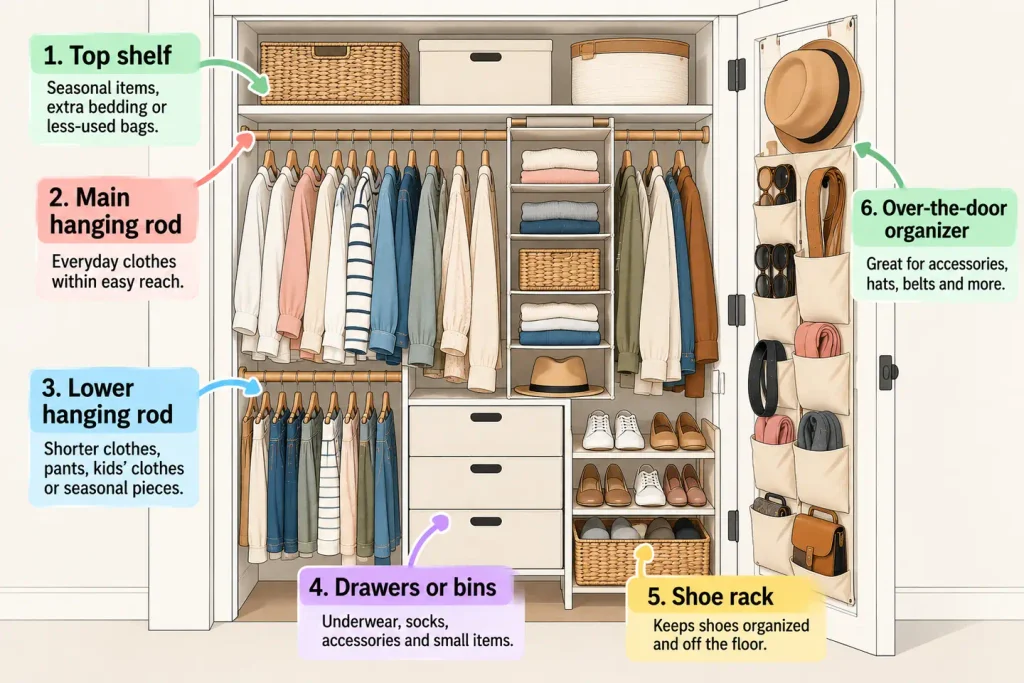
If you are starting with a basic reach-in closet, you do not need to use all 15 ideas.
A practical setup might look like this:
Top shelf: three lightweight labeled bins for less frequently used items.
Upper rod: shirts, blouses, jackets, and other everyday hanging clothes.
Lower rod on one side: skirts and folded pants.
Below the remaining short garments: one compact drawer unit for socks, underwear, or workout clothes.
Floor: a low shoe rack.
Side wall or door: a few hooks for bags, belts, or accessories.
That is already six different storage functions without installing a custom closet system.
The important part is that each addition responds to something the original closet could not do.
If the real issue is that your small closet is holding too many clothes, adding another organizer will eventually stop helping. In that case, edit what deserves space in the closet first, then add storage only for the categories that remain.
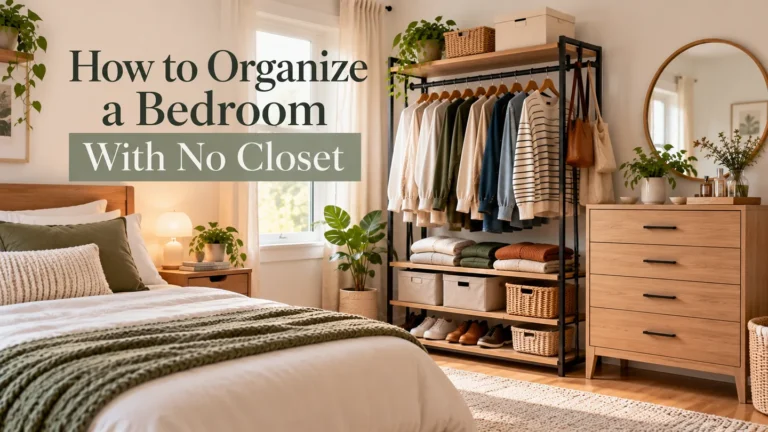
If the bedroom has no closet at all, the strategy changes again because you are creating clothing zones in the room rather than improving an existing closet.
Final Thoughts
The best storage for a small closet without built-ins does not come from squeezing an organizer into every available gap.
It comes from recognizing what your closet is missing.
If you need more hanging room, add another hanging level. If folded clothes have nowhere to go, create shelves or drawers. If the floor is chaotic, give shoes structure. If the upper shelf is wasted, contain it.
Start with the biggest storage problem first, add one solution, and see how the closet functions before adding another.
A small closet may never feel enormous — but it can feel intentional, accessible, and much easier to live with.