
17 Small Kitchen Storage Ideas to Make the Most of Every Inch
A small kitchen can feel full surprisingly fast. A few appliances on the counter, a crowded cabinet, and one awkward stack of pans may be all it takes to make the entire room feel short on storage.
But limited square footage does not always mean limited storage. Often, the most useful space is already there. It is simply above a shelf, behind a door, beside a cabinet, or tucked into a narrow gap you have stopped noticing.
These small kitchen storage ideas focus on making those overlooked inches more useful without filling every surface with organizers.
Before You Add Storage, Look for the Space You’re Not Using
Before buying baskets, bins, or another storage cart, take a quick look around your kitchen.
Pay attention to three types of space:
- Empty vertical space inside cabinets
- Bare surfaces such as walls, doors, and cabinet sides
- Awkward gaps that are too narrow for traditional furniture
These areas often offer more useful storage than adding another freestanding cabinet.
The goal is not to fit as much as possible into a tiny kitchen. It is to give everyday items sensible places to live while keeping counters and work areas easy to use.
Quick Guide: Where to Find More Storage in a Small Kitchen
Not sure where to start? Look at the part of your kitchen that feels most crowded or underused, then match it with a storage solution below.
| If You Need… | Try This | Best For |
|---|---|---|
| More room inside cabinets | Shelf risers or stackable storage | Plates, bowls, mugs, pantry staples |
| Better use of narrow spaces | A slim rolling cart | Cans, bottles, oils, baking supplies |
| More accessible cookware | Vertical dividers or wall hooks | Pans, lids, baking sheets, cutting boards |
| Extra storage without using floor space | Wall rails or cabinet-side storage | Utensils, towels, small kitchen tools |
| A better use for awkward corners | Turntables or pull-out bins | Jars, bottles, baking supplies |
| More space around the sink | Under-sink drawers, bins, or door storage | Cleaning supplies, cloths, trash bags |
| Storage for rarely used items | High shelves or above-cabinet storage | Serving dishes, specialty appliances, entertaining pieces |
The most useful solution is usually the one that fixes a specific problem rather than simply adding another organizer.
17 Small Kitchen Storage Ideas That Make Every Inch Work Harder
1. Add Shelf Risers Inside Cabinets
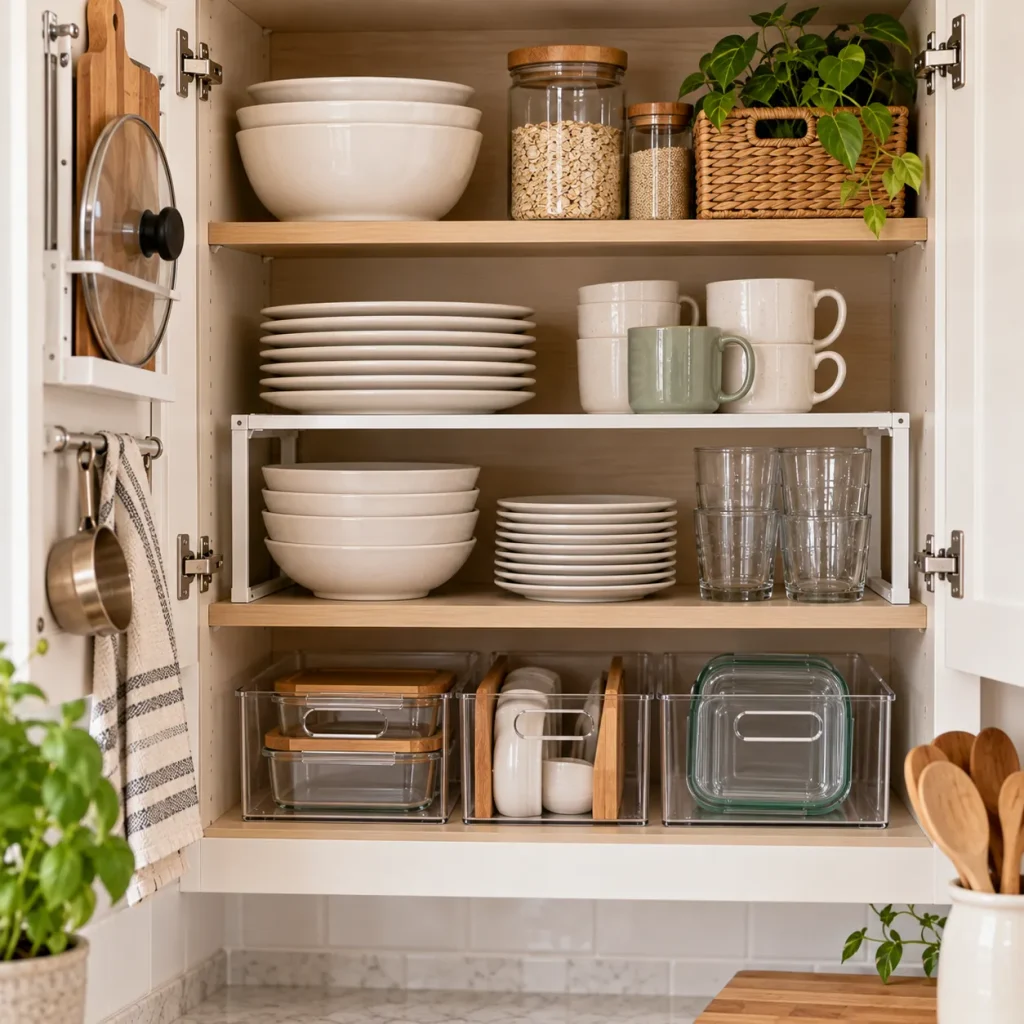
Open a kitchen cabinet and look above your plates, bowls, or mugs. If there is several inches of empty space before the next shelf, you are wasting valuable storage height.
A simple shelf riser creates another level without permanently changing the cabinet.
Use one to separate dinner plates from smaller plates, stack mugs on two levels, or keep canned goods visible instead of piling them on top of one another.
This works especially well in older kitchens where cabinet shelves are spaced farther apart than necessary.
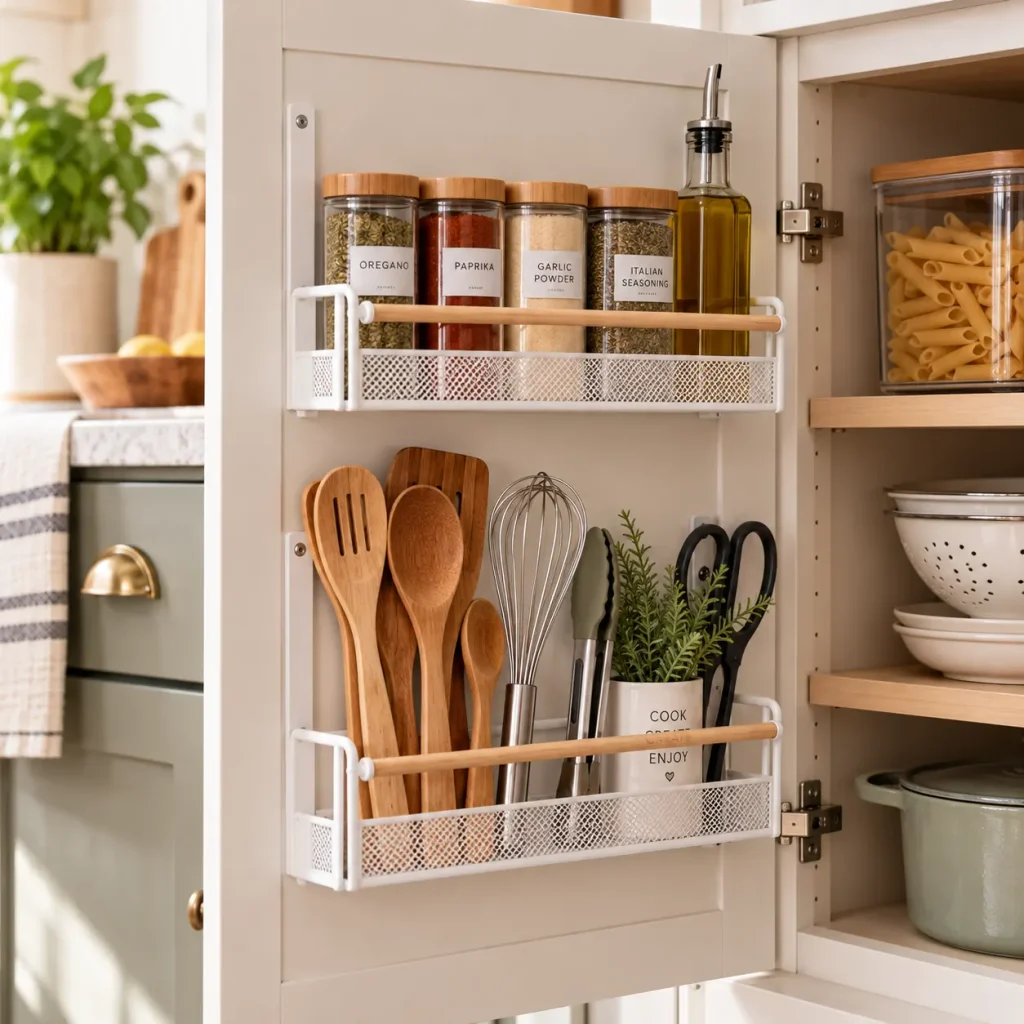
2. Use the Backs of Cabinet Doors
Cabinet doors are easy to overlook because they are thin, but they can hold lightweight items that otherwise clutter drawers and shelves.
Try a shallow rack for cutting boards, pot lids, food wraps, or cleaning supplies. Small adhesive hooks can also hold measuring spoons, oven mitts, or other lightweight tools.
Just keep the organizer shallow enough that the door can still close without hitting the shelves inside.
In a tiny kitchen, even a few inches of door depth can become genuinely useful storage.
3. Take Cabinets All the Way Up
If your cabinets stop below the ceiling, the empty area above them can handle items you do not need every day.
Large serving bowls, cake stands, holiday dishes, extra glassware, and occasionally used appliances are good candidates.
Matching baskets or simple lidded boxes can keep smaller pieces contained and make the area look intentional rather than forgotten.
Keep everyday dishes lower. High storage works best for things you only need occasionally.
4. Turn the Side of a Cabinet Into Storage
The exposed side of a cabinet or kitchen island can become a surprisingly practical storage zone.
Add a narrow rail, hooks, magnetic strip, or slim rack depending on what you need to store.
You might hang kitchen towels beside the sink, keep frequently used utensils near the stove, or mount a narrow spice rack where bottles remain easy to see.
Because these surfaces are vertical, you gain storage without taking away counter or floor space.
5. Add a Rail to an Empty Wall
Not every small kitchen has room for additional shelving, but many have enough wall space for a narrow rail.
A rail with movable hooks can hold utensils, measuring cups, small baskets, kitchen towels, or lightweight pans.
Place it close to the area where those items are actually used. Cooking tools make sense near the stove, while mugs might work better beside a coffee station.
This keeps frequently used pieces within reach while freeing up drawer and cabinet space.
6. Use Magnetic Storage on the Refrigerator
If the side of your refrigerator is exposed, treat it like another small wall.
Magnetic shelves and racks can hold spices, paper towels, kitchen cloths, frequently used condiments, or other lightweight essentials.
This is particularly useful in rental kitchens where drilling into walls or cabinets may not be an option.
Avoid covering the entire refrigerator with storage. One or two well-placed organizers usually provide useful extra capacity without making the kitchen feel visually crowded.
7. Slide a Narrow Cart Into an Awkward Gap
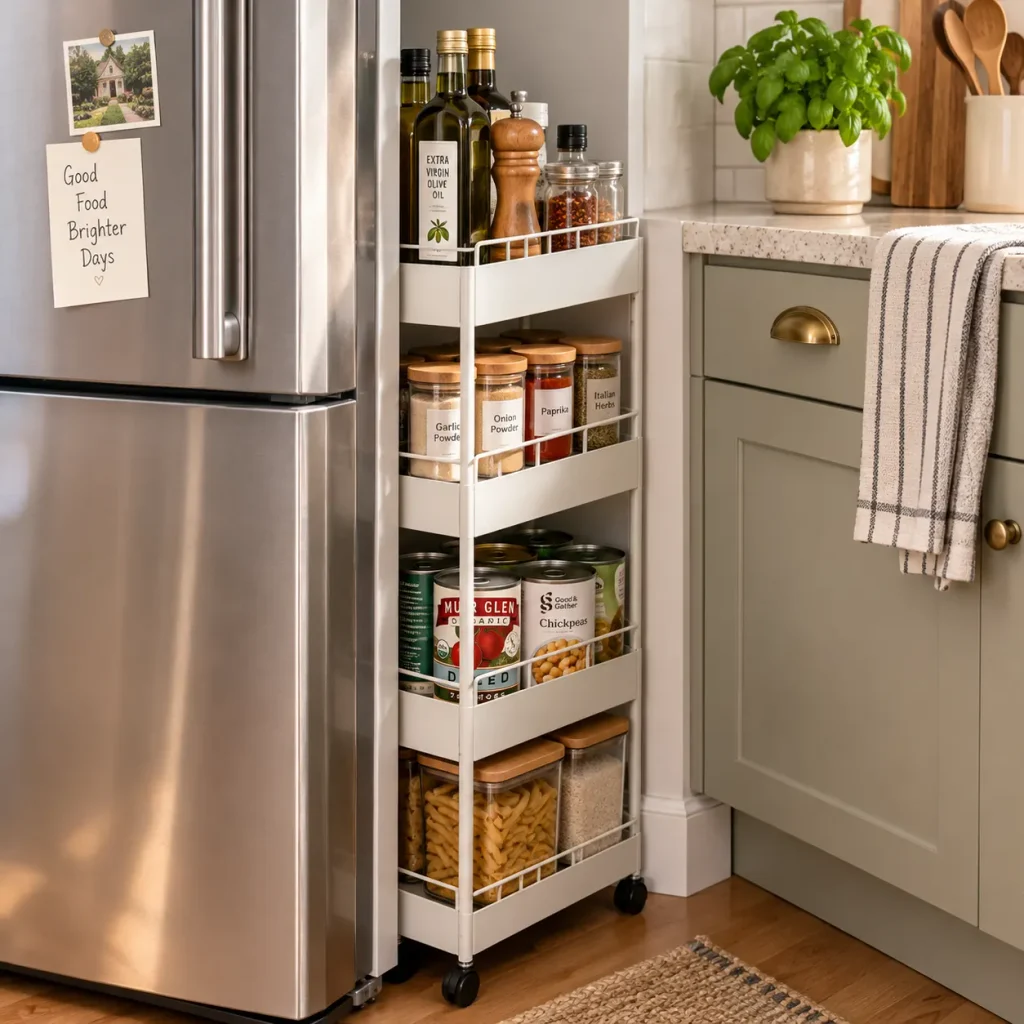
That slim opening beside the refrigerator or between two cabinets may be too small for furniture, but it could be perfect for a narrow rolling cart.
Use it for canned food, bottled drinks, oils, baking supplies, or backup pantry staples.
A pull-out design is particularly helpful because everything remains accessible even when the storage itself is only a few inches wide.
Measure carefully before buying one. In a small kitchen, a cart that fits neatly into an existing gap is far more useful than one that creates another obstacle.
8. Add Hooks Under Upper Cabinets
The underside of an upper cabinet is another overlooked surface.
A few hooks can create easy storage for mugs, measuring cups, or lightweight utensils while leaving the shelves above untouched.
This can work particularly well around a coffee station, where hanging mugs directly above the coffee maker keeps everything together.
Keep the arrangement simple. Too many hanging objects can quickly make a small kitchen look busier than it is.
9. Put Deep Drawers to Work With Dividers
Deep drawers provide plenty of volume, but without structure they often turn into piles.
Use adjustable dividers to create dedicated sections for utensils, food containers, baking tools, or cooking equipment.
For especially deep drawers, consider storing some items vertically rather than laying everything flat.
The important part is matching each section to what you actually own. A few larger compartments are often more practical than dozens of tiny ones.
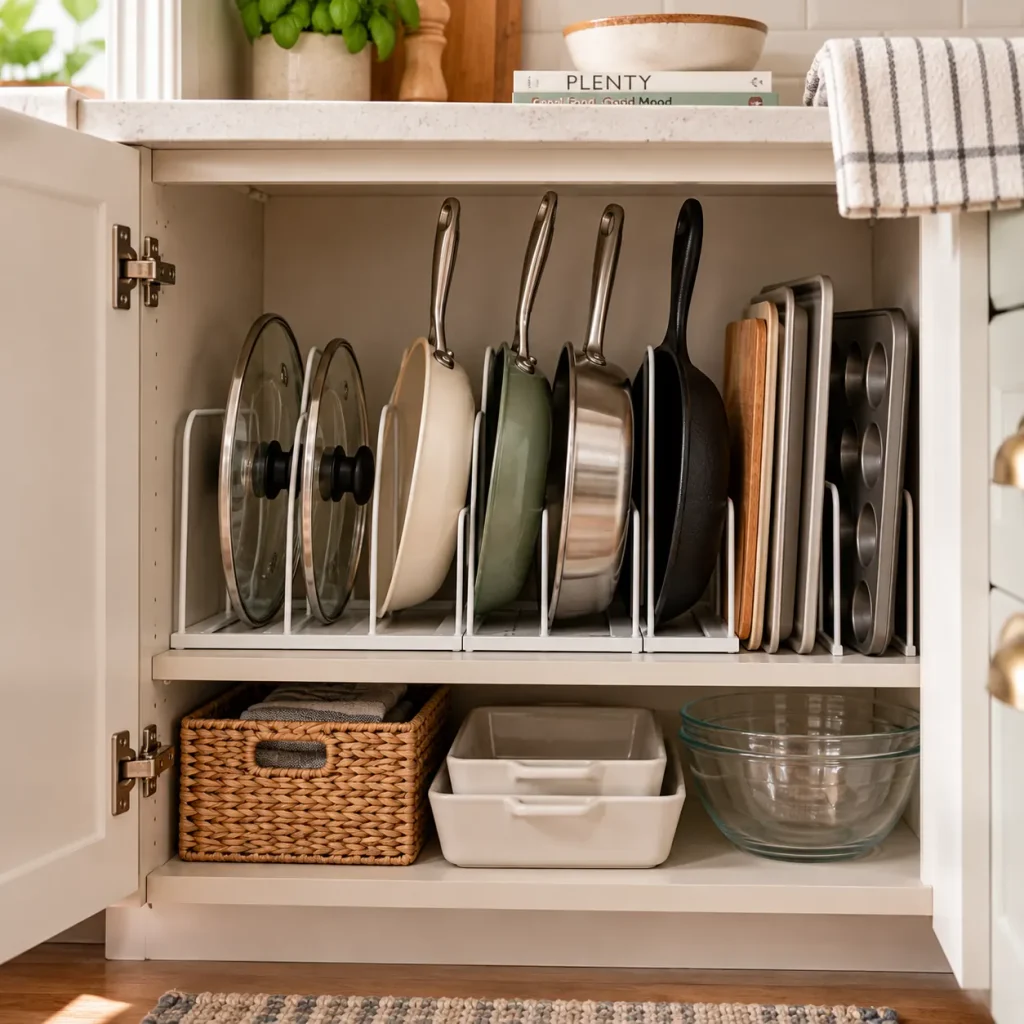
10. Store Pans and Lids Vertically
Stacks of frying pans and baking sheets may technically fit inside a cabinet, but retrieving the bottom piece usually means moving everything above it.
Vertical dividers solve that problem.
Use them to file baking sheets, cutting boards, muffin tins, frying pans, and pot lids upright.
Instead of digging through a stack, you can pull out the piece you need like a book from a shelf.
This is one of the simplest space saving kitchen storage changes for narrow cabinets.
11. Use the Space Above the Refrigerator
The area above the refrigerator often becomes either completely empty or a random dumping ground.
Give it a specific purpose instead.
A cabinet here can store infrequently used kitchenware. If you have an open shelf, use one or two large baskets to contain lightweight items such as linens, reusable shopping bags, or entertaining supplies.
Avoid creating a tall pile of miscellaneous objects. Defined containers make this difficult-to-reach space much easier to maintain.
12. Make Corner Cabinets Easier to Reach
Corner cabinets can offer plenty of space while somehow making half of it difficult to use.
Instead of pushing loose items toward the back, use a turntable, pull-out system, or large removable bin.
A turntable works well for bottles and jars. A handled bin can hold baking supplies or small appliances that you can pull forward as one group.
The best solution is the one that lets you access the back of the cabinet without unloading everything in front.
13. Create Smarter Storage Under the Sink

Plumbing makes the cabinet under the sink awkward, but it can still provide useful storage.
Work around the pipes rather than trying to force a standard shelving system into the space.
Stackable drawers, narrow bins, a small tension rod, or a shallow door organizer can create separate zones for dishwashing supplies, trash bags, cleaning cloths, and sponges.
Keep frequently used products toward the front and avoid packing the cabinet so tightly that you cannot see the plumbing or reach the shutoff valves.
14. Add a Small Shelf Above a Window or Doorway
Look above the kitchen window or doorway. There may be enough room for a shallow shelf even when every conventional wall is already occupied.
This is not the place for your everyday coffee mug.
Instead, use high shelves for attractive pieces you occasionally need, such as serving dishes, pitchers, baskets, or cookbooks.
Because the shelf sits above eye level, keeping the display restrained will help the kitchen feel organized rather than crowded.
15. Hang Frequently Used Cookware
If large pans take up most of a cabinet, consider moving a few of your most-used pieces onto the wall.
A sturdy rail or properly installed hooks can hold skillets, small saucepans, or cooking tools close to the stove.
The key is to be selective.
Hanging three pans you use constantly can free significant cabinet space. Hanging every piece of cookware you own can make a small room feel even smaller.
Let function decide what stays visible.
16. Use Stackable Storage Where Height Is Wasted
When a cabinet or shelf has more height than the objects stored inside it, stackable storage can turn that empty air into usable space.
Clear drawers can work for tea, snacks, or small pantry items. Stackable bins can separate food-storage lids, baking supplies, or reusable containers.
Choose containers based on the dimensions of the space rather than buying a matching set first and trying to make it fit later.
Good storage ideas for small kitchens should adapt to the kitchen you have, not require the kitchen to adapt to the organizer.
17. Give Rarely Used Items the Least Convenient Space
Not every inch of kitchen storage needs to be equally accessible.
In fact, one of the easiest ways to improve a small kitchen is to reserve the best storage for the things you use most.
Everyday plates, pans, knives, and ingredients should be easy to reach.
Holiday dishes, specialty baking pans, oversized serving pieces, and appliances used a few times a year can go above cabinets, on high shelves, or toward the back of deeper storage areas.
Think of accessibility as part of your storage system.
The less often you use something, the less valuable kitchen real estate it needs.
How to Choose the Right Storage Ideas for Your Kitchen
You do not need all 17 ideas.
Start with the area that causes the most frustration.
If cabinets feel crowded even though there is empty space above your dishes, add shelf risers. If counters are overloaded with utensils, look at your walls or cabinet sides. If baking sheets are constantly falling over, vertical storage may solve more than another basket ever could.
For a kitchen with very little built-in food storage, a more intentional pantry system may be more useful than simply adding organizers.
Most importantly, consider where you use an item, how often you use it, and how easily you need to reach it.
The best small kitchen organization ideas shorten everyday routines. A pan stored beside the stove or a cutting board within reach of the prep area is more valuable than an organizer that simply makes a cabinet look tidy.
Before buying anything, measure the available space and decide exactly what the organizer needs to hold.
Small kitchens rarely benefit from adding storage products without a purpose.
Make the Space You Have Work Better
A small kitchen does not need storage packed onto every available surface.
Start with the overlooked inches: the empty space above a shelf, the back of a cabinet door, an unused wall, or the narrow gap beside an appliance.
A few thoughtful changes can create more usable storage while keeping the kitchen comfortable to cook in.
The goal is not to fit more into the room. It is to make the space you already have work harder.