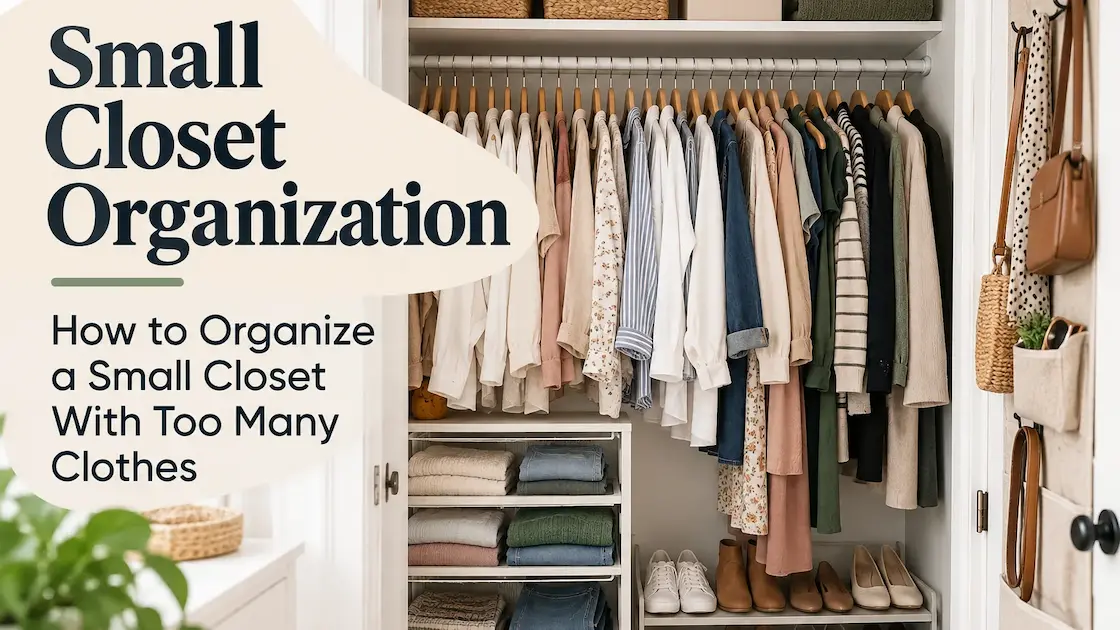
How to Organize a Small Closet With Too Many Clothes
A small closet can feel impossible when every hanger is packed together, folded clothes keep sliding into piles, and putting away clean laundry requires rearranging half the wardrobe.
But the solution is not always to add more storage.
Good small closet organization starts by deciding what deserves space, giving the easiest-to-reach areas to the clothes you actually wear, and using the closet you have more intentionally.
The goal is not to squeeze the maximum number of clothes into a tiny space. It is to create a closet where you can see what you own, reach what you need, and put things away without starting over every week.
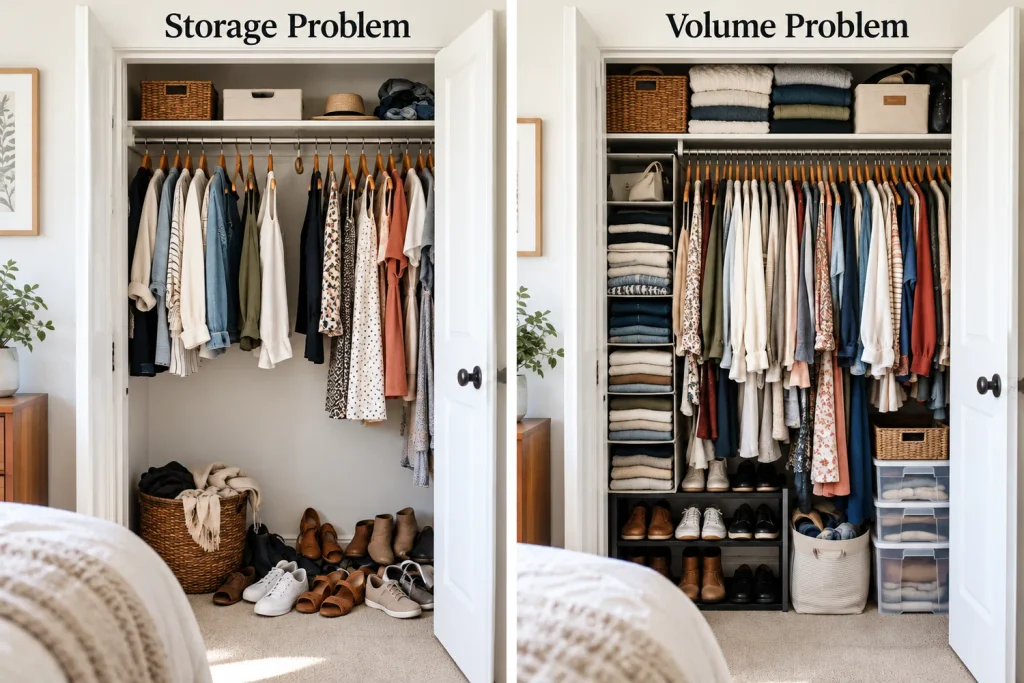
First, Is It a Storage Problem or a Volume Problem?
Before buying bins, hangers, or another closet organizer, figure out why the closet feels too small.
Sometimes the space is poorly used. Other times, there are simply more clothes than the closet can comfortably hold.
Use this quick check.
| If this keeps happening… | The likely problem |
|---|---|
| The rod is packed, but there is empty space underneath | Layout problem |
| Hangers are so tight they barely slide | Capacity problem |
| Shoes collect in a pile on the floor | Missing shoe zone |
| Seasonal clothes occupy the easiest shelves | Priority problem |
| Tall shelves contain short stacks with lots of empty space | Unused vertical space |
| Clean laundry has nowhere to go | The closet is probably over capacity |
| You regularly forget what is stored in the back | Visibility or access problem |
You may have more than one problem.
That is why it helps to edit the contents and understand the empty space before choosing storage products. Architectural Digest recommends a similar order: edit first, then measure, then decide what storage actually fits the remaining wardrobe.
Step 1: Edit the Clothes Before You Organize the Closet
Take enough clothing out that you can clearly see the rod, shelves, floor, and corners.
You do not necessarily need to get rid of half your wardrobe.
You do need to decide which clothes deserve to occupy limited closet space.
Create four simple groups.
Keep Here
These are clothes that fit, work for your current life, and are worn regularly enough to justify easy-access storage.
Keep, but Move Elsewhere
This category is especially useful in a small home.
It might include:
- off-season coats
- formalwear
- sentimental clothing
- ski or vacation clothing
- maternity clothing you plan to reuse
- special-event pieces
You are not decluttering these items. You are simply deciding that they do not need prime closet space.
Donate or Sell
If an item no longer fits your life and you are comfortable letting it go, move it out now rather than organizing around it.
Repair or Decide Later
Keep this category small.
A giant “maybe” pile usually becomes another form of storage.
If you want to do a more intensive wardrobe edit later, treat that as a separate decluttering project rather than allowing this closet reset to turn into an all-day decision marathon.
This order also matches the way many professional organizing guides approach a crowded closet: reduce and sort first, then reorganize what remains.
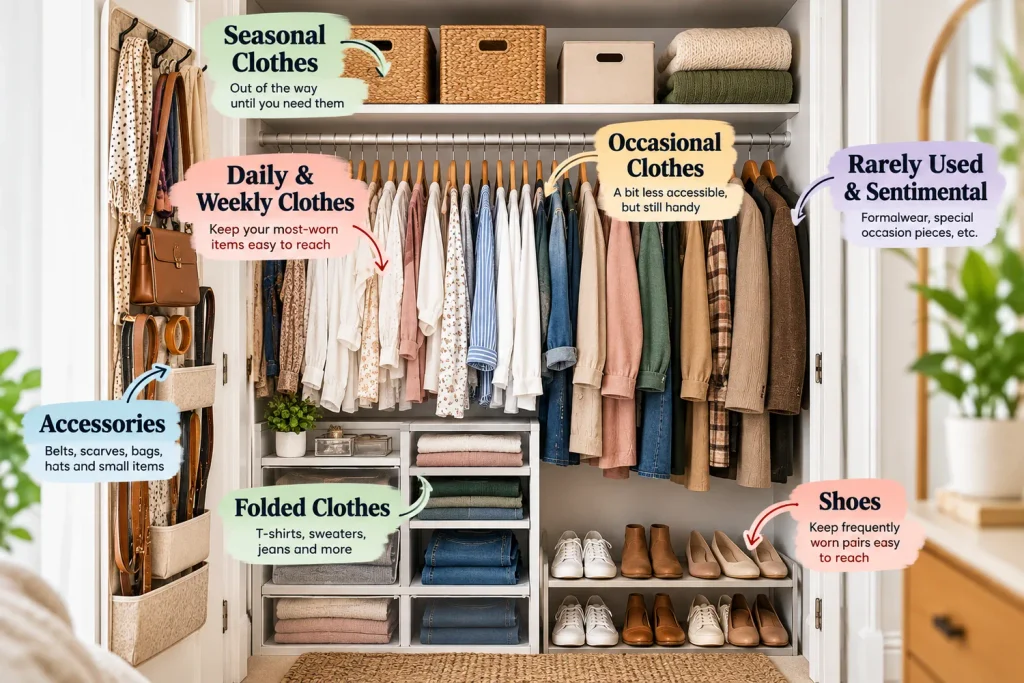
Step 2: Decide What Deserves Prime Closet Space
Not every item needs equally convenient storage.
A small bedroom closet works much better when its easiest areas are reserved for the clothes you use most.
Divide your wardrobe roughly by frequency.
Daily and Weekly Clothes
Put these where they are easiest to see and reach.
This might include:
- work shirts
- everyday pants
- favorite dresses
- frequently worn jackets
- everyday shoes
These items belong on the easiest section of the rod, on accessible shelves, or in drawers you can open without moving something else first.
Occasional Clothes
Items worn a few times a month can occupy secondary positions.
Think outer sections of the hanging rod, slightly higher shelves, or less convenient drawers.
Seasonal Clothes
A heavy winter sweater does not need eye-level storage in July.
Likewise, shorts and summer dresses do not need prime closet space all winter.
The most accessible areas should usually hold what you are using now.
Rare-Use and Sentimental Clothing
If something is worn once or twice a year, ask whether it needs to live in the bedroom closet at all.
A labeled container on a high shelf, under-bed storage, or another protected storage area may be more appropriate.
This simple change can free surprisingly useful space without requiring you to get rid of clothes you genuinely want to keep.
Step 3: Divide the Closet Into Functional Zones
Once you know what is staying, give each category a home.
You do not need an elaborate built-in closet system. Even a standard reach-in closet can function well when each area has a clear job.
Hanging Zone
Use hanging space for clothing that benefits from hanging, such as:
- dresses
- blouses
- button-down shirts
- jackets
- trousers that crease easily
Try not to hang something only because there happens to be a rod.
Bulky sweaters, T-shirts, jeans, workout clothes, and similar items may use less space when folded.
Folded-Clothes Zone
Keep folded clothing in manageable stacks or drawers rather than building one tall tower.
If retrieving one sweater causes six others to fall over, the system is too fragile for everyday use.
Shelf dividers or small bins can help later, but first make sure the shelf itself is being used for the right category.
Shoe Zone
Frequently worn shoes should be easy to reach.
Less-used pairs can move toward the sides, upper shelves, under-bed storage, or another appropriate area.
Avoid letting the closet floor become an undefined shoe pile. Once every pair can be dropped anywhere, the floor quickly stops functioning as useful storage.
Top-Shelf Zone
The top shelf is valuable precisely because it is inconvenient.
Use it for things you do not need every morning.
Good candidates include:
- out-of-season clothing
- special-occasion items
- spare handbags
- labeled accessory bins
- travel items
Avoid filling the top shelf with miscellaneous objects simply because they fit.
Door and Side-Wall Zone
The inside of a closet door or a narrow unused side wall can work well for lightweight accessories.
Think belts, scarves, small bags, hats, or similar items.
In a tiny closet, these narrow vertical areas can help relieve pressure on the main rod and shelves without making the closet harder to use.
Step 4: Match the Storage Method to the Clothes
A common small-closet mistake is trying to store every category the same way.
Instead, look at the shape of the clothing.
Hang pieces that wrinkle easily or are easier to scan vertically.
Fold bulky items that consume excessive rod space.
Contain small items that otherwise scatter across shelves.
Stack carefully sturdy items such as jeans, but keep stacks low enough to use without rebuilding them.
Give awkward pieces their own zone instead of forcing them into whichever organizer happens to have an empty compartment.
The best storage method is the one that makes both retrieval and putting away easy.
That second part matters.
A closet is not truly organized if it looks perfect after a reset but takes five steps to put away a T-shirt.
Step 5: Use the Closet’s Full Height
Once the wardrobe has been edited and zoned, look for genuinely unused space.
Small closets often have more potential vertically than horizontally.
Check:
- the gap above the existing shelf
- empty wall space beside the rod
- the area below short shirts
- the back of the door
- wasted height between shelves
- unused space above a low drawer unit
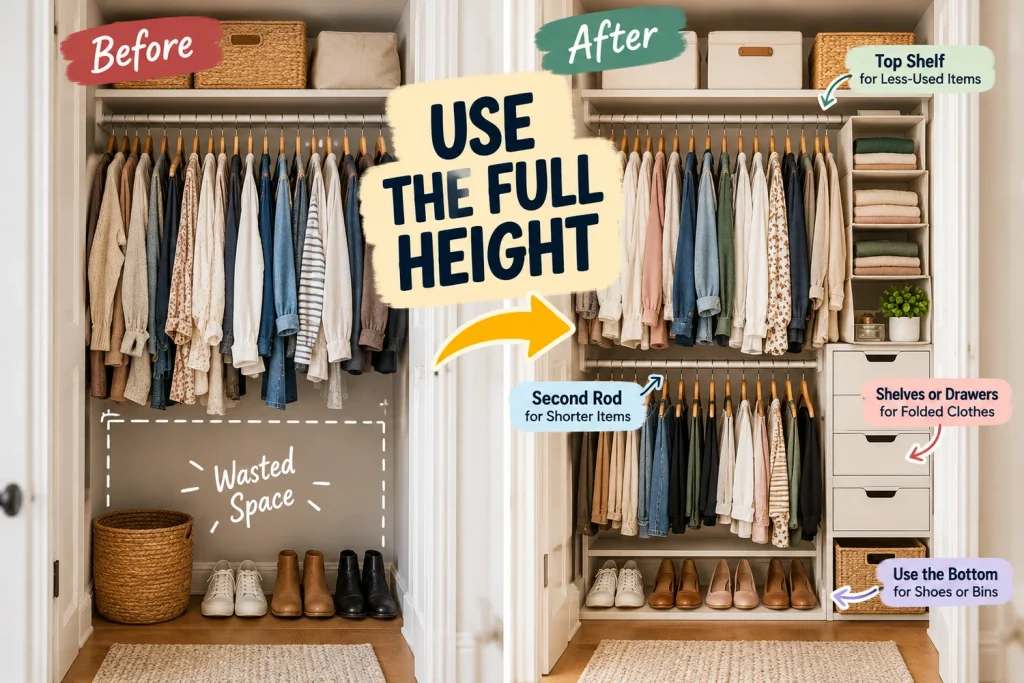
This is where additions such as a second hanging rod, shelf divider, small drawer unit, hook, or door organizer can make sense.
The important part is matching the addition to a specific problem.
For example:
😞 Problem: Shirts occupy only the upper half of a tall hanging section.
🎯 Possible solution: Add a lower rod for another row of short garments.
😞 Problem: Handbags continually fall over on a shelf.
🎯 Possible solution: Add dividers.
😞 Problem: Small accessories disappear into piles.
🎯 Possible solution: Add a contained bin or hanging organizer.
If the closet still has unused vertical space after editing, a few small-closet storage add-ons can help you use that space without installing a full built-in system.
Step 6: Rotate Seasonal Clothes Out of Prime Space
A small closet does not need to hold every season equally all year.
If you live somewhere with distinct weather changes, rotating seasonal clothing can free useful space without forcing you to part with anything.
During warmer months, heavy coats and thick sweaters can move to less accessible storage.
When cold weather returns, rotate summer pieces out instead.
The key is to create a clear seasonal clothing storage system rather than moving clothes into random boxes.
You should be able to answer:
- what is inside
- where it lives
- when it should return to the closet
That keeps seasonal rotation from becoming another form of hidden clutter.
Step 7: Give Rarely Used Clothes a Permanent Secondary Home
Seasonal clothes are one thing.
Some pieces are used rarely all year and may not deserve prime closet space at any time.
Examples include:
- formal dresses
- suits
- specialty jackets
- sentimental clothing
- costume pieces
- vacation-specific items
These can live in a secondary storage zone such as:
- under the bed
- a high bedroom shelf
- a storage bench
- another appropriate closet
- a small drawer unit elsewhere in the room
The best storage setup for a tiny closet often depends on accepting that not every clothing category has to live inside it.
But secondary storage still needs limits.
Moving five bins of unsorted clothes under the bed does not solve the problem. It relocates it.
Give each overflow area a defined purpose.
For example:
Under-bed storage = formalwear and low-frequency clothing only
or
Upper bedroom cabinet = sentimental pieces and special-event clothing
The more specific the rule, the easier the system is to maintain.
How Full Should a Small Closet Actually Be?
There is no universal percentage that every closet must follow.
A more useful test is whether the closet still functions.
Your closet is probably too full if:
- you cannot slide hangers apart to see clothing
- pulling out one folded item collapses the entire stack
- you regularly lose clothing behind other clothing
- items fall when you open the door
- you must remove one object to access another everyday object
- clean laundry routinely waits outside the closet because there is nowhere to put it
- putting something away feels harder than leaving it on a chair
A little empty space is not wasted space.
It is what allows the system to work.
Think of that breathing room as part of the storage design rather than capacity you have failed to use.
A Simple Small-Closet Setup That Works
You do not need an Instagram-perfect closet.
For a typical small bedroom reach-in closet, a simple arrangement might look like this:
| Closet Area | What to Store There |
|---|---|
| Top shelf | Seasonal and rarely used items |
| Main eye-level rod | Most-worn tops, dresses, and jackets |
| Secondary/lower rod | Short garments such as shirts or pants |
| Accessible shelf or drawers | Folded everyday clothes |
| Side wall or door | Belts, scarves, lightweight accessories |
| Floor | Frequently worn shoes |
| Less accessible corners | Occasional-use items |
Use this as a starting point rather than a rigid formula.
Someone who wears dresses daily needs a different closet from someone who owns mostly folded T-shirts and jeans.
Your wardrobe should determine the layout, not the organizer you happen to buy.

What Not to Buy Until You’ve Finished Organizing
Storage products can be useful, but a small closet makes bad purchases especially expensive in terms of space.
Wait before buying:
- large storage bins
- extra shoe racks
- bulky drawer units
- hanging cubbies
- shelf risers
- duplicate sets of hangers
- matching baskets simply for appearance
First determine what remains after editing.
Then measure the available space.
Then identify the exact category that needs help.
It is also worth measuring around real obstructions, not only wall-to-wall dimensions.
Door trim, hinges, shelf brackets, sliding doors, baseboards, and existing rods can all affect whether an organizer actually fits.
How to Keep a Small Closet From Filling Up Again
The best small closet organization ideas are the ones you can maintain on a normal Tuesday morning.
A few simple habits help.
Leave Space for Laundry to Come Back
Your closet is not finished when every available inch is full.
It is finished when the clothes currently in the laundry can return without creating a crisis.
Keep a Small Outbox
A basket or designated bag for clothes you no longer want prevents unwanted pieces from quietly rejoining the wardrobe.
When it fills, deal with it.
Reset Seasonally
You do not need a complete closet makeover every month.
A seasonal check is usually enough to move irrelevant clothing, reconsider unworn pieces, and correct categories that have started drifting.
Notice What You Consistently Skip
If ten shirts are technically fine but you repeatedly reach past them, that information is useful.
You do not need to make an immediate decluttering decision, but frequently skipped clothing should not automatically receive the best storage space forever.
Put Things Back Where the System Expects Them
An organizing system should make the correct action easy.
If putting something away feels unnecessarily complicated, adjust the system instead of assuming you simply need more discipline.
The Bottom Line
When you are figuring out how to maximize a small closet, start by deciding what the closet actually needs to hold.
Give the easiest spaces to the clothes you use most, move seasonal and low-frequency pieces out of prime storage, and use the closet’s full height without overcrowding it.
A small closet may never hold an unlimited wardrobe, but it can hold the right wardrobe in a way that makes getting dressed and putting everything back much easier.