
10 Japanese Closet Ideas Worth Borrowing for Small Bedrooms
A small bedroom closet does not always need more organizers. Sometimes it simply needs to be easier to understand, easier to reach, and easier to reset after a busy week.
That is where Japanese closet organization offers some surprisingly useful ideas.
Japanese homes and American homes are not built exactly the same way, and neither are their closets. But several Japanese storage principles translate well to a small reach-in closet: measure before buying containers, give the easiest-to-reach space to the things you use most, organize vertically, and avoid packing every available inch just because you can.
Here are 10 Japanese closet ideas worth borrowing for a small bedroom — without turning the room into a minimalist showroom.
What Japanese Closet Organization Gets Right About Small Spaces
First, it helps to clear up one misconception: there is no single “Japanese closet.”
Traditional Japanese homes often include an oshiire, a deep built-in storage space originally intended for bedding such as futons. Modern Japanese homes may also have Western-style closets with hanging rods for clothes.
That difference matters.
An oshiire can be considerably deeper than a typical American reach-in closet. MUJI, for example, offers storage cases in different depths depending on whether they are intended for standard closet storage or deeper spaces.
So the goal is not to copy a Japanese closet product for product.
It is to borrow the principles that transfer well and adapt them to the dimensions of your own room.
1. Measure the Closet Before Buying a Single Organizer
The fastest way to make a small closet harder to use is to buy attractive bins first and figure out where they fit later.
Start with the space itself.
Measure:
- the full interior width;
- usable depth;
- height from the floor to the hanging rod;
- space above the rod or top shelf;
- door opening width;
- areas partly blocked by sliding or folding doors.
Depth deserves special attention.
Japanese storage systems frequently come in several depths because a container made for a deep storage cabinet is not automatically suitable for a shallower clothes closet.
That is a useful rule even if you never buy a Japanese organizer:
Choose storage for your actual measurements, not for the closet you saw online.
A drawer that fits neatly from the back wall toward the front may give you more usable space than two mismatched baskets surrounded by narrow, unusable gaps.
2. Give the Best Storage Space to the Clothes You Wear Most
Not every inch of a closet has equal value.
The space you can reach while standing normally — without crouching, stretching, moving another container, or grabbing a step stool — is prime storage.
Treat it that way.
Japanese organization advice commonly prioritizes items according to frequency of use. Clothes and accessories used regularly stay in easy-access areas, while occasional items can move higher, lower, or farther back.
For a small bedroom closet, your easiest-to-reach zone might hold:
- work clothes;
- favorite jeans;
- everyday shirts;
- pajamas;
- frequently used bags.
Special-occasion dresses, spare linens, ski accessories, and once-a-year holiday sweaters do not need the same premium position.
Many crowded closets accidentally do the opposite: everyday clothing gets squeezed into whatever space remains while rarely used belongings permanently occupy the easiest shelves.
Before adding storage, ask:
Does the best part of this closet belong to the things I actually use?
3. Divide the Closet Into Upper, Middle, and Lower Zones
Stop thinking of the closet as one box.
Think of it as three storage zones.
Japanese home-organization guidance often divides closet space vertically, with frequently used clothes in the accessible middle and less frequently needed belongings above or below.
A practical small-bedroom version looks like this:
Upper zone
Use it for lightweight or occasional items such as:
- off-season clothing;
- extra bedding;
- travel bags;
- hats;
- occasional accessories.
Middle zone
Reserve this area for the wardrobe you use regularly:
- shirts;
- dresses;
- jackets;
- pants;
- everyday accessories.
Lower zone
Use the space beneath hanging clothes for:
- compact drawers;
- folded T-shirts;
- socks and underwear;
- workout clothes;
- shoes.
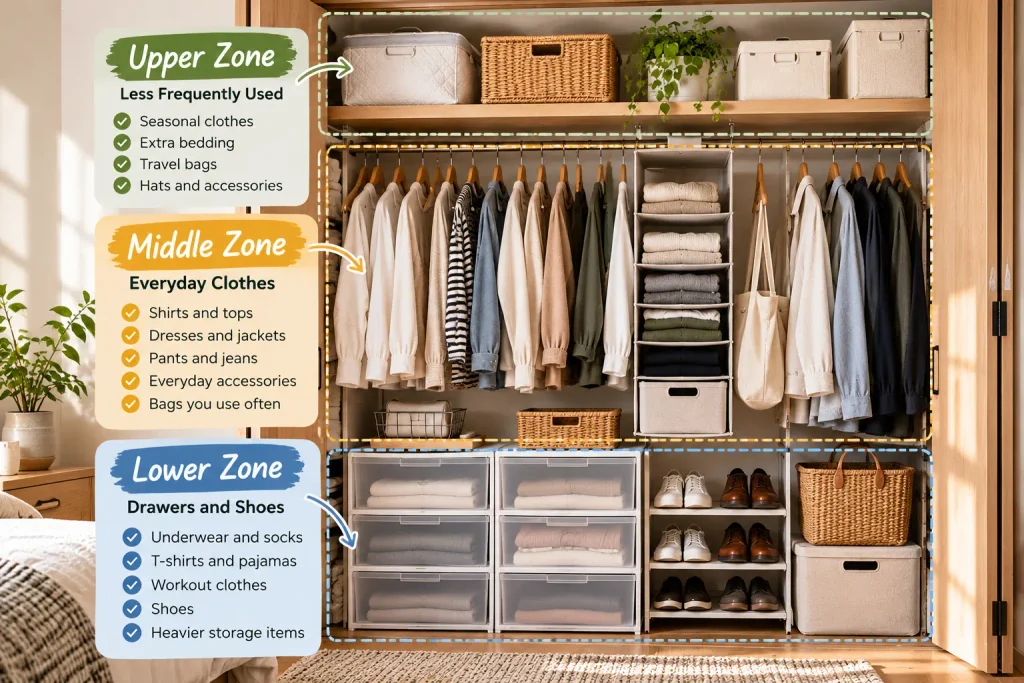
A simple three-zone closet setup keeps seasonal items high, everyday clothes within easy reach, and drawers or shoes belowThe benefit is not simply fitting more inside.
Each part of the closet now has a clear job, making it much easier to notice when one category starts spreading into spaces where it does not belong.
4. In a Deep Closet, Organize Front to Back Too
Vertical zoning works in almost every closet.
Front-to-back zoning is more situation-dependent.
But if your closet is unusually deep, this Japanese idea can be especially useful.
Because traditional oshiire storage has significant depth, Japanese organization methods often consider not only what belongs high or low but also what belongs toward the front versus the back.
You can adapt the same principle:
Front = what you use now.
Back = what you need occasionally.
For example, current-season clothing might occupy the most accessible position while a clearly labeled container farther back holds items you use only a few times a year.
There is one important caveat:
Do not create double-deep storage simply because you saw it in a Japanese home.
If your closet comfortably accommodates only one accessible row, keep one row.
Placing another line of bins behind it may increase theoretical capacity while making half the closet inconvenient to use.
5. Put Drawers Under Short Hanging Clothes
Look under the shirts hanging in your closet.
There is often a surprising amount of empty space between the hem of a shirt and the floor.
Japanese storage systems frequently use that lower zone for stackable drawer units, and the same idea works particularly well in a small American bedroom.
A compact two- or three-drawer unit can hold:
- underwear;
- socks;
- workout clothes;
- T-shirts;
- pajamas;
- small accessories.
This is especially helpful if your bedroom does not have enough floor space for a traditional dresser.
If that is your bigger problem, clothes storage without a dresser can extend beyond the closet with wall-mounted, under-bed, and compact freestanding options.
Before buying any drawer unit, measure the clothes hanging above it.
A drawer tower that fits perfectly under shirts might interfere with long dresses or coats.
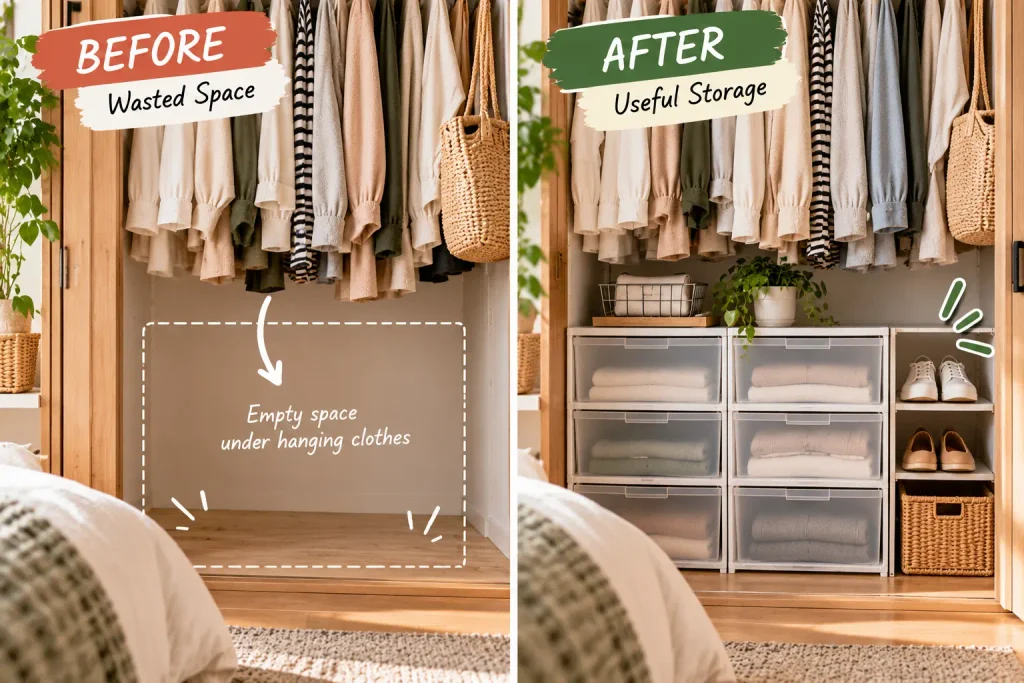
Adding compact drawers under short hanging clothes turns unused lower space into practical storage6. Standardize Storage Instead of Collecting Random Bins
A small closet can lose a surprising amount of usable space through tiny gaps.
A narrow basket here, a rounded fabric bin there, a wide plastic tub squeezed beside both — eventually the closet becomes a storage puzzle.
Modular Japanese storage offers a better principle to borrow.
Instead of collecting unrelated containers, standardize a few dimensions and functions.
That might mean keeping:
- similar container depths;
- compatible widths;
- one or two drawer heights;
- one hanger style;
- consistent label placement.
The pieces do not need to match perfectly.
They simply need to work together.
Three compatible drawers can often use a small footprint more efficiently than three unrelated baskets bought at different times.
This principle also applies well beyond closets. Many tiny home storage options work because the pieces are selected around limited dimensions and clear functions rather than added one at a time.
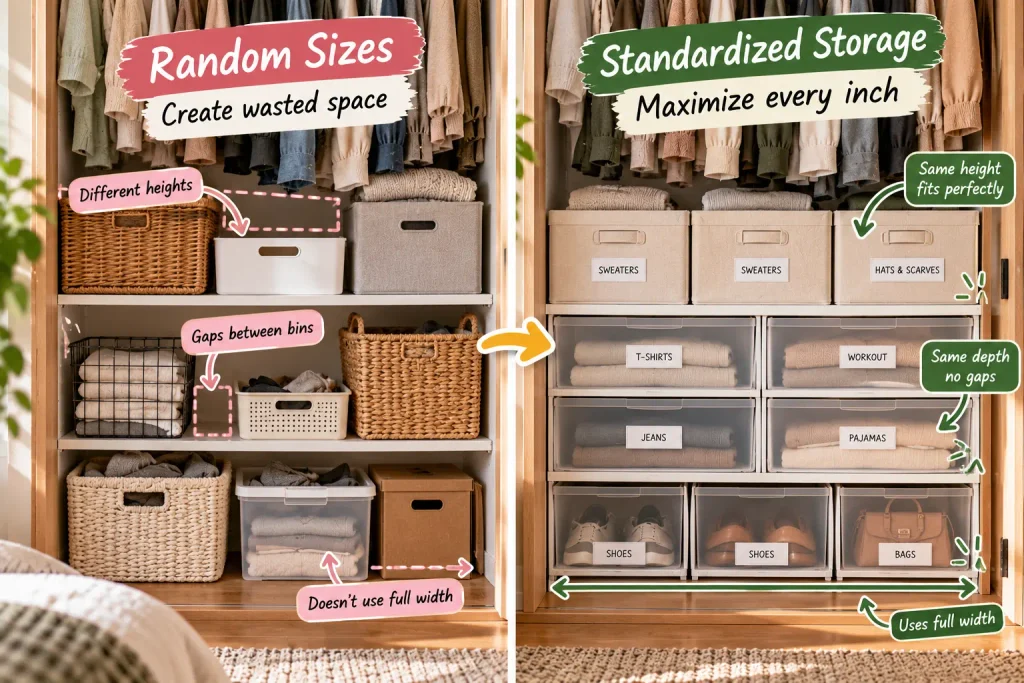
Matching container dimensions can reduce awkward gaps and make a small closet easier to organize7. Leave a Little Breathing Room
Small-space advice often focuses on maximizing every cubic inch.
But maximum capacity and maximum usability are not the same thing.
If you have to press hanging clothes sideways with both hands just to return one shirt, the closet may technically hold your wardrobe — but the system is already difficult to maintain.
Try intentionally leaving:
- a little movement between hanging clothes;
- enough clearance to open every drawer fully;
- a small amount of space on frequently used shelves;
- room inside everyday bins for items to be returned easily.
That empty space is not wasted.
It is working space.
A closet needs enough flexibility to handle laundry day, one new sweater, or a week when everything has not been folded perfectly.
Instead of asking how much the closet can physically contain, ask how much it can contain while remaining easy to use.
8. Move Off-Season Clothing Out of Prime Space
A tiny bedroom closet does not necessarily need to display an entire four-season wardrobe at once.
If bulky winter sweaters occupy your easiest shelf in July, or summer clothing crowds the hanging rail throughout winter, seasonal rotation can make the closet considerably easier to use.
Possible secondary locations include:
- the top closet shelf;
- labeled storage bags;
- a high bedroom shelf;
- another low-frequency storage area;
- space beneath the bed.
If you use the last option, treat it as a real storage zone rather than somewhere to slide miscellaneous belongings out of sight. Good under bed storage organizing should keep categories contained, visible, and retrievable without turning the area into a hidden junk drawer.
The goal is not to hide seasonal clothes randomly.
Keep them together and clearly labeled so switching seasons does not require searching through several unrelated boxes.
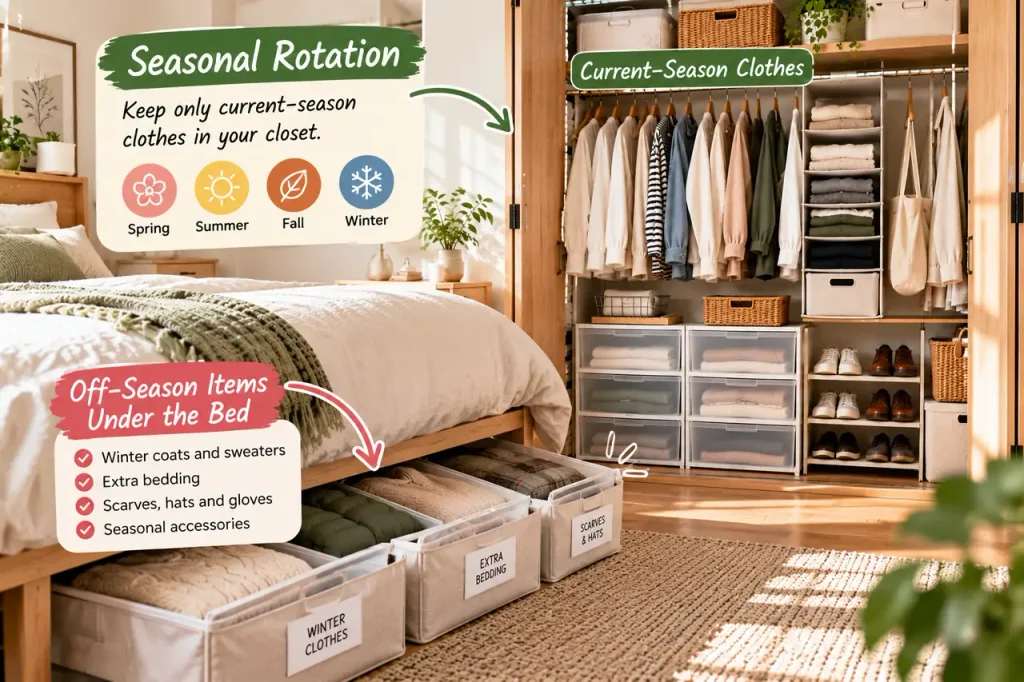
Keep current-season clothes in the easiest-to-reach closet space and move off-season items to labeled under-bed storage9. Fold Small Clothes So You Can See Them at a Glance
The useful part of compact folding is not creating perfect rectangles.
It is visibility.
If T-shirts are stacked ten high, you have to disturb most of the pile whenever you want the shirt at the bottom. Eventually the stack collapses and the drawer becomes a jumble again.
Where the drawer depth allows it, folding clothing so individual pieces remain visible can work well for:
- T-shirts;
- leggings;
- underwear;
- pajamas;
- workout clothes;
- lightweight sweaters.
Drawer dividers or small inserts can also stop categories from sliding together.
You do not need an elaborate folding ritual.
Use whichever method lets you answer one question quickly:
Can I see what I own without digging through it?
If yes, the system is doing its job.
10. Build a Closet That Is Easy to Reset
The best closet organization system is not the one that looks most impressive immediately after you finish it.
It is the one you can still maintain three months later.
Every frequently used item should have an obvious return path.
Socks go into one drawer.
Work shirts return to one section of the rod.
Bags have one designated home.
Seasonal items do not slowly migrate back into prime everyday space.
This is one of the most transferable ideas behind Japanese closet organization: storage should make it easy not only to take something out, but also to put it back.
That gives you a useful test for every organizer you are considering.
Do not ask only:
How much can this hold?
Also ask:
Will I actually put things back here?
A beautiful lidded box stacked behind three other containers may offer plenty of capacity and terrible everyday usability.
What Not to Copy From a Japanese Closet
Japanese storage ideas can provide excellent small-space inspiration, but copying the physical setup without considering your own closet can backfire.
Do Not Buy Oshiire-Sized Storage Without Measuring
Traditional oshiire storage may be considerably deeper than a standard American reach-in closet.
A deep storage case that looks wonderfully efficient online could stick out, interfere with a closet door, or leave clothing inaccessible.
Always measure first.
Do Not Add Front-and-Back Storage to a Shallow Closet
Depth zoning works only when there is genuine usable depth.
If you have to remove one container every time you want the one behind it, you may not have gained useful storage.
You may simply have hidden things.
Do Not Buy Organizers Just to Create a “Japanese” Look
Neutral bins, translucent drawers, wooden hangers, and minimalist labels can look beautiful.
But they are not the organization system.
The more useful Japanese storage principles are much less aesthetic:
measure carefully, organize by frequency, use clear zones, choose compatible storage, and make frequently used belongings easy to return.
Start there.
Do Not Confuse Minimalism With Hiding Clutter
A closet can look calm when the door is open and still be completely dysfunctional inside its bins.
If one container holds five unrelated categories simply because everything fits, visual simplicity has not solved the organization problem.
Storage should reduce decisions, not hide them.
A Simple Japanese-Inspired Closet Setup for a Small Bedroom
You do not need a complete closet makeover to put these ideas to work.
For a typical small reach-in closet, start with this simple map:
| Closet Area | Best Use |
|---|---|
| Top shelf | Lightweight seasonal or occasional items |
| Eye-level area | Frequently worn clothes and everyday accessories |
| Hanging rod | Current-season clothing that hangs well |
| Under short clothes | Compact drawers for folded basics |
| Lowest accessible area | Shoes or heavier storage |
| Deep/back areas | Low-frequency items, only if the closet has sufficient depth |
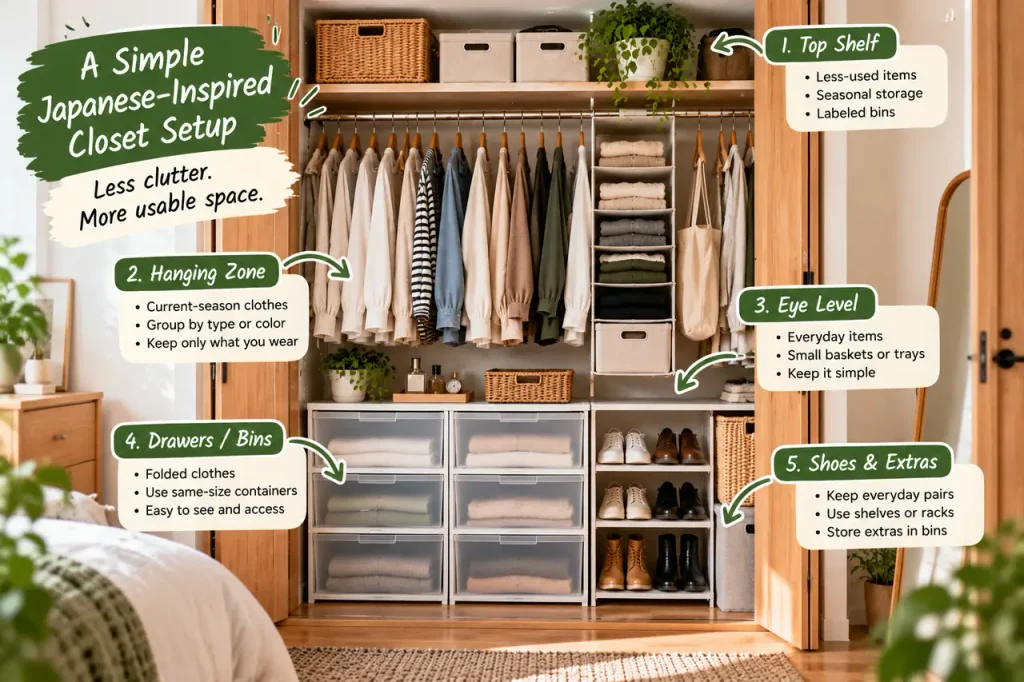
Then make one rule:
The harder a location is to reach, the less frequently you should need what lives there.
That single principle can make a small closet noticeably easier to use without adding another shelf, rack, or basket.
Final Thoughts
The most useful lesson from Japanese closet organization is not that every possession needs to disappear into a perfectly matching box.
It is that limited storage works better when every part of the space has a purpose.
Measure before buying organizers. Put everyday clothing where your hands naturally reach. Use upper, middle, and lower zones intentionally. Take advantage of depth only when the closet actually has it. Choose compatible storage instead of accumulating random containers. And leave enough breathing room for the system to function in real life.
A small closet will always have physical limits.
But when the things you use most are visible, accessible, and easy to put away, those limits become much easier to live with.