How to Organize a Balcony Garden Without Losing Floor Space
A balcony garden can start with three innocent little pots and somehow turn into an obstacle course of planters, watering cans, bags of potting mix, and gardening tools.
The problem usually is not that the balcony is too small. It is that plants and supplies gradually take over the same floor space you need for walking, sitting, watering, and actually enjoying the balcony.
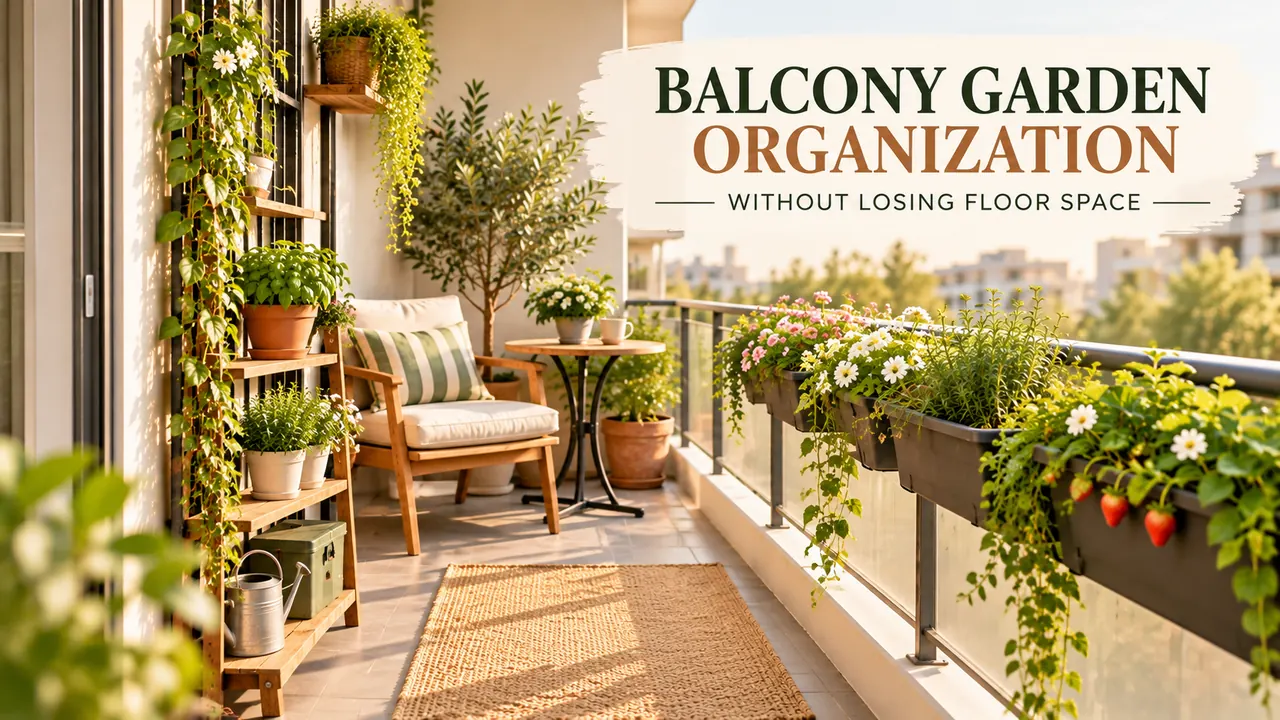
Good balcony garden organization works differently. Instead of squeezing another pot into every available gap, you decide which parts of the balcony should stay open and move as much of the garden as possible to railings, vertical structures, shelves, and carefully planned corners.
Here is how to organize an apartment balcony garden while keeping valuable floor space usable.
Start With the Floor Space You Want to Keep
Before organizing the plants, decide what the balcony floor needs to do.
Do you want enough room for:
- one chair and a small table?
- two people to sit outside?
- a clear path from the door to the railing?
- access to an outdoor storage closet?
- space to water and maintain plants comfortably?
Treat those areas as non-storage zones.
This is especially useful on a narrow balcony. Instead of placing pots first and trying to squeeze yourself around them later, mark an imaginary path from the balcony door to the main usable area.
Keep that path open.
Then build the garden around its perimeter.
You may discover that a balcony does not need more floor storage at all. It needs better use of the surfaces above the floor.
Before adding substantial containers or anything attached to the railing or building, also check your lease, condo rules, or property guidelines. Balcony restrictions can cover attachments, railing planters, drainage, and what may extend beyond the railing.
Organize the Balcony in Three Layers
One easy way to organize plants on a balcony is to stop thinking of the space as one flat rectangle.
Think of it as three storage and growing layers instead.
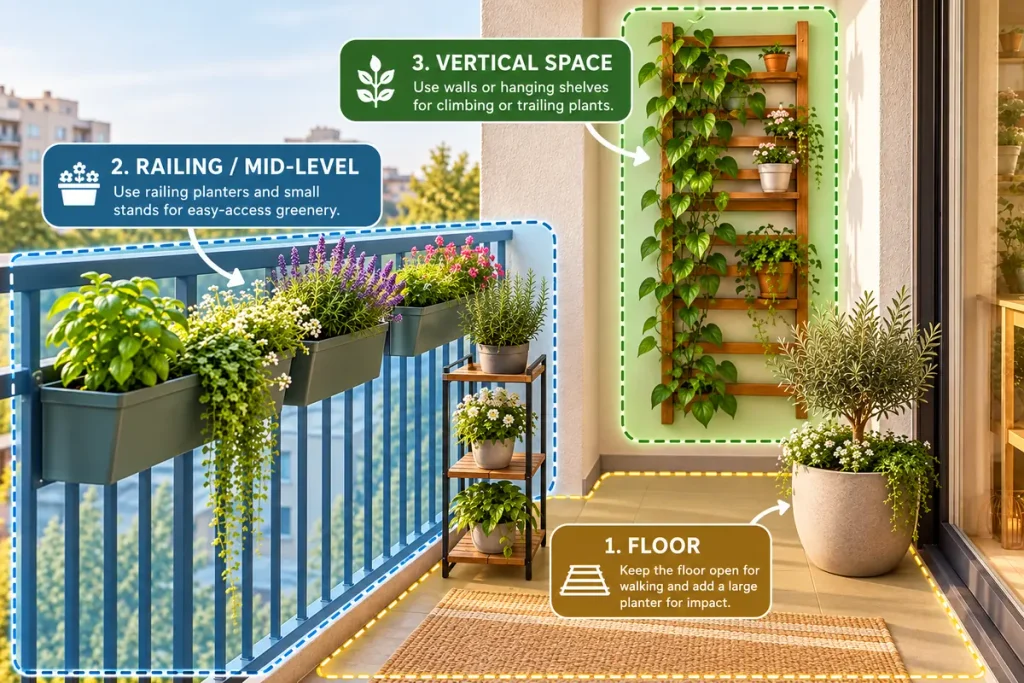
Layer 1: Floor
Reserve this layer for things that genuinely need floor support:
- one or two large planters
- a narrow plant stand
- a compact gardening station
- seating
- heavy containers
This should be the least crowded layer.
Layer 2: Railing and Mid-Level Space
This is useful space that many balconies barely use.
It can hold:
- securely fitted railing planters
- narrow shelving
- tiered plant stands
- small pots elevated on a rack
- gardening supplies stored at working height
Moving plants to this level immediately reduces the collection of individual pots scattered across the floor.
Layer 3: Vertical Space
Finally, look upward.
A freestanding trellis, vertical planter, approved wall system, or other secure vertical setup can give climbing and compact plants room to grow without expanding across the balcony.
This doesn’t mean covering every wall with greenery. One concentrated vertical growing zone usually looks calmer—and is easier to maintain—than several unrelated systems.
If you want to explore that approach more deeply later, vertical garden ideas for a small balcony deserve their own setup rather than being squeezed into every available wall here.
What to Grow Where: Small Balcony Garden Ideas by Zone
Choosing plants by appearance alone can make a small balcony harder to organize.
A better approach is to match the plant’s growth habit and container needs to the part of the balcony you want it to occupy.
That way, your small balcony garden ideas support the layout instead of gradually taking over the floor.
| Balcony zone | Good plant choices | Why it works |
|---|---|---|
| Railing planters | Herbs, strawberries, compact flowers | Uses the balcony edge instead of floor space |
| Vertical trellis | Peas, beans, climbing nasturtiums, compact cucumbers | Sends growth upward |
| Tiered plant stand | Basil, parsley, thyme, lettuce, small flowering plants | Groups multiple pots into one footprint |
| Large floor pot | Dwarf tomato, compact pepper, dwarf citrus where conditions allow | Gives floor space to plants that benefit from a larger container |
| Shelf edge or upper tier | Trailing petunias, nasturtiums, cascading herbs | Uses downward space without adding another planter to the floor |
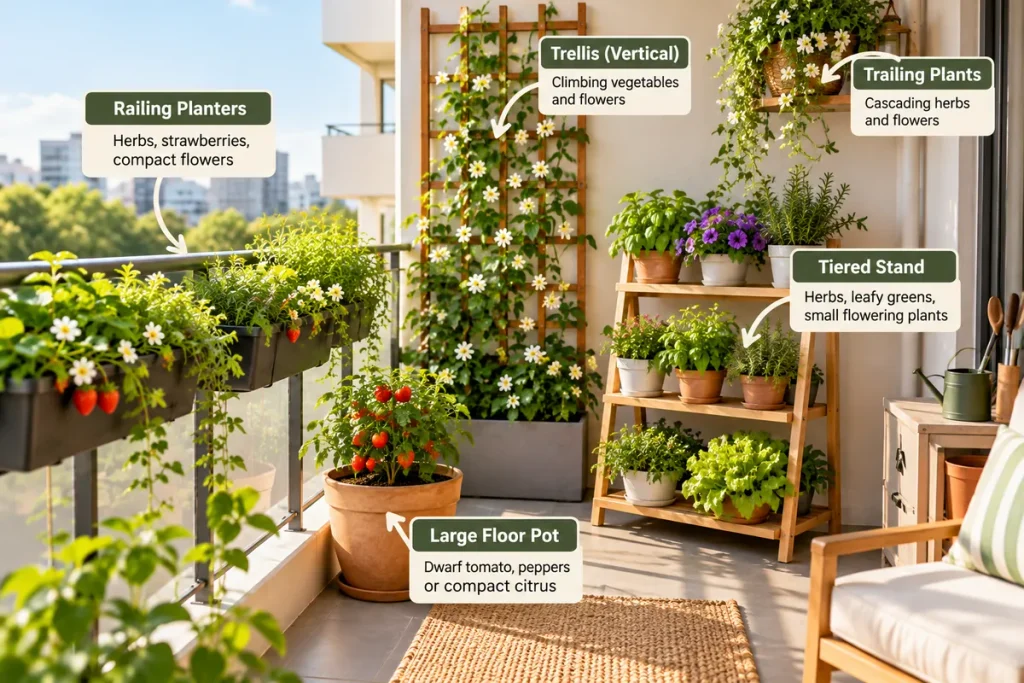
Railing Planters: Keep the Plants Compact
Railing boxes work especially well for plants that stay relatively compact.
Herbs such as thyme, parsley, chives, and basil can fit neatly into smaller containers. Strawberries and compact flowering plants can also make good use of balcony edges.
The organization benefit is simple: instead of putting five small pots on the ground, you can consolidate them into one or two railing planters.
Just make sure any railing planter is securely installed and allowed under your building rules.
Trellises: Choose Plants That Naturally Grow Up
If you are dedicating part of the balcony to a trellis, choose plants that actually benefit from vertical support.
Climbing beans, peas, certain compact cucumber varieties, and climbing flowers such as nasturtiums can turn a narrow vertical zone into productive growing space.
This is much more efficient than allowing sprawling plants to spread across several floor containers.
Tiered Stands: Best for Small Pots
A tiered stand is particularly useful for herbs, leafy greens, succulents, and small flowering plants.
Instead of lining small containers around the balcony perimeter, stack them vertically in one defined zone.
Keep plants that need frequent attention at an easy-to-reach level and reserve higher or lower tiers for plants you handle less often.
Large Floor Pots: Make Them Earn the Space
Floor space is valuable, so larger pots should have a clear purpose.
A dwarf tomato, compact pepper plant, or another productive specimen may justify one larger container.
What usually does not work well is allowing several medium-to-large pots to accumulate simply because each plant looked manageable when you bought it.
Think in terms of one or two intentional floor plants, not an expanding row.
Trailing Plants: Use the Space Below the Shelf
Trailing plants can make use of space that might otherwise remain empty.
Placed along the edge of an upper shelf or planter, cascading flowers or herbs can grow downward instead of requiring another container beside them.
Just avoid hanging or trailing growth where it blocks a walkway, neighboring space, or access to the balcony railing.
The larger principle is simple: choose plants that fit the structure you already have, rather than adding new furniture or containers for every plant you want to grow.
9 Ways to Organize a Balcony Garden Without Crowding the Floor
A simple balcony garden organization plan works best when each edge of the balcony has a specific job and the center stays open.
You do not need to use every technique below. Choose the ones that solve an actual space problem.
1. Use the Railing Before Adding More Floor Pots
When floor space is scarce, the railing is one of the first places worth evaluating.
A few securely installed railing boxes can replace several individual pots sitting around the perimeter. Herbs, compact flowers, strawberries, and other appropriately sized plants can work particularly well here.
Keep the arrangement intentional rather than covering every inch of railing.
For example, three matching planter boxes generally create a cleaner visual line than six unrelated pots and baskets.
Safety matters here. Check both your building rules and the planter manufacturer’s installation requirements before attaching anything to a balcony railing. Consider the container at its filled and watered weight, not just how light it feels in the store.
If an outward-facing planter could create a hazard below, keep the setup on the interior side or choose another arrangement.
2. Build One Vertical Growing Zone
Vertical gardening is useful on a balcony, but scattering vertical planters everywhere can make a tiny outdoor area feel even smaller.
Instead, designate one vertical growing zone.
That might be:
- a narrow freestanding trellis
- a vertical planter tower
- a slim ladder-style plant stand
- an approved wall-mounted system
- a renter-friendly freestanding frame
Put it against one wall or at one end of the balcony rather than in the middle.
Then allow that zone to carry much of the garden upward.
The key organization principle is consolidation. A dedicated vertical zone is usually easier to manage than several unrelated planters spread across walls, railings, and the floor.
If you later want more growing systems, that is where a guide to vertical garden ideas for a small balcony becomes useful without turning this whole balcony into a vertical-gardening project.
3. Consolidate Small Pots Onto a Tiered Stand
Ten small pots can consume surprising amounts of floor space when each one has its own footprint.
A narrow tiered plant stand lets several containers share essentially the same floor zone.
It also makes the garden easier to read visually.
Instead of:
pot — pot — pot — pot — pot
across the balcony floor, you get one defined plant station.
Place larger or heavier containers lower and smaller pots higher. Make sure the stand itself is suitable for outdoor use and stable in the conditions on your balcony.
Avoid choosing a huge rack simply because it technically fits. A narrow stand that holds six plants and leaves breathing room can be more useful than a large shelf that turns the balcony into outdoor storage.
4. Give Corners a Specific Job
Corners tend to collect whatever has nowhere else to go.
A bag of potting mix lands there. Then an empty planter. Then the watering can. Eventually you have an accidental gardening pile.
Assign each useful corner a job instead.
One corner might be the plant corner, with a tall planter or narrow tiered stand.
Another could become the maintenance corner, containing a compact supply container and watering can.
You don’t need to fill every corner.
The point is to prevent unplanned overflow.
If you prefer a calmer, more restrained outdoor look, some Japanese balcony garden options use the same basic idea: fewer elements, deliberate placement, and enough open space for each plant to read clearly.
5. Keep Only a Few Large Pots on the Floor
Large containers sometimes belong on the floor. Trying to elevate everything isn’t practical.
But be selective.
One substantial planter can create more impact than a collection of seven medium pots occupying the same area.
Use floor space for plants that genuinely need larger containers or greater stability, then move smaller plants upward.
Container gardening also comes with an easily overlooked issue: weight.
The University of Maryland Extension notes that a 20-inch container filled with moist potting mix and plants can weigh around 100 pounds.
That is one reason balcony gardeners should not estimate loads based on empty pots. Follow your building’s requirements and don’t assume that an available patch of balcony floor automatically means it should hold another large planter.
6. Create One Compact Gardening-Supply Zone
Plants are only half of balcony garden clutter.
You may also have:
- hand tools
- gloves
- fertilizer
- plant ties
- pruning scissors
- empty pots
- saucers
- watering equipment
- potting mix
When planning balcony storage for gardening supplies, start with one contained maintenance zone rather than several small storage spots.
A weather-appropriate lidded container, narrow cabinet, compact cart, or small outdoor storage box may be enough for frequently used supplies.
Keep only what you regularly use outside.
Bulk soil, spare pots, seasonal supplies, and duplicates do not automatically deserve permanent balcony space.
If you repot plants often, a small balcony potting station can combine a work surface and supply storage without allowing gardening materials to spread across the entire balcony.
7. Store Tools Vertically
Long-handled tools leaning against a wall look harmless until they slide, fall behind pots, or block access.
Even smaller hand tools become clutter when they are scattered across shelves and planter ledges.
Contain tools together.
Depending on what your building permits, that might mean a small tool caddy, hooks inside an outdoor cabinet, a freestanding tool rack, or another non-permanent vertical organizer.
The goal is not to create a miniature garden shed on your balcony.
It is to give every tool one predictable home.
If your supplies have already outgrown the balcony, a dedicated garden tool storage solution for a home without a shed makes more sense than forcing every spare tool into this small outdoor area.
8. Group Plants by Care Routine
Balcony organization isn’t only about making things look tidy.
It should make plant care easier.
Try grouping plants with similar watering and light needs instead of arranging everything solely by appearance.
For example, plants that need frequent attention might share one accessible railing or shelf, while tougher, less frequently watered plants occupy another zone.
NC State Extension recommends combining container plants with compatible light, water, and nutrient requirements.
This has an organizational benefit too: watering becomes a route rather than a scavenger hunt.
You can move through the balcony zone by zone instead of checking fifteen unrelated containers individually.
9. Make Heavy or Frequently Moved Pots Mobile
Sometimes the most efficient organization tool is simply mobility.
If a substantial container needs to move for cleaning, weather protection, or changing sunlight, consider placing it on a suitable plant caddy or wheeled platform.
Virginia Cooperative Extension notes that platforms with wheels or casters can be useful for apartment and balcony gardening because containers can be repositioned for available sunlight or weather conditions.
Just don’t turn mobility into another excuse to accumulate pots.
The advantage is being able to temporarily clear or reconfigure the balcony—not packing more plants into it.
A Simple Layout for a Very Small Balcony
If you’re staring at a tiny rectangle and wondering where everything should actually go, start with a simple perimeter layout.
Along the railing:
Use a limited number of secure railing planters.
Along one short wall:
Place a narrow vertical planter, trellis, or tiered stand.
In one corner:
Keep one larger statement plant if you have room and the location is appropriate.
Near the balcony door:
Keep frequently used gardening supplies contained and easy to return after use.
In the center:
Nothing.
That last part is important.
Empty floor is not wasted space.
It is circulation space. It lets you step outside without navigating around pots, reach your plants, pull out a chair, clean the balcony, and enjoy the garden you created.

What Not to Store on a Small Balcony
A balcony can easily become overflow storage because it sits just outside the home.
Try not to let that happen.
Be particularly cautious about keeping:
Stacks of empty pots. Keep a small number you’ll realistically reuse and relocate the rest.
Half-used bags of gardening materials everywhere. Consolidate supplies into one appropriate storage location.
Broken gardening equipment. Repair it, discard it appropriately, or remove it from the active gardening zone.
Furniture nobody uses. A chair that never gets sat in can consume more usable space than several plants.
Too many tiny planters. Small pots may look space-efficient individually, but dozens of separate containers create maintenance and visual clutter.
Also pay attention to drainage.
Containers need appropriate drainage for healthy roots, but runoff can create its own balcony problems. Virginia Tech recommends containers with adequate drainage, while the University of Maryland Extension notes that drained water can mark surfaces or affect balconies below; saucers can help where appropriate but should not be left holding standing water.
Organization should account for where water goes, not just where the pot fits.
Keep the Garden Organized as Plants Grow
A balcony garden isn’t static.
Plants grow wider. Vines travel. Empty pots appear. Gardening supplies multiply.
Give the space a quick reset every few weeks during the growing season.
Ask:
Is the main path still clear?
Has a plant outgrown its assigned zone?
Are empty containers starting to accumulate?
Can I reach everything easily for watering?
Are tools and supplies returning to their designated storage spot?
Is anything unstable, overcrowded, or blocking drainage?
If the balcony begins feeling cramped, resist immediately buying another shelf.
First remove what no longer needs to be there.
Sometimes reorganizing a small space means adding storage. Other times, it simply means deciding that the space has reached capacity.
A Small Balcony Garden Needs Empty Space Too
The best balcony garden organization isn’t the setup that fits the greatest possible number of plants.
It is the one that lets plants and people comfortably share the same small outdoor space.
Keep the main walking area open. Move smaller plants upward. Use railings and vertical zones carefully. Consolidate supplies instead of scattering them. Give large floor pots a reason to be there.
Most importantly, don’t be afraid to leave part of the balcony empty.
When the floor remains clear enough to step outside, tend the plants, pull up a chair, and enjoy the greenery, your balcony is doing more than storing a garden.
It is functioning as part of your home.